Sunday, 22 December 2013

Syria's Barrel Bomb Technology Relative To Aleppo Syria Attacks - The Good, The Bad And The Ugly

Richard M. Lloyd, Warhead Technology Consultant at Tesla Laboratory Inc. takes a look at the DIY barrel bombs used in Syria.

Introduction
The Syrian government over the last year has supplemented it's traditional conventional air campaign with cheap weapons that have been referred to as Barrel Bombs (BB). These Do It Yourself (DIY) weapons are derived from low cost cylinders that are filled with explosive, fuel and irregular shaped steel fragments. These DIY bombs are manually deployed by soldiers from Russian HIP helicopters. The idea is these helicopters can roam around Syrian neighbourhoods and drop these weapons with more accuracy than firing aircraft rockets.  The purpose of this paper is provide some fundamental frame work of how these bombs work, while exploring the myths and false information that has been associated with these weapons.

Initial Barrel Bomb Technology
The main objective of the Syrian barrel bomb program is to provide cheap and lethal damage on urban areas in Syria. When these bombs were initially developed they were deployed from HIP helicopters from low altitudes. These low altitude deployments would ensure the barrel bombs could maintain pin point accuracy and damage specific targets that the Syrian government wanted to kill. However, over time the Syrian rebels acquired Man Portable Air Defense System (MANPADS) that deterred these low launched bombings and drove the Syrian government to drop these bombs from altitudes near 7000ft. A description of a Syrian helicopter that has been shot down from a rebel who fired a MANPADS missile is shown in figure 1.

Figure 1 Syrian Helicopter Shot Down With Rebel Fired MANPADS
These rebel MANPADS attacks have forced the Syrian barrel bomb helicopters to release their bombs from high altitudes.  This increased altitude reduces the accuracy of these bombs and now their impact points are random.  Currently, barrel bomb are not attacking point targets, but rather they are attacking large urban areas killing humans and damaging infrastructure such as building.

Over the last year there have been many false claims made by Syrian civilians as well as the press that barrel bombs have been deployed, when actually they were Russian conventional bombs. These false claims have given barrel bombs false praise by claiming their damage potential is greater than what it really is.  Figure 2 shows photos of a HIP-8 helicopter dropping a barrel bomb relative to a Russian Hind Helicopter dropping a conventional Russian bomb. 

Figure 2 Comparison Of HIP Mi-8 Barrel Bomb And Hind Conventional Bomb
As stated, there have been many false claims in Syria that damage to Syrian cities has been caused by barrel bombs when the damage was actually caused by Russian conventional bombs that have significantly higher reliability than these DIY barrel bombs.

Barrel bombs designs that are observed though social media demonstrate that the Syrian government designed these barrel bombs with a fuse wick that requires a heat source (matches, cigarettes, cigars) to ignite.  The Syrian government must have made the simple calculation that if the helicopter is at a known altitude (H) and the fuse wick burns at a known rate (\(\begin{equation} \dot{b} \end{equation}\)) then the time that it takes for the bomb to detonate is \(\begin{equation} t=H/\dot{b} \end{equation}\). However, this simple equation that computes the time before detonation is false.  Whoever designed these barrel bombs does not understand that there is a 10% burn rate error in the fuse wick.  They also don't understand that if the helicopter is not at the designed altitude it will affect the time of fall.  In conjunction with these errors, they did not take into account the barrel size, mass, barrel bomb L/D ratio, tumble rate, drag effects, wind speed as well as the time it takes the soldier to deploy the bombs once it has been lit inside the helicopter. All of these effects must be accounted for if a fuse wick is going to be used.  Lets perform an example calculation that only considers the 10% error source of the fuse wick burn rate and assume all of the other errors are zero or negligible. The Syrian government would first be required to compute the terminal velocity of the barrel bomb by using the equation \(\begin{equation} V=\sqrt{2W/\rho AC_{d}} \end{equation}\).  The terminal velocity accounts for the weight of the barrel bomb as well as the air density, average cross sectional area and drag of the barrel falling to the ground.  A 500lb barrel bomb has a terminal velocity near 250f/s. Based on this calculation the time it takes the barrel to impact the ground is just 7000ft/250ft/s=28 seconds.  So, the selected fuse wick that has a known burn rate is cut to a length which would burn for 28 seconds and detonate just when it impacts the ground. However, since there is a 10% burn rate error, there exists a probability that it could detonate early.  If the burn rate is 10% too fast then the entire fuse wick would have completed its burn at 25.2 seconds.  This means the warhead would detonate 700ft before hitting the ground.  Examples of these early bursts have been demonstrated through many videos as shown in figure 3.

Figure 3 Barrel Bombs Detonate Early From Negative Errors
These early bursts  have been widely seen in Syria, which are caused by an accumulation of the errors that potentially can exist.  It is unknown how accurate the helicopter pilot attempts to keep the helicopter at the designed altitude.  It is also unclear if the Syrian barrel bomb builders understand drag effects and fuse wick errors and probability timing . Another example of another error is a Syrian Solider lighting and pushing barrel bombs out of the helicopter. In this instance, time must be taken into account and there is obviously no control of how the bomb is thrown out where time must be accounted for.  A photo of a Syrian soldier pushing a barrel bomb out of a helicopter is shown in figure 4.
Figure 4 Description of Barrel Bombs on Syrian Helicopter Prior to Deployment
These early barrel bomb weights are around 100-300lbs and are ignited using fuse wicks. The soldier lights the fuse wick using a cigar because the wind would blow out a match or lighter.  A close up of the fuse wicks is also shown where they should all have the same length.  After the fuse wick is lit, the soldier quickly pushes the bomb from the helicopter. It is unclear how the Syrian designers of these bombs expected to time the fall exactly because there is clear evidence that many of these barrel bombs detonated early which is referred to as a negative time delay.

The above analysis has only considered what could happen if the total time is less than the required time to detonate the barrel bombs given a ground impact.  However, what would happen if the barrel bomb detonated late. Based on our example problem, the fuse wick would burn for a longer time than 28 seconds.  If this occurs, then the barrel bomb would actually hit the ground or a building while the fuse wick is still burning.  If this occurred, then based on video and photo evidence the barrel bomb would shatter upon ground impact or detonate if the fuse wick and bomb were not destroyed. There is clear evidence that barrel bombs can detonate given a positive delay time as shown in figure 5. This figure shows two potential out comes when the time delay is positive where the barrel bomb will either detonate or turn out to be a dud.

Figure 5 Comparison Of BB Detonating or Duding Based On Positive Time Delay
The next step is to try to understand why there is and explosion in one case and not in another. One explanation,assuming all is equal, is the effect of  the shock-wave through out the barrel bomb's front endplate which holds the fuse wick. The stress of a steel case impacting concrete, grass or sand has been investigated.  By using the shock Hugoniot equation \(\begin{equation}
P=\rho c\mu+\rho s\mu
\end{equation}\) , the interface pressure between the ground surface and steel barrel bomb is calculated.  The density of the material is \(\begin{equation}
\rho
\end{equation}\)while the bulk sound speed of the material is \(\begin{equation}
c
\end{equation}\) where \(\begin{equation}
\mu
\end{equation}\)is the particle velocity and s is the slope between shock velocity and material stress. These calculations show that the impact stress of a barrel bomb impacting concrete or rock is 3.5-5 times greater than if the barrel bomb impacted sand or dry soil.  This increase in stress will cause the endplate that holds the fuse wick in place to fracture from the barrel bomb which disables the bomb.

Another important parameter that must be considered that would determine if positive time delayed barrel bombs can detonate is the impact point on the bomb. If a barrel bomb impacts directly on the fuse endplate, then there is an increased probability that the bomb could fail.  Based on video analysis and ground inspection, these barrel bombs do not contain any fins to help control the fall of the bomb by providing stabilization.  These bombs randomly tumble and the probability that these bombs could impact on the fuse/endplate is just 1/6 or 16.6%. If we assume a uniform random distribution of barrel bombs that contain negative and positive time delays, then just based on this fact the probability of a positive bomb impact is 50%.  As of now, there is a 50% chance the bomb will not work and a 50% chance that the bomb will work.  Now lets account for the ground and the impact position of the barrel to the ground.  If the barrel bomb impacts concrete then the bomb will break apart and not work as intended. However, if the bomb impacts softer ground, it is probable, as observed, that these bombs will not break apart and wil function correctly. Our analysis assumes a 50% probability that the bomb will impact concrete/rock and a 50% probability that the bomb will impact sand or grass with light rubble.  This means the probability that the bomb will function is just the probability that the time delay is positive or negative and the probability that the ground is hard or soft.  This calculation is \(\begin{equation}
P=(1-0.5)(1-0.5)=0.25
\end{equation}\)which means there is a 25% chance these fuse wick barrel bombs will work. So, it requires the Syrian government to deploy four barrel bombs to get one bomb to detonate the way it's intended.  A description of two different barrel bombs is shown in figure 6.  The barrel bomb on the left is one that impacted on a soft surface,where the stress was not high enough to fracture off the fuse wick endplate, while the barrel bomb on the right is shown hitting concrete and fracturing off the fuse wick endplate.

 Figure 6 Comparison between barrel bombs impacts on soft and hard surfaces
Barrel Bomb Designs
The remains of these barrel bomb duds have been investigated to understand how the Syrian government has assembled them, and to determine how lethal these bombs can be.

It is evident from visual observations that there has been little to no quality control on these designs because of the many shapes and sizes that have been observed.  There appears to be clear design trends that clearly show that Syrian personnel have no weapon design and effects training.  Most Syrian barrel bombs contain many large steel components, such as cut rebar or large machine metal pieces such as large industrial bearings. These large metal chunks are inserted inside and mixed with the TNT explosive. The problem with this approach is when the explosive detonates, it's using a lot of its energy to accelerate these large chucks of metal which reduces its blast effects as clearly seen in figure 7. These added steel materials reduce the blast effects by making the explosive use its energy to accelerate it.
Figure 7 Large Metallic Metal Components Added In Barrel Bomb Explosive Mixture
However, if these large metallic pieces were to impact a human then they would cause catastrophic incapacitation. There are mathematical equations that predict the optimum fragment size that is required to kill a person by taking into account probability theory and applying weapon design equations. The probability of incapacitating a person is computed with this equation\(\begin{equation} P=1-e^-a({mv^{3/2-b)^{n}}} \end{equation}\)

Based on this equation, the optimum fragment mass can be computed to increase barrel bomb performance.  The barrel bomb case would break apart into thousands of small fragments from the natural fragmentation of the explosive shock wave interaction with the smooth case.

The fragment mass is m and the impact velocity is v where test derived constants are a, b and n. The velocity of the added metallic fragment is computed by using the Gurney equation which is\(\begin{equation} V=\sqrt{2E}\sqrt{C/M/(1+D/2L)(1+C/2M)} \end{equation}\)
The \(\begin{equation} \sqrt{2E} \end{equation}\)is the explosive Gurney constant which is around 2.4km/s for TNT. The explosive mass is C while the metallic mass plus the barrel bomb case is M. The parameters D and L are barrel bomb diameter and length respectively. The barrel bomb average case fragment can be computed by \(\begin{equation} \mu^{1/2}= Bt^{5/6}d_{i}^{1/3}(1+t/d_i) \end{equation}\) where B is a constant, t is the barrel bomb thickness and \(\begin{equation} d_i \end{equation}\) is the explosive diameter. The estimated number of fragments from the barrel alone is \(\begin{equation} N(m)=M/2\mu \end{equation}\)where the number of fragments in a particular weight class is calculated by \(\begin{equation} N(m)=M/2\mu e^{-(m/\mu)^{1/2}} \end{equation}\)

These equations have been exercised pertaining to the Syrian barrel bombs.  The analysis clearly shows that these weapons are under-designed and their lethality in urban areas can significantly increase by changing their approach and understanding of weapon effects.  Even though these embedded large chunks of metal are highly lethal against humans, the probability of being hit by one is extremely low. Given a 40ft stand-off distance of a human from a barrel bomb explosion, there would be a 96% probability of death given a hit from one of these fragments,  However, the probability of being hit from these chunks of metal is only 3%, which gives a total probability of incapacitation of 2.8%. An example calculation is shown in figure 8.

 Figure 8 Barrel Bomb Probability of Incapacitation and Probability Equations
The blast effects have been investigated, and where the pressure-impulse to incapacitate a human has been calculated.  The blast damage is directly related to the amount of explosive as well as the metal casing surrounding it. The lethal blast radius has been calculated, but it is not reported in this version of the report.

Changing Barrel Bomb Technology
There are several significant changes that have been observed in Syrian barrel bomb technology.  It is evident from these changes that the military determined they were not getting explosive detonations on the ground and their bombs were not working.  The Syrian government has switched from using fuse wick fuses to impact fuses. As stated earlier, these fuse wicks have minimal chance of working because of their time delay errors.  However, the addition of impact fuses accounts for all of the errors that are associated with fuse wicks. These new impact fuses are clearly DIY and in conjunction with these new fuse concepts, the sizes of the barrel bombs have significantly increased.  Today's Syrian barrel bomb weights can exceed over 2000lbs of TNT, making them highly lethal given a high order explosive detonation in urban areas. A description of a recovered barrel bomb with these new design features is shown in figure 9.

Figure 9 Newer barrel bombs designed with DIY impact fuzes
These impact fuses were created using detonation cord to ignite the bulk TNT explosive charge. It is unclear what the exact reliability of these fuses are and how well they actually work. However, it is expected that the Syrian builders have performed some testing of this device to have enough confidence that it will work given that the barrel impacts the ground on the fuse. In order for these new bombs to work they must impact on the fuse which means they must impact on the front of the barrel.  The only way to accomplish this is to add fins to stabilize the bomb so it won't tumble as it falls to the ground.

This recovered barrel bomb did not operate and detonate correctly because the fins appear to be too small.  The explosive weight of this bomb is near 2000lbs with small fins attached to the middle of the bomb. Figure 10 is a picture of the small fins that were welded to the center of the bomb.  A picture of a typical Russian bomb is shown, which clearly shows these bombs are designed with fins in the back of the bomb and not in the middle.  It has been concluded with high confidence that this massive bomb still tumbles and the probability of falling on the impact fuse is random.  It appears the fins are designed too small and the barrel bomb is randomly tumbling to the ground.  If we assume the probability of the fuse working correctly is 75% and the cylindrical barrel bomb has 6 sides, then given random tumbling, the probability of success is 1/6 or 16.6% given 100% reliability of the fuse. However, if the DIY fuse has a reliability near 75%, then the probability of success is 12%.

Figure 10 Syrian barrel bomb with small fins attached to the middle
It appears the Syrian builders have discovered this problem with their fins and their inability to generate a stable and aligned bomb.  There is clear evidence that the Syrians have moved these fins from the middle of the bomb to the aft end, which is the design norm of all the gravity bombs in the world. Figure 11 shows a large barrel bomb just after it has been deployed.

Figure 11 Large Barrel Bomb Deployment  Showing Initial tumbling Of Weapon
These new design features have increased the probability that the barrel bomb will fall aligned with stable flight and impact the fuse. We have already estimated that the fuse has a 75% chance of working given an impact. Based on these fins relative to known bombs around the world, it appears that the stability of the bomb will increase, but it is still unclear whether the fins are large enough and far enough to the back of the bomb to provide good stability.  A conservative estimate of the fin performance based on Russian and US fins relative to the Syrian barrel bombs is 50%. This estimate is based on analyzing Russian bombs of similar weight, and measuring their fin distance and diameter relative to the recovered barrel bombs. Given these two performance probabilities, the probability that these new Syrian barrel bombs will work correctly is 37.5%.

Barrel Bomb Design Variations
There have been several recovered barrel bombs that are designed differently compared to most traditional barrel bombs. Some of these barrel bombs contain smaller warheads that are embedded within the explosive to ignite the much larger barrel bomb explosive.  This design technique uses the small warhead as a booster, which is really not required.  An example of this is shown in figure 12.

Figure 12 Syrian barrel bomb using small warhead as a booster
The explosive has appeared to be soaked in oil which would give the same features as ANFO. ANFO is an explosive mixture which contains some small percentage of oil.  This oil actually reduces the explosive detonation velocity which reduces the blast and fragment acceleration power of the explosive.  This bomb has an impact fuse, but the most disturbing observation is it has no fins. Without fins, this bombs reliability is very low and the odds of it working are small.  In fact, all objects that fly through the air eventually turn and fly with the side with its greatest presented area.  If this rule of thumb is applied, this bomb will never rotate and align its front surface to the ground.  The highest probability of the side with the fuse impacting is just 1/6 or 16.6% which assumes there is an equal chance of any side impacting. Now, if the reliability of the fuse is 75%, then the probability that the barrel bomb will function is 12.4%.                

The Syrian government over the last year has significantly increased it's barrel bomb sizes from hundreds of pounds of explosive to 2000 pounds of explosive. However, there is strong evidence that these weights are larger than this.  A video exists that shows the Syrian military throwing barrel bombs from a helicopter with a large fuel auxiliary tank. This video shows to the right a large yellow tank, which is the helicopter's internal fuel auxiliary tank. This tank can contain over 960 litres of fuel ,or, if it was converted to a high-explosive barrel bomb, it would contain around 3000-3500lbs of explosive as shown in figure 13.

Figure 13 Syrian Military Using Helicopter Fuel Auxiliary Fuel Tank As Barrel Bomb
With the need for larger barrel bombs and the Syrian military's need for larger explosions, there is reason to believe that the military could be using these auxiliary fuel tanks as Fuel Air Explosives (FAE).  There is no clear evidence of the military converting these fuel tanks to FAE'S but there appears to be very large unexplainable explosions in Syria that that are clearly made from unknown FAE weapons. If the military made these tanks into FA'S and they were able to master the weaponization of deploying fuel and igniting it, these tanks would generate explosions greater than 15 tonne TNT equivalent weights. One of these unexplainable explosions that has not been attributed to ground fuel explosions, fuel or high explosive depots or anything but a dropped bomb is shown in figure 14.  This unexplainable explosion distinctly shows that a FAE or fuel weapon was used in Syria that generated a fireball cloud with a diameter near 2000ft.  The TNT equivalent yield is estimated from the height of the dust cloud where many yield equations have been derived for nuclear and large explosive events in the 1960's. This explosion did not persist like known explosions that were started from fuel depots or fuel lines from conventional bombings. This explosion occurred and persisted for about 120 seconds and then disconnected from the ground.  Also, there have been several barrel bombs that have been observed from helicopters that appear to have platforms that are attached to wheel tracks.  These bombs would weigh over 3000lbs and would require a sled system to move it on and off the helicopter.

Figure 14 Potential Syrian derived weapon, which supports unexplainable explosions
This explosion would generate significant damage to all buildings within a 600ft diameter. The analysis assumed the fuel is ethylene oxide which has an energy content of 28000J/g while TNT explosive is around 4180J/g.  This large increase in energy is another reason why the Syrian military may be investigating weaponizing auxiliary fuel tanks into FAE weapons.  It is known that Syria possesses Russian ODAB 500 FAE weapons that only have a TNT equivalent yield of one tonne.

Aleppo barrel Bombs Attacks
It was reported that Syrian government aircraft dumped barrels packaged with explosives on at least four opposition-held neighbourhoods of Aleppo on December 18, 2013. This would be the fourth day of increased air strikes on this contested northern city. It appears this air campaign killed more than 100 people in the first three days alone.  A map of the potential barrel bombings is shown in figure 15.  The damage radius of these bombs looks very large from observing videos of the explosions.  In fact, it is still unclear if all 11 of these explosions were solely from barrel bombs.  The Syrian people have a history of calling all bombs dropped from helicopters barrel bombs, which is false. There has been many reports that all of these attacks are barrel bombs but given the probability of success, this seems questionable and further analysis is required. However, lets assume all 11 explosions were from barrel bombs and lets also assume that all 11 barrel bombs possessed fuse wicks.  Since the probability of a fuse wick barrel bomb working is 25%, it would require around 88 barrel bomb drops to achieve 11 successful explosions based on the probability equation of \(\begin{equation} P=1-(1-P_{k/h})^n \end{equation}\)

The single shot probability of success is 25% and given a 90% probability requirement it would take 88 fuse wick barrel bombs which appears to be an unrealistic scenario where Russian bombs would be mixed in. We know that the Syrians have developed or increased their capability by adding impact fuses to account for the timing errors of the fuse wicks. Let's assume that the barrel bombs contain impact fuses but do not contain fins that are able to stabilize the bombs for a successful impact on the fuse. The single-shot probability of these barrel bombs is 12%. This means that the Syrian military would have to drop nearly 187 barrel bombs to obtain 11 explosions. This large number of barrel bombs also does not appear realistic, as the Syrian military uses no or very small fins in the middle of the bomb.    

Figure 15 Aleppo Bomb Impact Points From December 2013 Attacks  
The next calculation will consider the most advanced barrel bombs it is believed the Syrian military has. The single-shot bomb probability of success is 37.5%, which means it would require five bombs to achieve one successful explosion.  The total number of bombs that the Syrian military would have to drop to obtain 11 explosions is 55.  It is unknown how many helicopters were used in these bombings, but if the capacity of a HIP helicopter is considered, then each helicopter could only hold around 3-4 bombs of 1000lb size.  A single video was found of a very large barrel bomb that appeared on the internet December 21, 2013.  It is believed this barrel bomb could have been used in the Aleppo attacks. Figure 16 shows this barrel bomb and it specifically shows that this bomb has an explosive yield of 1500-2000lbs.

Figure 16 Large barrel bombs filmed and posted online on Dec 21, 2013
However, if the military has mastered the fuel air explosive dispersal technique, then this bomb would have a yield of 6 tonne TNT equivalent weight.  The damage on the ground strongly supports that very large bombs were used to generate the amount of damage that is seen in many of the videos.  Another key observation of the barrel bomb is the fins are on the back of the bomb, and not in the middle. It appears that this bomb concept has a good chance to be aligned and stable to allow for a lethal fuse impact. A closer look at the barrel bomb from the December 21 attack is shown in figure 17.

Figure 17 Close up of the barrel bomb from video
Summary
It is unknown how many bombs in Aleppo were DIY barrel bombs and how many were Russian conventional bombs. If we estimate that there were three helicopters used in this campaign and each helicopter contained three 2000lb barrel bombs, then based on each helicopter performing two separate missions, an estimate can be made as to whether it's feasible that all the explosions in Aleppo were from barrel bombs.  The calculations show that each day, there were 18 barrel bombs dropped with only 3.6 explosions per day. After three days of bombing, the total number of barrel bombs dropped is 54 which correlates with the 55 barrel bombs required that must be deployed to achieve 11 explosions. It appears possible that all the attacks in Aleppo could have been DIY barrel bombs because these attacks occurred over 3-4 days, as it is clearly possible that 55 barrel bombs could have been dropped with their new and enhanced designs over this period of time. The video analysis of the overall damage strongly supports that very large barrel bombs were used.

Saturday, 21 December 2013

A Year Of Conflict In Syria In Ten Videos - 10 to 7

With the year coming to an end, and websites across the world producing lists of all things 2013, I thought I'd throw my hat in the arena with a list of ten videos that, for me, defined the last 12 months of the Syria conflict, and the way in which social media and open source media has been used to understand the conflict.  This list is in no particular order, nor does it represent the entirety of the hundreds of thousands of videos produced from Syria in the last twelve months, but I hope they represent both the broad spectrum of videos coming from Syria, as well as some of the more newsworthy videos.

10 - Croatian Weapons On Syrian State TV

At the start of 2013, I started to see new weapons appearing in the south of Syria in videos published by groups belonging to the Free Syrian Army.  When I first saw the weapons appear, I thought that perhaps they were just another example of weapons appearing from the local black-market, but then I saw a report on Syrian State TV that indicated this was something much bigger.  The original video is no longer online, but the footage from the report can be seen in this video from ANNA News at 0:47


As per the English subtitles on the video, Syrian State TV identified at least some of the weapons of being Israeli in origin, but this an example of something I've seen time and time again in Syria, where a much more interesting story is missed because of the attempts to use images as propaganda (another recent example of that is here).

For me, this video was the point where I realised the weapons I had been seeing weren't just a handful of weapons purchased on the black-market, but something much bigger.  I then began to review all the videos posted on YouTube channels, looking for more examples of these weapons, so I could understand what was going on with these weapons.  What I did was actually pretty simple, I watched videos, then documented them on a pretty simple spreadsheet, posting my findings in a series of blog posts.  James Miller on EA Worldview and Michael Weiss on Now Lebanon were the first to pick up on my work, and eventually I compiled the information I had collected into a post for the New York Times' At War blog, which led to the New York Times using the information I had provided to take the investigation further, exposing a smuggling route that involved Croatia, Saudi Arabia, and Jordan, all with the apparent knowledge of the CIA (more here).

This was a great example of how studying and analysing information posted to social media can help inform traditional methods of investigative journalism. The areas these weapons appeared in were pretty much isolated from the rest of the conflict, at the time the weapons started appearing there were no Western journalists in the area, and it's unclear if they would have been aware of the significance of the weapons, nor the scale of their appearance in the region.  Thanks to nothing more than YouTube videos and a spreadsheet, I was able to gather information that helped expose a secret smuggling operation, and that clearly demonstrates how valuable this open source information can be.

9 - ISIS Executes Three Men In Raqqa

Sometimes it's hard to imagine that less than 9 months ago the Islamic State of Iraq and al-Sham was barely known, but for me, one video was the clear point where they started to make their mark on the conflict in Syria


The video, posted in May from the city of Raqqa, shows three men being executed in a town square in front of a large crowd.  What was unusual about this video is the group carrying out the executions.  At the time, Abu Bakr Al-Baghdadi, the leader of the Islamic State of Iraq, had recently announced Jabhat al-Nusra would merge with the Islamic State of Iraq to form the Islamic State of Iraq and al-Sham.  This video showed the Islamic State of Iraq and al-Sham carrying out the execution, and seemed to be also announcing the arrival of ISIS to the conflict in Syria.

Since the video was published, ISIS has grown to dominate much of the discourse about the Syrian opposition, and they've worked to establish control of  the opposition held areas in the north (detailed here).  To me, this video represents the first time they really made their presence felt in Syria, and it certainly wasn't the only public execution they've carried out in the months since.

8 - How To Make A Hell Cannon

The Syrian conflict has continued to produce a variety of DIY weapons from both sides of the conflict, but this year, one stood out among all others.  The dramatically named "Hell Cannon" first appeared back in late April, and it's arrival was marked with the following video, showing the manufacturing process for the Hell Cannon, and it's ammunition


The group producing the Hell Cannon seemed quite proud of their invention, even producing a statistics sheet for it (more details here)


The Hell Cannon has continued to be a popular choice with opposition forces, with dozens of videos showing it in action posted online, and it even became part of the push back against claims that the government was responsible for the August 21st attacks.  While not the mostly widely used DIY weapon by the opposition, in 2013, it has certainly been the most noticeable.

7 - The Daisy Chain IED Attack

Since early on in the conflict, IEDs have been a mainstay of the Syrian opposition arsenal, but one video stood out from the many IED videos posted online by various opposition groups in Syria


In this very unusual example, 50 IEDs were reportedly linked together, to create a daisy chain of explosions, destroying a convoy.  While many reported cases of IED use in Syria are the various VBIED attacks often used as part of opposition military operations, it shouldn't be forgotten that smaller IEDs have also played a widespread and key role in the conflict.


Thursday, 19 December 2013

"Bashar al-Assad Is Not As Bad As These People!" - A Libyan On Joining Jabhat al-Nusra

Earlier this week, Die Welt published a piece by Alfred Hackensberger, "Islamists are worse than Assad", which included an interview with a Libyan, identified as Alah al-Fakhri, detailing his experiences as a foreign fighter in Syria.  The article translates rather well from German to English, and details the fighters time with Ansar al-Allah, which he claims was part of Jabhat al-Nusra, and how he reached Syria with the help of Ansar al-Sharia in Libya.  Alfred Hackensberger has sent me parts of the interview with the fighter which didn't make it to the Die Welt article, which provides additional information on the fighters experience.  The text has been translated from Arabic to German, then German to English.

Question: You went to Syria to fight. Why does a Libyan go to another country to fight?
Answer: This is the solidarity of a Muslim who aids his beleaguered brethren. I wanted to help the Syrian people to obtain their freedom. I wanted to fight alongside the Free Syrian Army, but that did not work out. I ended up with Jihadists.
Q: How did that happen ?
A : I tried to make contacts and a friend had sent me to Ansar al-Sharia. However, I did not who I was fighting with until I arrived in Syria. And it was not the FSA.
Q: With whom then?
A: With a group called Ansar al-Allah, who fought under the umbrella Jabhat al-Nusra.
Q: Were there more foreigners in the group?
A: Yes, most of them were foreigners. They came from Bulgaria, Afghanistan, Egypt, Somalia.
Q: What was standing Ansar al-Allah among the rebels ?
A: They had a bad image. "How can you fight with these people," I had often heard. "They are dangerous and kill people by dozen" .
Q: Have you even seen atrocities?
A: No, I have only heard of it.
Q: How did you come to Syria?
A: We entered the country via Turkey. Some via Istanbul, the others via Ankara. The coordination was in Antakya, also for all other foreign fighters. There, everything was organized, including our trip by bus across the border. They sent a bus with women and children, so we came disguised as a family across the border. The bus went back back and forth.
Q: And the Turkish?
A: There was no military. It was like a normal crossing, people going in and out but without control. The Turkish could have caught us before. But obviously they had no interest.
Q: Where were you been fighting?
A: In the east of Aleppo in the countryside and also at the airport. Exactly, I can not say that. As I drove back home, I was told : Share no information or names, or we kill you! You have to take these people seriously.
Q: Why did you return to Libya after only a month?
A: It was not what I wanted. They fight for a caliphate in all Arab states. They just want the power to be able to enforce their interests. They do not fight for the Syrian people. I wanted the Syrians only help, want a state, which brings democracy and Islam together. So I 'm a non-believer for them. All who disagree are infidels.
Q: Was the group you were with very strict?
A: Music, radio, television and smoking, which was very hard for me as a smoker, was forbidden . Discussions did not exist. If you had just a bit of a different opinion, made you suspicious. You could be seen as a Kuffer, an unbeliever and end up dead. (He puts his hand from one side to the other side of his throat).  I do not want to live and fight in such a repressive atmosphere, and to  risk my life in the war in this kind of situation. I tell you, Bashar al-Assad is not as bad as these people! They are far more dangerous!
Q: Because they slaughter people?
A: Because they do unbelievable things!
Q: What would they do?
A: I don't want to talk about it.
Q: Why did not you go to the other Libyan Liwa fighting in Idlib?
A: I did not know them and had no contacts.  As far as I know, they take the route through Egypt to Syria.
Q: What did normal Syrians, ordinary people, say to you as Libyan fighter in their home country ?
A: In Aleppo I barely came into contact with ordinary civilians. But when leaving I met some. They were very aggressive towards me. “What, do you have want here in Syria? Go back home!” Honestly, this was something I had not imagined! I thought we were welcome to help them. But it seemed to be the opposite!
Q: Does Ansar al- Sharia let go so easily ?
A: Yes, that was relatively easy. I said I want to fight longer, but for that I first had to go home to fix this with my family. They knew that I came to see and check out the situation first, before stay. They did not know that I would not come back. All others with whom I set off remained. I just got this warning from the leaders to keep my mouth shot.
Q: Was there anybody else thinking like you?
A: There was only one guy, who had similar problems. He came with my group to Syria. But he stayed. Maybe there were a couple of others, but we couldn't talk freely what was on our mind.
Q: Are you planning to go again to Syria?
A: Not now! At this point I am more worried about Libya than about Syria. But if I would go again, I would certainly fight only with FSA.  

Wednesday, 18 December 2013

A Case Of Weapon Misidentification By Jihadists And Assad Supporters

Frequently in my trawls through social media and open source information I come across images where the group showing them is making one claim, but the actual facts are far more interesting.  For example, with the Croatian weapons story, state media was describing the weapons as Israeli weapons, completely over-looking the real significance of the weapons.  Along that same vein, the following picture was sent to me today by @Kgthetweet 


This picture had reportedly been doing the rounds in Jihadist circles, claiming to show NATO munitions captured by ISIS forces.  This story was then picked up by pro-Assad groups, that added an bit of extra spin to the story, and adding their own branding


There's actually two interesting things about this picture.  First of all, it actually shows Iranian munitions, not NATO munitions, examples of which I've detailed in this blog post.  From the above picture we can see the stencilling on the box and mortar matches other examples of Iranian munitions, as shown below


We can also make out in the "NATO" photo the fuze type, AZ111A2, produced by the Iranian Defense Industries Organisation.  Once listed on their website, the links have now been removed.  

The other thing is the manufacturing date, that can be seen clearly on the mortar, and somewhat less clearly on the crate.  These mortars were manufactured in 2013, during the conflict, and after it was reported Iran had already violated UN sanctions against Iran in 2012.

This goes to show, sometimes you can be looking so hard for something that what's actually there completely passes you by.

You can contact the author on Twitter @brown_moses or by email at brownmoses@gmail.com

The Factions of Abu Kamal

A guest post by Aymenn Jawad al-Tamimi.

Figure 1: Scene from Abu Kamal during a recent period of heavy rain.
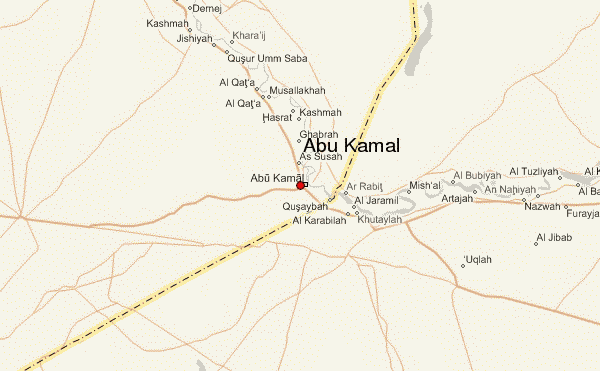
When it comes to reporting on Syria, much is written about fighting on the frontlines but comparatively little exists on the nature of factions in towns long since freed of regime control, particularly in the eastern areas of the country. Here I consider the case of the town of Abu Kamal (also Al-Bukamal, which is the more accurate transliteration from Arabic) in Deir az-Zor governorate, along the Euphrates River and bordering Iraq.

It has been out of regime hands since last year, as regime forces- aware of the inability to hold out if spread too thinly- retreated from a number of northern and eastern localities to concentrate on defending provincial capitals. The question now arises of who exactly controls or is present in the town.

In my own research, I have identified a number of factions operating in the town of Abu Kamal and sharing power in the local revolutionary coordination committee: namely, Kata’ib Junud al-Haq, Katiba Bayariq al-Sunna, Kata’ib Allahu Akbar, Liwa Allahu Akbar, Liwa al-Mujahid Omar al-Mukhtar, and Liwa al-Qadisiya al-Islamiya. So what is the nature of each of these groups?

Kata’ib Junud al-Haq

Translating to “Battalions of the Soldiers of Righteousness,” this faction is the local Abu Kamal affiliate of Jabhat al-Nusra. However, it has not exclusively remained in the Abu Kamal area but has rather sent fighters as far afield as the town of ash-Shaddadi in al-Hasakah province to the north and Sakhna in the desert area of Homs governorate, besides the major front of the city of Deir az-Zor itself further up the Euphrates.

Figure 2: Kata’ib Junud al-Haq raid on ash-Shaddadi (the town was taken over by Jabhat al-Nusra) featuring captured regime fighters.
Figure 3: Kata’ib Junud al-Haq in Sakhna, Homs governorate, after capturing a checkpoint.
The group is of particular interest because of its shifts in allegiances on the question of the Islamic State of Iraq and ash-Sham [ISIS]/Jabhat al-Nusra dispute. When Sheikh Abu Bakr al-Baghdadi announced the existence of ISIS in April, Kata’ib Junud al-Haq switched affiliation to ISIS, changing its emblem to reflect ISIS imagery, releasing a video in May of an ISIS training camp for Abu Kamal, and putting out a statement in the name of “ISIS- Deir az-Zor province” on a failed request to have Abu Kamal students in Deir az-Zor take their exams in their hometown. At the same time, the group’s Facebook page continued to put up graphics and material in support of Jabhat al-Nusra.

Figure 4: Scene from a Kata’ib Junud al-Haq training camp for children: “Cub-Scouts of the Caliphate.” Note the use of the ISIS banner and name. The children also chant a slogan asking God to protect and preserve the muhajireen, indicating, that, like other Jabhat al-Nusra branches, the group has a combination of native Syrians and foreign fighters.
Figure 5: Video released in mid-May while Kata’ib Junud al-Haq was affiliated with ISIS.
Yet after Sheikh Aymenn al-Zawahiri announced that ISIS should be dissolved, Kata’ib Junud al-Haq reverted by late June to Jabhat al-Nusra affiliation, while retaining the new logo it had adopted after Sheikh Baghdadi’s announcement of ISIS. However, by September, the group had reverted to a prior logo indicating explicitly affiliation with Jabhat al-Nusra. However, this reversal of affiliation does not necessarily mean hostility to ISIS, as Kata’ib Junud al-Haq’s spokesman indicated to me in an interview: “We are all brothers.” Further, when I asked him about whether Kata’ib Junud al-Haq supports ISIS’ jihad in Iraq, he indicated in the affirmative.

Figure 6: A logo of Kata’ib Junud al-Haq prior to the announcement of ISIS.
Figure 7: The logo for Kata’ib Junud al-Haq adopted after the announcement of ISIS.
Figure 8: An old Kata’ib Junud al-Haq logo readopted in September.
Besides these shifts in affiliations, Kata’ib Junud al-Haq and Jabhat al-Nusra reinforcements from outside the town also notably clashed with Liwa Allahu Akbar in mid-September. In the wake of these clashes, Jabhat al-Nusra released a statement of apology to the people of Abu Kamal, relevant excerpts of which are featured below.

Figure 9: Copy of jabhat al-Nusra statement released on 16 September for the people of Abu Kamal.
“To our people in Abu Kamal, we offer an apology for what happened last Saturday…and we call to witness God- Almighty and Exalted is He- to the fact that we are not responsible for this fitna…In truth, what happened is the result of the continued attempts by Liwa Allahu Akbar to attack people from the distinguished folk of the land and the members of Jabhat al-Nusra, to the point of launching an attack on the headquarters of Jabhat al-Nusra more than once with arms and attacking the members [of Jabhat al-Nusra], including a strike on the Shari’a committee with 23 mm cannon following on from protests against the Front [Jabhat al-Nusra].

And matters were made worse by what members of Liwa Allahu Akbar undertook last Friday in preventing members of the Front from praying in the mosques, so whenever a member of the Front entered, they prevented him from entering saying it was an order from Saddam [leader of Liwa Allahu Akbar]. An apology and treaties follow on their part from all these incidents of aggression, while we were not responsible for any acts of harassment and aggression during the course of these months against Liwa…but because we are a symbol for Islam, we want to offer an example of forgiveness for the people.

[…]

Where is Jabhat al-Nusra in all these happenings: a group in Deir az-Zor fighting and bringing forth martyrs, and a group in rural Homs attempting to the best of its ability to defend the honor of Muslims, and when the matter came to our attention regarding the preventing of us from praying in the mosques and the manifest aggression, it was thus that we summoned members from the fighting fronts to protect what remained of our members in Abu Kamal after we saw what Liwa Allahu Akbar was planning from acts of aggression in preparation to fight the Islamists and that is because its leadership is in Turkey, their alliances are well-known; and their ambition to rule Syria and establish a secular state is not concealed from anyone, and for the sake of this there has been established what is called the alliance of Ahfad al-Rasul.”

After describing in-depth the alleged sequence of events on the Saturday whereby Liwa Allahu Akbar opened fire on Jabhat al-Nusra and the latter responded in defense of its members and headquarters in Abu Kamal, the statement documents the following post-clash conditions:

“1. Embracing a ceasefire on our part and an end to armed demonstrations on our part in defense of the souls of the innocent civilians in accordance with the demand of the wise and judicious of Abu Kamal.

2. Whoever attacks us, we will respond to him in kind or greater, as this is the path of God- the Almighty has said: ‘For whosoever attacks you, attack him just as he attacked you.’

3. Entrusting a committee composed of the different battalions in Abu Kamal to investigate the disappearance of Khattab al-Rakheetah as per a request from Saddam.

In conclusion, we thank all those who stood by us from the different families and tribes of Abu Kamal and its countryside as well as its distinguished men not out of love for our members but out of love for our Islamic program- may God reward them. So we ask God- Almighty and Exalted is He- to guide the youth of Liwa who are misguided by their leadership…So we ask the families of the youth not to offer their sons and their pure blood for the sake of the glory of this person called Saddam, who will not benefit them in this world in preference to the Hereafter: a man who pushes them into battles and wars so that he can attain power, wealth and fame as they shout: ‘With soul and blood, we defend you oh Saddam!’”

The relevant text of the ceasefire agreement between Liwa Allahu Akbar and Jabhat al-Nusra- signed on 13 September by most of the battalions I listed above- is as follows:

“-Withdrawal of members of Liwa [Allahu Akbar] and Jabhat al-Nusra to their headquarters, with no placing of checkpoints and the leaving of protection and checkpoints to Katiba Amniya [joint security committee with recruits drawn from all factions], Allahu Akbar and the other kata’ib.

- No entry of masked men from any front.

-No raid on any home except by the Shari’a Committee and Katiba Amniya.

-Every week or more the putting in place of a program for a meeting gathering the leadership of the battalions and the brigades with discussion of any incident and accounting for harm on any side.

[…]

- Withdrawal of the muhajireen since there is no fighting in Abu Kamal and no need for masked men and armed demonstrations.”

Figure 10: Text of ceasefire agreement in Abu Kamal.
Like most battalions, Kata’ib Junud al-Haq has its selection of martyrs, primarily pointing to local origins with names such as Amr al-Ishaq al-Dulaimi, Mohammed Abd al-Razzaq al-Farh, Karam al-Karkoush, Ahmad Aboud al-Hussein, Firas al-Jahjah, Ahmad Naji al-Quduri, and Mohammed Rabie al-Mousli.

Figure 11: Scene in Abu Kamal from early September featuring the funeral of Mohammed Rabie al-Mousli, killed in the city of Deir az-Zor. His body was covered by the Jabhat al-Nusra flag.
Figure 12: From a video dedicated to Kata’ib Junud al-Haq martyr Abu Mus’ab Maher al-Tafah, indicating the group’s ideological affinity- as expected from a branch of Jabhat al-Nusra- as the martyr’s photo is featured alongside photos of al-Qa’ida figures like Osama bin Laden and Abu Mus’ab al-Zarqawi.

Katiba Bayariq al-Sunna


Figure 13: Emblem of Katiba Bayariq al-Sunna
The name of this group translates to “Banners of the Sunna Battalion.” The battalion- led by one Abdullah al-Habib- describes itself as independent, but in an interview, the group’s spokesman affirmed to me that Katiba Bayariq al-Sunna shares the ideology of Kata’ib Junud al-Haq and supports the establishment of an Islamic Caliphate. Indeed, it would seem that there is close general affinity between Kata’ib Junud al-Haq and Katiba Bayariq al-Sunna. However, the membership of the latter battalion is exclusively native Syrian.

It was a signatory to the 13 September ceasefire agreement and like Kata’ib Junud al-Haq has deployed fighters beyond Abu Kamal, most notably in the city of Deir az-Zor, where it closely coordinated with the Fatihun min Ard ash-Sham brigade and Jabhat al-Nusra in operations in al-Rashdiya quarter during the autumn, consequently being praised by the former group in October. In November, the battalion sent a further deployment of fighters to al-Rashdiya.

Katiba Bayariq al-Sunna also distributes weekly da’wah (faith outreach) pamphlets for the local population in Abu Kamal.

Figure 14: Section of a da’wah pamphlet from April distributed by Katiba Bayariq al-Sunna, with sections on interpretation of the Qur’an, “al-Hadith al-Mawḍu’” (i.e. discussion of a hadith weakest in reliability in being attributed to the Prophet or his Companions), “Flags of the Ummah,” “Don’t be Sad,” “From the Life of the Companions” and “It’s not from the Sunna.” 
Figure 15: Photo from June of fighters from Katiba Bayariq al-Sunna- “Lions of the Sunna”- in the group’s training grounds. 
Figure 16: Photo from Deir az-Zor taken by members of Katiba Bayariq al-Sunna.
Figure 17: Another scene from Deir az-Zor.
Figure 18: From October, vehicle from a Katiba Bayariq al-Sunna convoy on its way to Deir az-Zor. Note the ISIS flag on the vehicle, corroborating the testimony related to me regarding the group’s jihadist ideological affiliations.
Figure 19: Katiba Bayariq al-Sunna preparing to fire missiles at regime forces in Hawiqa, Deir az-Zor, where ISIS and Jabhat al-Nusra have also operated.
Figure 20: Scene from military training exercises Katiba Bayariq al-Sunna runs for local children.

Kata’ib Allahu Akbar


Figure 21: Logo of the Kata’ib Allahu Akbar
The “Allahu Akbar Battalions”: the group is distinguished by its affiliation with the eastern branch of the “Jabhat al-Asliya wa al-Tanmiya” (Authenticity and Development Front), which is a nationwide alliance of rebel groups that use FSA flags and symbols but do not actually identify themselves as part of ‘the FSA’: see, for example, this message from late April directed from Kata’ib Allahu Akbar to the “Free Army,” urging for unity in the latter’s ranks.

Apparently taking its name from calling Abu Kamal “the Allahu Akbar town,” it is led by one Khaz’al al-Sirhan (Abu al-Waleed, who refers to the struggle against “the immoral Nusayri regime”) and it played a role in the capture of Hamdan military airport near Abu Kamal in November of last year, claiming some military defectors in the process. The group also seems to have a subsidiary military unit-Liwa al-Fatah al-Mubin- and has participated more recently in fighting for Deir az-Zor military airport.

Figure 22: Logo of Liwa al-Fatah al-Mubin
Figure 23: Wall mural set up by Kata’ib Allahu Akbar/Liwa al-Fatah al-Mubin dedicated to martyrs of Abu Kamal. Note the FSA-banner flags.
Figure 24: Fighters from Liwa al-Fatah al-Mubin in Abu Kamal area.
In May, Kata’ib Allahu Akbar put out a statement announcing the formation of an “Army of the town of Allahu Akbar in Abu Kamal,” consisting of Liwa Allahu Akbar, Liwa al-Mujahid Omar al-Mukhtar, Liwa al-Qadisiya, Kata’ib Allahu Akbar, and Katiba Bayariq al-Sunna. However, while the statement appears to bear the relevant leaders’ signatures, there is no evidence to suggest that this formation ever came to exist as something beyond a declaration on paper, and testimony I gathered elsewhere- which I will detail below as regards insistence on independence- also tells against this supposed army existing on the ground.

Figure 25: Statement in May announcing “Army of the town of Allahu Akbar in Abu Kamal.”
As for the ideology of the Kata’ib Allahu Akbar in line with the wider Authenticity and Development Front, it was outlined to me in an interview as follows by the head of the military office of the Kata’ib Allahu Akbar:

“Of course our ‘aqida like the rest of the Syrian people is Sunni Islam and we want the rule of God’s law and the creation of laws derived from the Qur’an and Sunna of His Prophet- may God’s peace and blessings be upon Him- with the protection of the rest of the rights for the other sects as specified for them by the Shari’a.

Our program is moderate and for justice and we do not declare takfir on anyone from the Ahl al-Qibla [i.e. those who adhere to the tenets of Islam]…and our school of thought consists of the great ‘ulama of the Ahl al-Salf like Ibn Taymiyya and Ibn Baz.”

The ideological vision of Kata’ib Allahu Akbar and the wider Authenticity and Development Front is therefore very much in accord with the Sunni Islamism that has characterized other major rebel groups like Liwa al-Tawhid (at least prior to the latter’s joining the Islamic Front). The most notable overlaps with the recent Salafi-leaning Islamic Front are the claim to protect minority rights within the framework of Shari’a and the claim to follow the likes of Ibn Taymiyya, which partly explains the anti-Alawite sentiment that is very much mainstream in the insurgency. In any event, the head of the military office also made clear to me that Kata’ib Allahu Akbar has good working relations with all factions in Abu Kamal and is currently participating on the same military fronts where they are fighting.

Liwa Allahu Akbar


Figure 26: Emblem of the Liwa Allahu Akbar
The “Allahu Akbar Brigade” is an affiliate of the nationwide Ahfad al-Rasul (“Descendants of the Prophet”) network aligned with Salim Idriss’ Supreme Military Command (SMC). Like Kata’ib Allahu Akbar, Liwa Allahu Akbar played a role in many incidents of fighting against regime forces last year, including the capture of Hamdan military airport, but unlike Kata’ib Allahu Akbar, the group not only uses FSA imagery but also calls itself part of ‘the FSA.’ The leader of the local Abu Kamal branch was until recently one Saddam al-Jamal, who was noted above in reference to the conflict with Jabhat al-Nusra in September.

However, a video recently emerged showing Saddam appearing in front of an ISIS flag, claiming his defection from Liwa Allahu Akbar to ISIS. Saddam goes on to document an alleged conspiracy involving Qatari, Turkish, Jordanian, Saudi and Western intelligence agencies whereby the Ahfad al-Rasul movement- originally of non-ideological orientation and just concerned with bringing the downfall of the regime- was co-opted as part of the wider FSA to fight ISIS.

It is of course true that generally speaking, the Ahfad al-Rasul movement lacks a clear manifesto and political program, and as noted above in the conflict with Jabhat al-Nusra, this point has made it the target of criticism for supposedly being only concerned with profiteering and warlordism.

As for ISIS’ accusation of collaboration with Western intelligence, this is a charge ISIS has leveled at Ahfad al-Rasul before during the conflict with the local Raqqa branch of Ahfad al-Rasul that saw the movement expelled from the city in August. Like the video of Saddam al-Jamal, ISIS circles put out a video in August of an Ahfad al-Rasul detainee in Raqqa purporting to document how the movement received aid from France to take on ISIS, whence the derisive name ‘Ahfad Faransa’ (“Descendants of France”) in ISIS circles for Ahfad al-Rasul.

When I asked Kata’ib Junud al-Haq’s spokesman about the video of Saddam al-Jamal, he confirmed to me that it is indeed authentic but pointed out to me he did not defect willingly. Rather, he was kidnapped, though the abduction did not take place in the town of Abu Kamal itself, but in an “unknown location.” More recently, rumors have claimed that ISIS has appointed Saddam al-Jamal as its own local commander for the Abu Kamal area, but I find no evidence from my local contacts to corroborate that.

It should also be noted that even after the ceasefire agreement between Jabhat al-Nusra and Liwa Allahu Akbar, not everything was harmonious, as Saddam al-Jamal escaped an assassination attempt in late September.

Figure 27: Aftermath of failed assassination attempt on Saddam al-Jamal in Abu Kamal.

Liwa al-Mujahid Omar al-Mukhtar


Figure 28: Emblem of Liwa al-Mujahid Omar al-Mukhtar
The “Mujahid Omar al-Mukhtar Brigade”: its name derives from the Libyan anti-colonial revolutionary Omar al-Mukhtar. In an interview, the group’s spokesman Abu Louay emphasized to me that the battalion is “independent” and while it has no links with “Islamic extremists,” it also rejects the Syrian opposition-in-exile coalition (SNC), despite sharing photos and postings of developments regarding the SNC on Facebook. In fact, Abu Louay indicated to me that Liwa al-Mujahid Omar al-Mukhtar has no ideology or political program, but is simply concerned with bringing about the downfall of the Assad regime.

Like most of the other groups documented above, it was a signatory to the September ceasefire and has played a role in more recent fighting outside of Abu Kamal, most notably in the city of Deir az-Zor. For these recent efforts, Liwa al-Mujahid Omar al-Mukhtar was commended by Katiba Bayariq al-Sunna. Interestingly, it has also claimed some martyrs from a deployment sent to aid the wider rebel front in the Qalamoun area of Damascus province.

Figure 29: Liwa al-Mujahid Omar al-Mukhtar convoy on the desert highways of Deir az-Zor province. Photo from late October.
Figure 30: Liwa al-Mujahid Omar al-Mukhtar fighters in Deir az-Zor with Liwa al-Qadisiya al-Islamiya, another Abu Kamal-based battalion. 
Figure 31: An FSA flag alongside a Liwa al-Mujahid Omar al-Mukhtar banner, yet the group is independent.
Figure 32: Mohammed Mena’ Aboud al-Mena’, killed in Qalamoun.
Figure 33: Hamza Sulayman al-Zakarti, another fighter for Liwa al-Mujahid Omar al-Mukhtar killed in the Qalamoun area.

Liwa al-Qadisiya al-Islamiya


Figure 34: Emblem of Liwa al-Qadisiya al-Islamiya
As mentioned above, Liwa al-Qadisiya al-Islamiya has participated in fighting outside Abu Kamal in Deir az-Zor province. Having an Islamic name but lacking a coherent political program, it appears to be one of the most recent formations in the Abu Kamal area and according to Kata’ib Junud al-Haq’s spokesman, it does not have a very significant presence inside the town. That said, the battalion, which is independent, has also coordinated with Salafist groups Ahrar ash-Sham and Liwa al-Haq as well as local Abu Kamal ally Liwa al-Mujahid Omar al-Mukhtar in targeting with Grad missiles Al-Tefur military airbase in the desert of Homs governorate during the autumn of this year.

Figure 35: Liwa al-Qadisiya al-Islamiya and Liwa al-Mujahid Omar al-Mukhtar fighters on their way to Homs governorate.

Figure 36: Liwa al-Qadisiya al-Islamiya vehicle on its way to the city of Deir az-Zor. Photo taken on 28 October.

Other Groups

While the above factions are the ones with meaningful power in the town of Abu Kamal itself (as corroborated in my interview with Kata’ib Junud al-Haq’s spokesman), the overall area with its surrounding countryside is home to more very small and generally insignificant factions. Some groups appear to be defunct: a case-in-point being the Katiba Junud al-Haq (“Battalion of the Soldiers of Righteousness”), which went by the FSA-label and not only conducted joint operations in 2012 with Jabhat al-Nusra in the Abu Kamal area but also released joint statements, such as a claim in October of that year to have downed a regime fighter jet in a coordinated operation between Jabhat al-Nusra, a member of Katiba Junud al-Haq, and Katiba Dhi al-Nurain. The group has since October 2012 otherwise been inactive, and likely evolved into Kata’ib Junud al-Haq that became a formal Jabhat al-Nusra affiliate. Other groups like Katiba Saraya al-Tawhid- similarly using FSA imagery- were announced to be part of some mergers last year, only never to be heard of again, whether in separate form or as part of the declared FSA mergers in the Abu Kamal area.

Figure 37: Emblem of Katiba Junud al-Haq, identified as part of the “Free Army.” 
Figure 38: Katiba Suqur al-Islam (“Falcons of Islam Battalion”), another apparently defunct FSA-banner group from the Abu Kamal area.
From the active factions of the town of Abu Kamal, can we identify a leading faction in particular? In my view, the answer to this question is yes. The key is to turn to examine the nature of the Shari’a committee of Abu Kamal.

The Shari’a Committee of Abu Kamal


Figure 39: Emblem of the Shari’a Committee of Abu Kamal.
The authority of the Shari’a committee of Abu Kamal is respected by all the factions operating in the town of Abu Kamal, but as indicated to me in an interview with the committee’s spokesman, it is led solely by Jabhat al-Nusra. Even without conducting an interview, it should be apparent that Jabhat al-Nusra leads the committee because the Shari’a institute is named after Sheikh Abdullah Azzam, who was a mentor of Osama bin Laden and an influential ideologue behind the foundation of al-Qa’ida (“martyred in Afghanistan,” as the spokesman for Kata’ib Junud al-Haq put it to me). The Shari’a committee regularly releases statements and has worked to crack down on smuggling of sheep, for example, from Syria to Iraq.

Figure 40: Shari’a Committee statement released this month and addressed to “all the fighting battalions and factions in the Abu Kamal area,” announcing a new session of intensive Shari’a learning at the Sheikh Abdullah Azzam Shari’a Institute.
Figure 41: The Sheikh Abdullah Azzam Institute for Shari’a Learning.
Figure 42: A classroom in the Shari’a Institute. 
Conclusion

The town of Abu Kamal defies simple characterizations. Indeed, pace Elizabeth O’Bagy’s misleading map in her now infamous Wall Street Journal op-ed, it would be wrong to think of Abu Kamal as a mere stronghold for “extremist groups.” The reality is that there are factions of a range of orientations in Abu Kamal, from non-ideological (Liwa al-Mujahid Omar al-Mukhtar and Liwa Allahu Akbar) to standard Islamist (Kata’ib Allahu Akbar) and pan-Islamist/jihadist (Kata’ib Junud al-Haq/Jabhat al-Nusra and Katiba Bayariq al-Sunna). This kind of arrangement can similarly be found in a number of towns with an ISIS presence, such as Tel Abyaḍ in Raqqa governorate, and Idlib towns like Saraqeb, Salqin and Ma’arat an-Na’aman.

As the September ceasefire agreement shows, Jabhat al-Nusra cannot simply do as it pleases in Abu Kamal, but it is not unreasonable to conclude that it is the leading faction in the town, especially in light of its monopoly on the Shari’a committee.

From the Iraqi perspective, there is the additional problem that the ISIS and Jabhat al-Nusra split does not really matter in the borderlands- something particularly apparent in the testimony relayed to me and corroborated by the fact that Zawahiri insists on cooperation between mujahideen in Syria and Iraq anyway. The Abu Kamal area is certainly an environment where cross-border exchange of manpower and resources between mujahideen can easily take place.

More generally, the number of factions in the area- considering Abu Kamal’s relatively small size- points to rampant localism across the rebel-held areas of Syria. Go a little further up the Euphrates in Deir az-Zor province and you will find a different set of factions in a town like Mayadeen. It is hard to see any kind of unifying rebel authority- let alone the unrepresentative Syrian opposition-in-exile- being able to assert itself over the expanse of rebel-held lands in Deir az-Zor province any time soon.

Aymenn Jawad Al-Tamimi is a Shillman-Ginsburg Fellow at the Middle East Forum and a student at Brasenose College, Oxford University. His website is http://www.aymennjawad.org  

Saturday, 14 December 2013

Responses To The Final UN Report Into The Use Of Chemical Weapons In Syria - Part 3

In part three of my review of the final UN report into the use of chemical weapons in Syria, Dan Kaszeta of Strongpoint Security takes a look at the chemical evidence in the report, and details what could be some key evidence.

Fluoride reactivation / regeneration techniques

Many observers, myself included, were worried about whether too much time had elapsed between exposure of alleged victims and the collection of biomedical samples.  I was also discouraged by the fact that the UN’s earlier report did not go into any great detail on the technical methods used for analysis of the samples.  Much of the technical discussion at the time involved techniques that were used in the aftermath of the 1994 and 1995 Japanese incidents, which have shortcomings. Acetylcholinesterase counting is non-specific and can’t tie the sample to an exact causative agent.  Measurement of direct Sarin, IMPA and MPA levels is rather time limited, due to hydrolysis of Sarin and the body’s gradual elimination of IMPA and MPA.  With regard to the incidents in Syria, the time elapsed between alleged exposure and the collection of biomedical samples meant that, at best, these older techniques would have been at the outside edge of their usefulness, if not useless entirely.

The final UN report provides some additional details about the technical methodology that I find reassuring.  Plasma and whole blood samples were prepared for definitive analysis by using a technique known variously as fluoride regeneration or fluoride reactivation. Fluoride reactivation is a technique has been explored since at least the early 2000s.  This technique obviates some of the deficiencies of older procedures.  Sarin not only reacts with the water in the blood plasma through hydrolysis (forming so-called ‘free metabolites’), but also reacts with various proteins to form ‘protein adducts’.  These protein adducts are not so easily removed from the body, and remain for a longer period of time than the free metabolites.  One clear advantage of this process is that the period, post-exposure, for determination of Sarin exposure is much longer, possibly 5 to 8 weeks according to at least one study. (Polhuijs M. et. al)

The fluoride reactivation process adds fluoride (often by use of a sodium fluoride solution) to the protein adducts to re-create the original Sarin, which can be measured by a number of conventional techniques.  As there are no other reasons why Sarin would be generated by fluoridation of protein adducts in a given blood sample, this technique is a very good indication that the person had been exposed to Sarin.  Also, as the fluoride reactivation specifically creates Sarin molecules, this technique discriminates between the various organophosphates.  In other words, this technique has good specificity –  it rules out exposure to other nerve agents or organophosphate pesticides as the causative agent.  Based on my review of the available literature and discussion with several scientists in this area, I believe that this technique is the best available for this sort of analysis.  I have no reasons to doubt the test results.

A more lengthy technical explanation of some of the earlier work in this area from 2003 and 2004 is contained in an article by E.M. Jakubowski, et. al., which is available online here.

Detection technologies used in laboratory analysis

The combination of gas chromatography and mass spectrometry is widely considered as highly definitive for identification of specific chemical compounds.  Numerous variants of this technique are routinely used around the world for chemical identification. The final report shows the following techniques were used by the OPCW laboratories:
  • Gas chromatography–High resolution mass spectrometry 
  • Gas chromatography–Tandem mass spectrometry
  • Liquid chromatography–Tandem mass spectrometry
  • Gas chromatography–Flame photometric detection
This list of techniques is consistent with my expectations.  As long as proper procedures were used, these methods are more than adequate for the chemical identification task.

Analysis of Appendix 5 of the Final Report

The final report, as expected, provides a greater amount  of information about the environmental samples collected at Moadamiyah and Zamalka.   There are numerous small differences between the original interim report’s Appendix 7 and the new Appendix 5.  I will summarize the differences I have discovered:
  1. Appendix 5 (i.e. the new report) contains more detailed descriptions of the how and what was sampled.
  2. Diisopropyl Methylphosphonate (DIMP) has been recategorized from “degradation and/or byproducts” to “other interesting chemicals.”  There’s no explanation for this re-categorization.  
  3. Several of the detections of actual Sarin (GB) are further annotated to indicate either trace or high concentrations.  These terms are not defined.  Only laboratory 2 makes this distinction. 
  4. There are some instances of minor discrepancies between the earlier report and the final report. In sample 1, lab 1 shows hexamine, where none was shown in the earlier report.  There can be many reasons why this is the case, including reexamination of samples after the interim report was issued, but that is only speculation.  As a general summary, more chemicals are shown in the final report. 
Specific examples in Appendix 5 that I feel are revelatory:
Sample 25.  The fact that a “high concentration” was found on this metal bolt, combined with paint and rust, is exactly where I would suspect the highest concentration to be found in the remnants of a weapon system.  Experience, not widely published or circulated, from both Iraq and the US chemical demilitarization effort have indicated that screw threads can trap nerve agents for a long time and that paints and coatings can trap Sarin between the paint and the metal, greatly increasing its persistence. 

Sample 28.  The rubber window gasket is another place where a high concentration of Sarin was found. Many rubber and plastic substances can be quite good at absorbing Sarin liquid and vapor, and only slowly desorbing the agent. 

I think that these two samples are very important.  Of all the samples, these would be the two where I would expect the highest concentration to be.  But that assessment is only based on many years of work in this field. I also think that someone deliberately planting evidence to fake this incident is not likely to have known what I know about field behavior of Sarin.  Very few people would have known to put the Sarin on the screw threads if it wasn’t there already from leakage from the munition.  Likewise, who would have put it into the window gasket? 

Hexamine may be the smoking gun

Hexamine was discovered in a wide variety of the environmental samples.  Hexamine also appears in the declared inventory of significant chemicals reported by the OPCW after disclosure and inspections subsequent to Syria’s accession to the Chemical Weapons Convention. It would have been informative if the UN and OPCW had explained why they considered hexamethylenetetramine (‘hexamine’) to be considered as a chemical of significance to this investigation.  I do not think that hexamine’s normal uses as a heating fuel and component of some conventional explosives do not merit its inclusion as a chemical of concern by the OPCW, nor would it merit inclusion in the declared stockpile (here) that needs to be destroyed.

However, based on numerous sources of information I have deduced the chemical warfare significance of hexamine, both in the numerous environmental samples and in the declared chemical inventory.  Hexamine is apparently being used by the Syrian government as an additive to binary Sarin.  The inspections subsequent to the UN/OPCW investigation covered by this report reveal that the Syrian concept of operations was to employ binary chemical weapons. (here)

Binary Sarin weapon systems combine methylphosphonic difluoride, also known as DF, with isopropyl alcohol to form Sarin.  The resulting mixture has a lot of residual acid in it, in the form of hydrogen fluoride (HF), which is highly destructive, possibly to the point of ruining the weapon system.  The US Army’s cold war era Sarin program used isopropylamine to reduce this excess HF.  Several chemists and engineers knowledgeable in the matter have confirmed to me that hexamine is useful as a Sarin additive for the same reason.  One hexamine molecule can bind to as many as four HF molecules. This would explain the declared Syrian stockpile of 80 tons of hexamine.  Interestingly, the same stockpile contains 40 tons of isopropylamine as well.   

I consider the presence of hexamine both in the field samples and in the official stockpile of the Syrian government to be very damning evidence of government culpability in the Ghouta attacks.  7 weeks of research on this subject reveal no public domain evidence of hexamine being used in this way in other Sarin programs.   The likelihood of both a Syrian government research and development program AND a non-state actor both coming up with the same innovation seems negligible to me.  It seems improbable that some other actor wanting to plant evidence would know to freely spread hexamine around the target areas.  

----------

More responses to the UN report can be found in part 1 and part 2 of this series.