Showing posts with label Adra. Show all posts

Monday, 16 September 2013

Who Was Responsible For The August 21st Attack?

In light of today's report from the UN confirming the use of sarin in the August 21st attacks in Damascus, I thought I'd take a look at the open source evidence of who is responsible.  I'll be looking at evidence that's freely available for anyone to examine, rather than what German spy boats may or may not of heard, or intelligence reports that tell us they have evidence, but don't actually show the evidence.  As always, evidence does not automatically equal proof, so it's up to you to decide if this information proves one side or the other was responsible.

Two munitions have been linked to the attack, the M14 140mm artillery rocket, and a munition I've previously referred to as the UMLACA (Unidentified Munition Linked to Alleged Chemical Attacks).

M14 140mm artillery rocket
UMLACA
The UN inspectors have now linked both munitions to the chemical attacks, so the question is, who used them?  In the 18 months I've been studying the arms and munitions in the conflict I have never seen either type of munition used by the opposition. The opposition has rocket artillery, for example the 107mm Type-63 multiple rocket launcher and the Croatian 128mm RAK-12, but I've never seen any sign of the 140mm systems (such as the BM-14) that would be used to launch the M14 artillery rocket.  More details on the M14, and it's origins, are in this video from RUSI


As with the M14, there's no evidence the Syrian opposition has access to, or have used, the UMLACA.
Since January 2013, a number of photographs and videos of these munitions have been published by opposition activists, who have consistently claimed these were fired by government forces.  The first video, posted from Daraya, Damascus on January 4th 2013, doesn't even link the munition to a chemical attack, and through the last 3 weeks of investigations on the munition, I've established there are at least two types of this munition; the type linked to the August 21st attack and other alleged chemical attacks, and a high explosive type, which I examine in this post.

It's important to note that the UMLACA has also been recorded at the scene of at least one other chemical attack, including one in Adra, Damascus, on August 5th, which I detail here.  Another video, from June 11th, also filmed in Adra, shows the remains of an UMLACA that's described as a "chemical rocket", although it's not specified which alleged chemical attack it was linked to.  Considering the new information presented in today's UN report, it seems worth re-examining some of the earlier allegations of chemical attacks in Syria.

One thing that must be stressed, is that the UMLACA is a munition that's never been seen in any other conflict, and it's origins are somewhat of a mystery.  This has led some people to claim the munition could have been constructed by the opposition, and one popular video shows what's claimed to be a chemical munition being used by the opposition, with some even claimed it's the UMLACA, even though it's clearly a totally different design


The above video is what's known as a "Hell Cannon", a popular mortar type weapon used by the Syrian opposition.  I've gone into more details about the Hell Cannon, and why it's not a chemical weapon, as some people have claimed, here, but there is one other aspect of it I want to explore in relation to the UMLACAs.
As I've said before, some people have claimed the UMLACA could be a DIY munition manufactured by the opposition, but by examining the construction of both the Hell Cannon and the UMLACA I think it's clear there's a very significant difference in the quality and complexity of construction.

When the Hell Cannon first appeared in May 2013, it was accompanied by a release of a promotional video showing the construction of the weapon, shown below


In this video we can see the most complex part of the system is the launching platform, with the munition itself being not much more than a gas cylinder welded onto a metal pole, with fins added.  The gas cylinder warhead is then filled with fertilizer based explosive, and fitted with a simple impact fuze.  The launching platform is pretty simple, just a mortar tube with the rest of the construction desgined to give it stability.  The following video, published on August 5th, shows ammunition for the Hell Cannon being produced


The design has had a slight improvement, with extendable tail fins added, and large numbers of the munitions being produced.  If these were all chemical weapons then it's pretty clear someone would have noticed by now, and this really demonstrates how basic the design of these munitions are, something that's reflected in pretty much all the munitions produced by the opposition.

Over the past three weeks I've been collecting detailed photographs of the UMLACA, trying to make sense of how it's put together, and how it works.  What's become clear is the UMLACA is far much more than just a barrel on a rocket.  Human Rights Watch's report on August 21st included a diagram of the UMLACA I helped produce, shown below


There's a lot of details that point to this being more sophisticated that the gas cylinders on a stick, for example, way in which the warhead appears to be designed to come apart.  There's clues to this in the various videos and photographs of the remains of the munition.  The following images are taken from 4 different UMLACAs, showing the remains of the outer shell of the warhead


You'll note that they've consistently split in exactly the same way, right down the length of the warhead, apparently pre-weakened to break open that way.  Another example is the rocket itself, as the below video of the high explosive variant of the UMLACA demonstrates, the housing for the rocket, which the tail fins are attached to, has been manufactured separately, and tightly fitted over the rocket, with fixtures added to the end so it can firmly attach to the base of the warhead (40 seconds onwards)


These are just a couple of examples of the design quality of the munition, demonstrating this is something that's beyond anything the opposition has manufactured themselves, strongly indicating this is something that's been manufactured by the Syrian military, or one of it's allies.  More examination of the construction of the munition can be found here.

There's also a number of videos and images showing what appears to be there munitions, or variants, being used by government forces.  This first video shows what appears to be a larger version of the same munition being loaded into a launcher, and launched


This video claims to show one of the munitions launched from the government controlled Qadam railway station in Damascus


The below screenshots of the video clearly shows the profile of the rocket matching the unusual profile of the UMLACA


This image appears to show an UMLACA loaded into what arms expert Nic Jenzen-Jones has described as an Iranian Falaq-2 type launcher, with the same launching vehicle photographed in November 2012


It was also possible to find the precise location of one of the munitions fired, and deduce it was fired from the north, the same direction as the 155th brigade missile base, and related sites (detailed here).

This is the evidence that the Syrian government was capable of the attack, and had a history of using the munitions linked to the attack.  As for evidence of Syrian opposition responsibility, that appears rather thin on the ground.  You have claims the attacks were faked, the victims being Alawite hostages from Latakia, that were somehow driven through hundreds of miles of contested and government controlled territory to Damascus.  There's claims that this was some sort of accident involving Saudi supplied chemical weapons, which fails to explain how one incident could effect two separate areas.  Other claims centre around the opposition having sarin, based off reports in Turkey in May, where it was reported Jabhat al-Nusra members were arrested with sarin.  The "sarin" was later reported to be anti-freeze, and only this week some of the members are being prosecuted for trying to make sarin, having only a shopping list of ingredients, rather than actual sarin.  It seems to me, that compared to the evidence of government responsibility for the attacks, the evidence of opposition responsibility seems very poor.

More posted on the subject of the August 21st attacks can be found here, and other posts on chemical weapons and Syria, including extremely informative interviews with chemical weapon specialists, can be found here.

You can contact the author on Twitter @brown_moses or by email at brownmoses@gmail.com.


Friday, 13 September 2013

Why The UN Report On Chemical Weapons In Syria Isn't Just About August 21st

It's being widely reported that the UN report on the August 21st alleged chemical attack in Damascus may be published on Monday, if not sooner, with claims that "it will provide a strong circumstantial case -- based on an examination of spent rocket casings, ammunition, and laboratory tests of soil, blood, and urine samples -- that points strongly in the direction of Syrian government culpability."

Those of you have been following the blog for the past few weeks will already know I've been spending a lot of time looking at "spent rocket casings", and that the UN has closely examined the munition I've dubbed the UMLACA (Unidentified Munition Linked to Alleged Chemical Attacks).  The evidence I've gathered seems to point towards the government being responsible for the use of these munitions, with evidence I've examined pointing towards the opposition being responsible seeming very weak.  If the UN report confirms these are chemical munitions, then it seems almost certain the government were responsible for firing them.  

What many people aren't aware of is that the same munitions are linked to at least one previous chemical attack.  Earlier on August 5th, two areas of Damascus, Douma and Adra, were hit by an alleged chemical attack, with around 400 victims reported injured in Douma, and at least a couple of dozen in Adra.  I've collected videos from the attack here, and the following video with English subtitles has one of the victims explaining what happen in Adra


There were also three other videos posted online showing the munition locals claim were used in Adra (warning - dead and dying animals in the first video)


Source
It seems clear that these are the same type of munition recovered from the August 21st attack in Eastern Ghouta, and examined by the UN.  It would seem that rather than being a freak incident, the August 21st attack was the second to occur in Damascus within 3 weeks.  It's also worth noting this video, originally posted online on June 11th, showing the remains of the same munition, with claims it was a "chemical rocket"


If the UN report does point towards these munitions being used to deliver the chemical agent, then it seems to strongly suggest the August 5th attack was also a chemical attack using the same type of munition, and might put previous alleged chemical attacks in the Damascus area in a new light.

More posted on the subject of the August 21st attacks can be found here, and other posts on chemical weapons and Syria, including extremely informative interviews with chemical weapon specialists, can be found here.

You can contact the author on Twitter @brown_moses or by email at brownmoses@gmail.com.


Thursday, 5 September 2013

UN Inspectors Examine The Unidentified Munitions Linked To Alleged Chemical Attacks (UMLACAs)

Since the UN's visit to Damascus, and their inspections of various sites linked to the August 21st alleged chemical attacks in Damascus, a number of videos have been posted online by activists showing them at work.  Last week, I wrote about the UN inspectors examining what appeared to be a M14 140mm artillery rocket, potentially the carrier of a 2.2kg sarin warhead, and this week videos have been posted online showing the inspectors closely examining the munitions I've named the UMLACA (Unidentified Munitions Linked to Alleged Chemical Attacks), a munition that has been recorded at several locations after the August 21st attack, and has been linked to previous alleged chemical attacks.

The location of these first three videos were verified by Storyful, and shows UN inspectors examining an UMLACA embedded in the ground


All videos show samples being taken from the rocket, but the third video has some additional pieces of information.  At the start of the video the UN Inspector C1 tells the crowd:
No mask? No close, okay?
Problem var (Turkish?), there's a problem there.  So if you don't have a mask, you don't come close.
This mask, it's probably not enough.  I'm talking a real mask.
We then see the UN inspectors using an LCD 3.3 (Light Chemical Detector) on the warhead section, which triggers an alarm.  The LCD 3.3 has a library of chemical signatures it's able to detect, and the screen displays details.  However, a number of substances can trigger false positives, so it's only used as a guide where to look, rather than a diagnostic tool.  At 1:36 we see another reading being taken, which triggers the alarm again, and a photograph being taken of the LCD 3.3's screen.  The munition is measured, and samples are taken from the ground around the warhead section.

The next videos show an UMLACA that's not been recorded before, taking the number used in the attack to 5 or 6


It appears the second video is filmed on the floor above the location of the first video, with the hole made by the munition visible on the ground, and in the first video you can see light coming in from above.  It's interesting the UN Inspectors have to force the door open, which suggests they were the first people to enter the room, meaning that it's likely the room has been untouched since the attack.  Both the warhead and tail section are visible in the first video, and the LCD 3.3 constantly beeps it's warning tone.  In the second video, the UN inspector seems unhappy the two opposition fighters are with him on the roof, showing them the LCD 3.3's display, and then telling them to leave.  They protest, and he says they can stay for one minute.

So what do these videos tell us? The one thing that seems to be clear is that the UN inspectors seem to have been very interested in these munitions, and examined at least two examples very closely, so hopefully we'll see all these details in the UN's final report.  As I've written previously, the evidence collected about these munitions points in the direction of them being used solely by the Syrian government forces, so if they are identified by the UN as carrying chemical agents, it seems to point towards the Syrian government forces using chemical weapons on August 21st.  Not only that, but these same munitions were recorded at the site of an alleged chemical attack on August 5th in Adra, Damascus, and have also been linked to previous alleged chemical attacks, so the significance of them being linked to chemical agents would go beyond just the August 21st attack.

Of course, if the UN reports these aren't chemical weapons then it'll leave a lot of questions about how the attack was executed.

Elsewhere, the New York Times published claims by researchers about the UMLACAs, who claimed
the warheads carried toxic payloads of about 50 liters (13 gallons), not the one or two liters (up to half a gallon) of nerve agent that some weapons experts had previously estimated.
Along with a diagram showing what they believed a complete UMLACA would look like.

I've also being doing a couple of interviews about these munitions, including this piece for Die Welt in German, and France 24 Arabic


More posted on the subject of the August 21st attacks can be found here, and other posts on chemical weapons and Syria, including extremely informative interviews with chemical weapon specialists, can be found here

You can contact the author on Twitter @brown_moses or by email at brownmoses@gmail.com.

Monday, 2 September 2013

A Detailed Summary Of The Evidence On Munitions Linked To The August 21st Attacks

Since the August 21st alleged chemical attack in Damascus, I've been working to gather as much evidence as possible relating to the attack, and sharing it on this blog.  This post acts to summarise the evidence I've gathered so far, as well as examining some of the claims made about the attack.  This is all up for healthy debate in the comments below, and it should be kept in mind that "evidence" does not equal "proof" when debating this information.

What munitions were used in the attack?

One thing to understand about the munitions used in chemical attacks is they are designed to disperse an agent, and as chemical agents are generally heat sensitive, huge explosions are the not the ideal mechanism to do that.  In many cases a smaller dispersal charge is used, and this means you can expect to find significant remains of the munitions used after a chemical attack.

M14 140mm Artillery Rocket
Since the attacks the remains of only two munitions have been recorded by activists in Damascus.  The first, a M14 140mm artillery rocket fired from the BM-14 multiple rocket launcher (and variants), was filmed in Medmah al-Sham in Damascus, and footage recorded by the activists shows the UN inspectors taking measurements and samples from the munition.  The remains shown in the video are barely damaged, with only the warhead and connector missing.  This may be significant, as one potential warhead carries 2.2kg of sarin, but it should be clear there's also a smoke warhead for this munition.  As with both munitions linked to the alleged chemical attack, it seems only the UN report will clarify whether or not these were likely to be carrying any sort of chemical agent.  Only one example of this artillery rocket was recorded and put online, it's unknown if there's further examples at the attack sites.  More details on the M14 140mm and my identification of it can be found here.


The second munition linked to the alleged chemical attack is pictured above.  What's extremely interesting about this munition is it appears to be something that's unique to the conflict.  I've spoken to a number of arms and chemical weapons specialists, and they do not recognise this as any specific type of munition.  For the purposes of this blog post, and to save me having to write out "the unidentified munition linked to alleged chemical attacks" repeatedly, I will refer to this as the UMLACA (Unidentified Munition Linked to Alleged Chemical Attacks).

There's two main strands to understanding this munition in the context of alleged chemical weapon attacks in Syria; what the munition actually, and it's use in the conflict so far.

Working with a number of arms and chemical weapons specialists, we've tried to build a picture of what the UMLACA actually is.  It appears there's actually at least two types of this munition, one with a high explosive warhead, the other with an unknown non-explosive fill linked to alleged chemical attacks.  I'll refer to these as UMLACA-HE (high explosive) and UMLACA-UK (unknown).

Why do you think there's two types of "UMLACA"?

A number of videos have been posted online showing the UMLACA (see here), and what stood out were two videos, one from Khalidiyah, Homs, on August 2nd, and a second from Camp Sbeineh, Damascus, on August 29th.  In both videos the payload, a yellow high explosive powder, has failed to explode.  We can also see they share the same black numbering, and the base plate of the warhead has one hole on it, which will be significant when we look at the UMLACA-UK.


As I mentioned before, an explosive payload would do massive damage to a munition, and as we can see in the above videos there's a significant amount of explosive inside these munitions, so we'd expect very little to remain of the munition after it detonated.

Now let's look at the images of the UMLACA-UK from the August 21st attacks


As damaged as they are, they've clearly not been involved with the sort of explosion the quantities of high explosive we've seen in the UMLACA-HE videos would create.  In all the images of the UMLACA-UKs, we see that the warhead section is undamaged, and no sign of the yellow high explosive powder from the UMLACA-HE videos.

There's also two other easily noticable differences between the UMLACA-UK and the UMLACA-HE.  First, multiple examples of the UMLACA-UK have red number, as opposed to the UMLACA-HE's black numbering


On the base plate of the warhead we also always see two holes, instead of the single hole on the UMLACA-HE base plate


These holes are one of the theories and ideas that are being explored about these munitions.  They include:
- The second hole on the UMLACA-UK being a fill port for the fill of the warhead.
- Coloured markings indicating the type of payload, with yellow and black stripes marked on the UMLACA-HE.
- The UMLACA-HE having a longer rocket motor to deal with the heavier payload.

How are the UMLACAs launched?

A week after the alleged chemical attack in Damascus the following video was posted online, appearing to show one the UMLACAs being loaded and launched


Here we can clearly see the munition is rocket propelled, and launched from a tube launcher.  Arms expert Nic Jenzen-Jones described this launcher as an Iranian Falaq-2-type launcher in his blog post on these munitions.  There's also a  few interesting details that are worth highlighting; it appears there's a yellow band on the tail of the munition, which might indicate it's a high explosive type (as previously explained), and the tail section seems significantly longer than that of UMLACA-UK, with this clearly being longer than the men stood by it, while the UMLACA-UK's tail section seems around the height of an adults shoulders.  One other thing that's very interesting, at this point in the video, the man in the red jacket appears to be screwing something into the base plate.  Could this relate to the hole in the base plate we've seen in both types of UMLACA?

It should be stressed that the design of these munitions is highly unusual and distinct, so even from a distance they stand out.  For example, in this image from November 2012 we see another Falaq-2 type launcher with what appears to be the tail section of an UMLACA extending from the rear


Which side is using the UMLACAs?

One thing to understand about these munitions is they aren't just linked to the August 21st attack.  Since January 2013 there's been a number of images of these munitions posted online, not always linked to alleged chemical attacks (which would be reasonable as we've established there's two types of munitions), but always showing the same design, and in all of these examples they are claimed to be munitions used by the Syrian military against the Syrian opposition.  Here's a list of videos by date and location

January 4th Daraya - Unknown type
June 11th Adra
August 2nd Khalidiya, Homs - UMLACA-HE
August 5th Yabroud - Unknown type
August 5th Adra - UMLACA-UK
August 21st Eastern Ghouta - Rocket 197 - UMLACA-UK
August 21st Eastern Ghouta - UMLACA-UK
August 21st Zamalka - UMLACA-UK

In all but the January 4th Daraya and August 2nd Homs video they are described as chemical munitions.  In the case of the 3 videos from Adra on August 5th, they are linked directly to an attack that took place on the same day, with videos of the victims of the attack showing the same kinds of symptoms.  I spoke to a doctor in Damascus who claims to have treated victims from both the August 21st attack and August 5th attack, and he claimed the symptoms where the same in both attacks.

The following video may also show the same munition being launched, from Qadam railway station in Damascus, currently under the control of Syrian government forces.


I've taken three close up frames of the munition in the video and pasted them side by side


As you can see the profile of the munition seems to be very much like that of the UMLACAs, certainly we can see two sections, with the warhead section being much wider than the rocket section, and the proportion of the warhead to rocket being what we'd expect to see.  As I've said before, this is a very distinct looking munition, and I'm not aware of any other rocket in either sides arsenal that has this same shape.

So on the government side we've got everything I've posted above, but what of evidence that the Syrian opposition has these munitions?  As far as I'm aware, none exists.  I've been tracking the arms and munitions used by both sides in the conflict for 18 months, and I've never seen this being used by the opposition.  If they did have these, and were just hiding them from view, I'd ask why over the past few months they've also developed the Hell Cannon, a type of DIY mortar, and the Sayidna Omar Gun, a larger version of the Hell Cannon, when they already have access to an obviously superior type of munition?

How do we know these are chemical weapons?

That's the thing, we don't.  As I've said all along these are munitions linked to alleged chemical attacks, not chemical munitions used in chemical attacks.  It's ultimately up to the UN to confirm if chemical weapons were used, and if that's the case then it seems only the munitions above have been linked to the attacks.  One of the few things we can be sure of is it's not a persistent agent, otherwise the people filming and photographing these munitions would be long dead.  There's been some discussion about whether or not these are FAE (fuel-air explosive) munitions, but ultimately it's up to the UN to confirm the use of chemical munitions.  In fact, the following video from August 28th shows members of the UN team taking samples from the location of one of the UMLACA-UKs


What about the video of rebels firing a chemical weapon?

The following video has been doing the rounds after the August 21st attack, claiming to show the opposition firing a chemical weapon


In some versions of this video it's even the attack taking place, which is impossible as this was filmed in daylight, and originally posted on Youtube over a month ago.  What we're seeing here is the previously mentioned Hell Cannon, a type of DIY mortar that has been used widely by the Syrian opposition over the past few months.  The group who originally built them even put out a promotional video about them, showing being constructed, and the rounds being filled with DIY fertilizer based explosives


Maybe the Syrian opposition has been filling these with chemical weapons, but there's no evidence of that, just claims on Youtube videos, and they really mean nothing without actual evidence.

What about the video showing rebels ordering the use of sarin?

Another video doing the rounds at the moment is this one, claiming to show the opposition ordering the use of sarin


This is a copy of a video produced by Liwa al-Islam, their logo being in the top left corner.  It's of course impossible to know the soundtrack is authentic, because this isn't the original video.  Liwa al-Islam's Youtube channels have an annoying tendency to get shut down by Youtube, so finding the original upload of this video may be impossible, but if anyone has it, and wants to prove this videos soundtrack is genuine, please let me know.

I heard it was an accident, what about that?

Mint Press recently reported that witnesses had told them that the chemical attack was the result of an accident after opposition fighters accidentally blew up a load of chemical weapons they'd been supplied by Saudi Arabic.  I asked a number of chemical weapons specialists to give their opinion on the story, and they seemed unconvinced, and there's the questions of how one accident could effect a wide area, yet miss locations in between the areas effected?

More posted on the subject of the August 21st attacks can be found here, and other posts on chemical weapons and Syria, including extremely informative interviews with chemical weapon specialists, can be found here

You can contact the author on Twitter @brown_moses or by email at brownmoses@gmail.com.

Thursday, 22 August 2013

More Videos Emerge Of Chemical Attack Linked Mystery Munitions

Yesterday, I wrote about a munition which local activist groups in Damascus claimed was linked with the alleged chemical attack that took place in Adra.


As I mentioned in the article, a number of these have been recorded before in the conflict, two of which were linked with alleged chemical attacks, and now footage has been posted online, filmed in Adra, that shows the same munitions again


What's interesting about these is the description in the video claims they aren't linked with the latest attack in Adra, but an earlier alleged chemical attack on August 5th, where another one of these munitions was filmed (warning, graphic images)


None of the remains of these munitions featured in the above three videos match each other, nor do they match the remains of munitions in other videos and photographs.  It's also interesting to note that one of the video shows a unidentified black substances splattered on the munition, which was seen in photographs and videos of other examples of these munitions.

The question still remains of what these could be?  In all cases these are munitions that the opposition has claimed the government has used, even before they were linked to chemical attacks, and they don't match any known munition used elsewhere in the world.  What their payload is, and how they are launched remains a mystery, but there's more and more images of these in relation to chemical attacks, and it seems they might be key to understanding some of the alleged chemical attacks in Syria.

Related Articles
Are These The Munitions Used In Today's Alleged Chemical Weapon Attack?
DIY Weapon Linked To Alleged Chemical Weapon Attack in Adra, Damascus
A Mystery Munition - Syrian Army DIY Rockets?
Collected Chemical Weapon Posts

You can contact the author on Twitter @brown_moses or by email at brownmoses@gmail.com

Wednesday, 21 August 2013

Are These The Munitions Used In Today's Alleged Chemical Weapon Attack?

Today, there have been a large number of reports of a chemical weapon attack in Eastern Ghouta, near Damascus, with dozens of videos of the victims posted online (here).  Large numbers of victims have been reported, and the following pictures have been posted online claiming to show two of the munitions used in the attack


[Source]

Update August 22nd Videos have now been posted on YouTube showing the same type of munition, as well as an additional munition, plus one linked to the attack, as well as a third munition linked to the attack, and  a gallery of photos showing one of the above munitions


What's extremely interesting about these devices is they match with devices previously recorded in the conflict, reportedly launched by government forces, with it's first appearance in Daraya, south-west Damascus on January 4th


With photographs of the munition taken elsewhere in Daraya on the same day


Adra, northeast of Damascus, on June 11th, described as a "chemical missile"


Adra, on August 5th, linked to an alleged chemical attack on the same day


Khalidiya, Homs on August 2nd.  This video gives us a sense of the size of one of these munitions, early in the video it's lined up against a car, and would be around 3-3.5 meters along, with the payload being around 1-1.5 meters long


It's interesting to note that the example from Homs appears to have an explosive fill, that would have likely destroyed much of the munition if it had detonated, while the other examples appear to have used up their payload without any damage to the munition, perhaps implying there's multiple payloads.

The obvious question are what are these munitions? There's clear evidence that these have been linked to previous chemical attacks in Syria, but also that there are explosive versions of these munitions being used in the Syrian conflict. The question is what other open source information can lead us to discover the true identity of these munitions.

Update August 22nd More information on these munitions can be found here.

Related Articles
DIY Weapon Linked To Alleged Chemical Weapon Attack in Adra, Damascus
A Mystery Munition - Syrian Army DIY Rockets?
Collected Chemical Weapon Posts

You can contact the author on Twitter @brown_moses or by email at brownmoses@gmail.com

Thursday, 13 June 2013

A Mystery Munition - Syrian Army DIY Rockets?

Occasionally I've come across items that appears to be some sort of unexploded ordnance (UXO) that I've been unable to identify at the time.  Sometimes it's because they are damaged beyond recognition, or they are badly filmed, or they are just weird.  In the weird category was this video from Daraya, south-west Damascus, filmed on January 4th 2013


It shows what is supposedly some type of rocket or missile embedded in the ground, supposedly fired by Syrian government forces.  What's odd is it doesn't appear to match any design of rocket or missile I could find, and seemed as if it could be a DIY weapon.  It certainly didn't match any of the DIY rockets I'd seen used by the opposition, and I even suspected it could have been some random piece of junk.

Six months later and we now have this video from Adra, north-east of Damascus, of what's claimed to be a "chemical" missile


This appears to be the same design as the missile in the January video, and I'll just explain how I came to that conclusion.  It's really all about the tail fin, shown below

January Video
June Video
The one thing that stands out is the tail ring is missing a section in the June video, but I suspect this might be due to damage.  You'll note the tail fins are welded to the body of the rocket/missile in the same way, and have been cut in an usually right-angled fashion.  In the below picture I've taken the tail fin from each video and lined them up against each other, to check the proportion of the tail fin to the tail ring


It should be noted the below half is angled towards the camera, so while it looks like it's slightly longer you'll note the base of the tail fin is the same distance apart.  I've marked the below version of the picture to make it clearer


So it appears they share identical dimensions.  This isn't the only similarity, the rocket motor also appears to be identical in both videos

January video
June video
You'll also note in the above pictures that in the position of the bolt or screw between the tail fins in the January video there's a hole in the June video, possibly that once held the same sort of bolt or screw.

So it seems clear these are the same design, but the questions remains what exactly they are?  It doesn't appear to match any design of rocket or missile I can find, which would imply it's possibly a DIY rocket, or something locally produced that hasn't been seen before.  I'd even consider it's the same rocket in both video they've filmed twice after doing some additional damage, but so far it remains a mystery munition.

Related Articles
More Details Of Air-To-Air Missiles Used As Surface-To-Surface Missiles
Video Footage Of Air-To-Air Missiles Being Used As Surface-To-Surface Missiles In Syria
DIY Weapons In Syria - The Mobile Mortar Battery
DIY Weapons In Syria - The DIY Grenade Launcher
DIY Weapons In Syria - The Hell Cannon
Unexploded Cluster Bomblets Repurposed As DIY Rocket Warheads
Unexploded Cluster Bomblets Repurposed As DIY Mortar Bombs
Unexploded Bombs Used In A Truck Bomb By Jabhat al-Nusra

You can contact the author on Twitter @brown_moses or by email at brownmoses@gmail.com


Friday, 24 May 2013

Devices Linked To Alleged Chemical Weapon Attacks Captured By The Syrian Opposition

Over the past few weeks I've been examining the evidence of chemical weapon use in Syria, and one key piece of evidence in at least two of the attacks, Saraqeb, Idlib, and Sheikh Maghsoud, Aleppo, has been the presence of what seems to be a unknown type of gas grenade at both attacks, later spotted with a Jabhat al-Nusra member

Saraqeb, Idlib
Sheikh Maghsoud, Aleppo
Carried by a Jabhat al-Nusra fighter
No-one knows the identity of these grenades, nor the contents, and how they relate to the symptoms seen in the victims, so I've been trying to gather all the evidence I can.  Now a new video has been posted online which claims to show equipment captured by the opposition from government forces in Irbin, Damascus


Several of the gas grenades can be seen here


And they are also held up to the camera, with the camera man stating "poisonous bombs"


Although it's blurry you can still make out the silverish screw and hole present in the Jabhat al-Nusra example


It's also interesting to note a number of improvised devices as well as gas masks


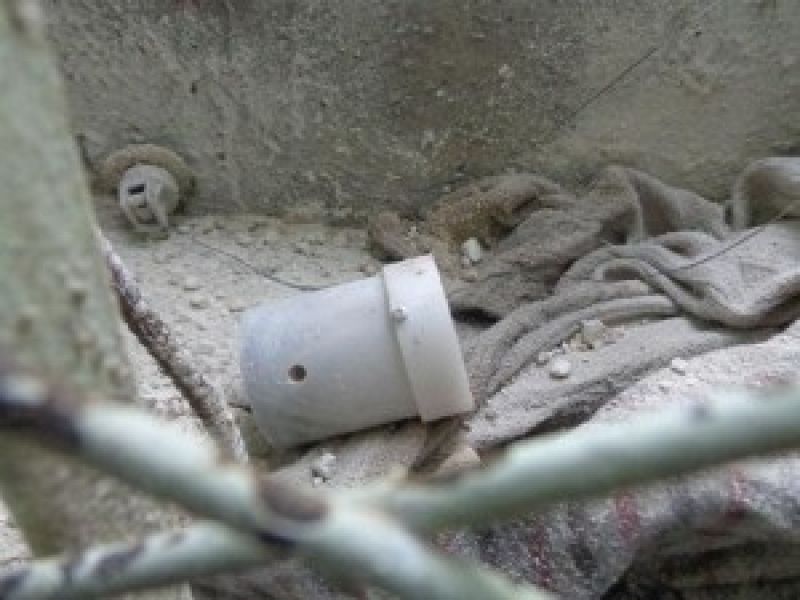
It's also interesting to note that just a couple of miles down the road in Adra last night there was another reported chemical attack (videos here), so it does beg the question of whether or not there's a link. The fact these gas grenades appear to be carried by government forces does seem to support the theory they aren't a deadly chemical weapon like sarin.

In an ideal world one of those grenades would makes it to a friendly news organisation who could have it independently analysed, so if anyone knows how to contact the Abu Dhar al-Ghafari Brigade in Damascus it's a good time to let me know.

Thanks to Johnny Six and Mark for highlighting this video.

Related posts