Here's the latest videos of cluster bombs and bomblets from the last 24 hours in Syria, starting with two videos from Al-Bab, Aleppo, showing PTAB 2.5m bomblets, as well as the canister in the second video
This photograph was also taken in the same area [source]
And from Rankus, Damascus, we have this video showing multiple cluster bomb canisters and bomblets, as well as a gallery of photographs from the same area
In Talbiseh, Homs, we have this video showing a cluster bomb canister, and multiple bomblets
And in Dayr Ful, Homs, we have this video of a partial canister
From Duweir, Deir Ez Zor, a cluster bomb canister
And finally from Maarrat al-Numan, Idlib, this very interesting video that appears to show a cluster bomb that didn't deploy correctly and appears to have detonated with all the bomblets still inside, worth a look
The following are videos of clusters bombs collected over the last two days. Earlier videos can be found here and here. I also recommend reading the Human Rights Watch report, Syria: New Evidence Military Dropped Cluster Bombs, which goes explores the issues surrounding the use of cluster bombs in more detail.
First of all two videos showing the the tail section of cluster bomb canisters in the Damascus suburb of Hamouriah, northeast of the city. It's unclear if these are two separate incident, although looking at the surrounding area it is possible
This video from Al Zafaraneah, Rastan shows another tail section buried in the soil
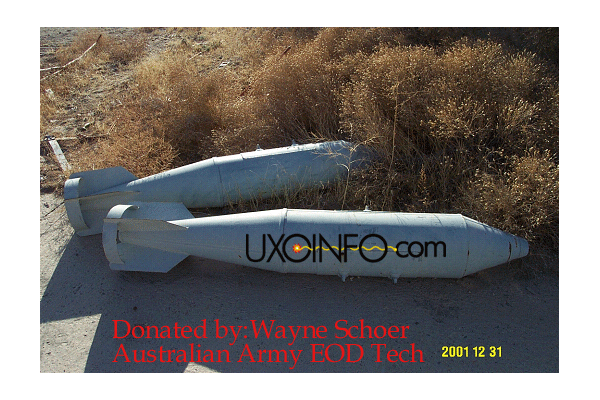
These next 3 videos from Kafar Takharim, Idlib, appears to show the same cluster bomb canister, which helpfully has the model and what is contains stenciled on the side, confirming this is a RBK 250-275 with AO1-Sch bomblets
Finally here's two videos from locations in Idlib, the second from Isqat, yet again showing partly buried tail sections
Over the last few days there's been a marked increase in the number of cluster bomb remains being filmed in Syria, and until today most were filmed around Maarrat al-Numan, along the main highway that connects central Syria (Hama, Homs, then Damascus and Daraa) to northern Syria (Idlib, Aleppo), which has recently come under opposition control. The concentration of reports from that area suggested at first that the use of cluster bombs was related to attempts to regain an important supply route to Aleppo. The following video shows four examples of cluster bombs used in the area, some of which were covered in my earlier post on the topic
However, in the last 24 hours multiple videos have been posted online showing cluster bomb remains in locations across Syria. In all of the examples they appear to show RBK-250 cluster bombs with PTAB 2.5m bomblets with removed fuzes. These first two videos show bomb casing and cluster bomblets in Tell Rifaat, north of Aleppo
From the coastal region of Latakkia we have this video that shows a complete casing along with a number of unexploded bomblets
To the east of Damascus we have this remarkable collection of casing and bomblets from 5 separate cluster bombs from Deir Al-Assafeer, East Ghouta
These videos were posted online in the last 24 hours, and demonstrates that cluster bombs now appear to be used across Syria. In the last 4 days I've seen videos of between 17-20 separate cluster bombs, compared to 3 videos in the prior 18 months, clearly pointing to an escalation in their use. It should be noted that unlike normal bombs cluster bombs generally always leave behind bomb casings, as they open up to scatter bomblets rather than exploding.
Cluster bomblets leave a deadly legacy for decades after conflicts have ended, as well as being extremely dangerous to handle, something that unfortunately is happening in a great number of these videos. Earlier videos of cluster bombs dropped in Syria can be found here.
Over the many months I've been examining videos from Syria there's been a rather unfortunate trend for activists to pick up and move the various unexploded ordnance (UXO) they've discovered in their home towns and cities.
While it's understandable that activists wish to show the world the sort of weapons that are being used against them it seems to me they are taking unnecessary risks to do so, and I also feel that in today's modern era of Youtube and 24 hour news coverage there's almost a demand for detailed footage of UXO.
I myself have examined various videos of UXO, but I'd be much happier if they were filmed from a safe distance, and left alone. No matter how sure you think you are that UXO is safe there's no real way to be sure, and Assad is killing enough people without helping him out trying to let the world know about the methods Assad is using. Here's a quick top ten of highly inadvisable UXO handling.
10: An unexploded mortar shell lying in the middle of a street, with an unnecessary close up
9: An unexploded artillery shell that's been stood upright so it can be compared to a bullet
8: Yet another artillery shell that's stood up by the cameraman so the audience can get a closer look, with the fuze leaning against a tree
7: A close examination of an unexploded artillery shell
6: An activist shows the audience an unexploded 70mm rocket jammed into the ground, and tries to pull it out of the ground
5: This video shows two UXO, one unexploded artillery shell, and one massive unexploded 240mm mortar, which is lifted up rather ungracefully on what you might describe as the business end of the mortar
4: Another unexploded 240mm mortar, this time being tapped with a rock
3: Here we see an OFAB 250-270 high explosive bomb being closely examined by activists, as well as the hole it punched in the roof it crashed through, and the crater the activists pulled this unexploded high explosive bomb out of to examine
2: Activists arranged these 9 AO-1 SCH cluster bomblets so they could tell you all about them, even though they are notorious for not exploding when deployed and hanging around on battlefields until someone bumps into them
1: In this video we see a man pick up an unexploded artillery shell, show it to the camera, and then throwing it onto the road like a piece of rubbish
So, to activists I would say please leave this items alone, none of the information we could gather from these videos are worth the life of a single activist, and you can never be sure if these items are safe, no matter what your past experience is with handling them, and to those who would encourage activists to risk themselves so you can have a more interesting image for your report, be it inadvertently or not, please consider that when they do that they are risking their lives, and the lives of those around them.
Following on from my earlier post on OFAB 250-270 High Explosive Bombs being deployed in Syria a pair of new videos have been posted online showing a new type of bomb (thanks to HamaEcho). Both videos were filmed at the same location in the Jabal Shehshebo region in the Hama countryside, the same area as the first OFAB 250-270 videos were filmed.
The video shows around 15 bomblets marked with A-IX-2, a Russian explosive used in military shells. This would imply the shells are loaded with explosives, but have failed to detonate. A poster on Something Awful pointed out that they appear to be AO-1 SCH bomblets (image), and are submunitions in a number of bombs. The next videos show the likely delivery device
Bjørn H Jespersen, of the excellent .processing blog put together a quick sketch of the weapon based on the above video
It is believed that the RBK-250-275 was originally designed to carry fragmentation bomblets designated AO-2.5. However, later versions carried 150 AO-1 SCh fragmentation bomblets, or 30 PTAB-2.5 anti-armour bomblets. The designation letters AO stand for aviatsionnaya oskolochnaya meaning 'aircraft fragmentation', PTAB stands for protivo-tankovaya aviatsionnaya bomba meaning 'anti-tank aircraft bomb'.
As I reported earlier, after we saw the OFAB 250-270 High Explosive Bombs being dropped in fields in the Jabal Shehshebo region in the Hama we then saw evidence of them being dropped on buildings in other parts of Syria, and with a failure rate high enough to allow us to identify a number of examples of the bomb landing somewhat intact. In fact, the final video showed a bomb that had gone through the roof of a house and landed in one piece in a large crater, so the question is, are we seeing old stock now being deployed in Syria, and could the explain the failure rate? Another theory is the fuse was incorrectly set on the bombs, and this led to a failed or partial detonation. And as it's clear there's large number of dud bomblets it's also important to point of the long term and unintentional effects of cluster bomb usage in civilian areas
Cluster munitions are inaccurate and unreliable weapons that by their very nature pose unacceptable dangers to civilians. They pose an immediate threat during conflict by randomly scattering thousands of submunitions or "bomblets" over a vast area, and they continue to take even more civilian lives and limbs long after a conflict has ended, as hundreds of submunitions may fail to explode upon impact, littering the landscape with landmine-like "duds."