Showing posts with label Assad. Show all posts

Monday, 30 July 2012

More High Level Defections Predicted In Syria

Activist THE_47th, who accurately predicted Manaf Tlass' defection from the Syrian regime has been making a series of Tweets about future defections
Exclusive: as I tweeted b4, Parliamnt Member Anas Al Shami is in Cairo now waiting for all his family members to leave 2 announce defection.

In lesser important news, Ana's Al Shami's brother, big Aleppo Sheikh Suhaib Shami, has arrived in Beirut also 2 announce his defection.

But the bomb news of the night is as follows: talks are now finalizing with top Syrian Gov official, expected within a week, the biggest 1.

This one official that I expect 2 defect within one week, holds a TOP position, is willing to defect, but waiting to get out. Cant say name.

I will have the exclusive on that person once he is out of Syria. This will be the ultimate slap on Assad's face. The biggest in 17 months.

This major defection will hinder how the Assad Gov works, and will shake the entire regime to its core. It is big, trust me.

Again, this major defection should be finalized this week, but it all depends in the exit. It won't be easy, very key position.

Related Posts
The Head Of The Investigation Into The Qubair Massacre Defects To The Syrian Opposition
Manaf Tlass And His French Far Right, Voltaire Network, Pro-Assad Friends

You can contact the author on Twitter @brown_moses or by email at brownmoses@gmail.com

Saturday, 14 July 2012

Car Bomb Left Outside Mosque In Damascus Disarmed By FSA

Today there have been a number of reports from activists in Jobar, Damascus of a car bomb left outside a mosque, for example this Facebook post (translated by @LostInBeirut)
After the end of large protest held following Friday Prayer, Assad's gangs entered the Jobar neighborhood and spread around the mosques. When they arrived at the Grand Jobar Mosque, they left a car (Saba brand) near the north gate of the mosque and then left the neighborhood. One of the residents noticed this car and notified members of the FSA, who came to to the scene and searched the car and found a large bomb in the trunk with wireless detonators. They defused it and removed the bomb from the neighborhood.

Assad's gangs threatened the people of Jobar a number of times with punishment if they did stop the demonstrations and sent warnings to several prominent people in the neighborhood that the rebels of Jobar wanted them to stop the demonstrations and they will not bomb the neighborhood or carry out a terrible massacre.

One of the officers in Assad's gangs told striking shopkeepers last Saturday that they will soon face tougher punishment.
And this post (translated by @LostInBeirut)
It was reported to the leaders of the Brigade the existence of a car (Saba brand), white color with the license number 429 691, parked next to the north gate of the Grand Jobar Mosque. It had been seen entering with Assad's criminal forces while they were storming the neighborhood following the mass demonstrations, after Friday Prayers, to condemn the crimes of the regime and its massacres against the rights of our people in Tremseh. 

The car had been parked in a suspicious way under the observance of security forces and Assad's brigades and immediately after the security forces exited, an engineering unit under the command of the Haroun al-Rashid brigade discovered that the car had an explosive device with around 100kg of explosives and a wireless detonator.

Praise be to god that they were able to disarm the bomb and move it out of the neighborhood and transfer it to the control of General al-Habib al-Mustafa and send the car to a public street near Martyr's Square where it was burned to condemn this despicable move by al-Assad.
This video has also been posted by local activists showing the car bomb they claim was placed by Assad's men (via @sherbalkis)
In the video we see a white car, as described in the above Facebook posts, in the boot of which we clearly see what appears to be some sort of tank with two devices attached, which are removed from the device.  Luckily for the people removing those devices there's no anti-tampering devices on the bomb.  A number of photographs of the two devices removed were posted on the local activists Facebook page (thanks to Xandu)
As always it's impossibly to independently verify any of the claims about the car bomb being planted by Assad's forces, but the local activists have provided a good number of images of the bomb, so hopefully anyone with knowledge of these devices might be able to identify where the above pictured wireless detonator and charge may have come from.  It's believed that this is the actual explosive charge used to detonate the tank
And this is the wireless receiving used to detonate the charge from a distance
You can contact the author on Twitter @brown_moses or by email at brownmoses@gmail.com

Tuesday, 10 July 2012

Evidence Of Cluster Bombs Being Deployed In Syria

Following on from my earlier post on OFAB 250-270 High Explosive Bombs being deployed in Syria a pair of new videos have been posted online showing a new type of bomb (thanks to HamaEcho).  Both videos were filmed at the same location in the Jabal Shehshebo region in the Hama countryside, the same area as the first OFAB 250-270 videos were filmed.

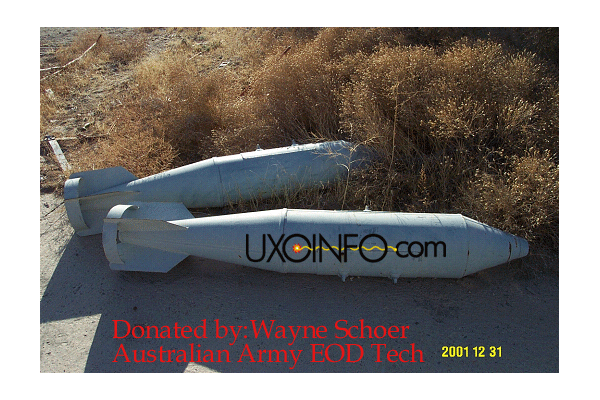
The video shows around 15 bomblets marked with A-IX-2, a Russian explosive used in military shells.  This would imply the shells are loaded with explosives, but have failed to detonate.  A poster on Something Awful pointed out that they appear to be AO-1 SCH bomblets (image), and are submunitions in a number of bombs.  The next videos show the likely delivery device
Bjørn H Jespersen, of the excellent .processing blog put together a quick sketch of the weapon based on the above video
It appears the bomb is an RBK-250-275 cluster bomb (image) (image),
It is believed that the RBK-250-275 was originally designed to carry fragmentation bomblets designated AO-2.5. However, later versions carried 150 AO-1 SCh fragmentation bomblets, or 30 PTAB-2.5 anti-armour bomblets. The designation letters AO stand for aviatsionnaya oskolochnaya meaning 'aircraft fragmentation', PTAB stands for protivo-tankovaya aviatsionnaya bomba meaning 'anti-tank aircraft bomb'.
As I reported earlier, after we saw the OFAB 250-270 High Explosive Bombs being dropped in fields in the Jabal Shehshebo region in the Hama we then saw evidence of them being dropped on buildings in other parts of Syria, and with a failure rate high enough to allow us to identify a number of examples of the bomb landing somewhat intact.  In fact, the final video showed a bomb that had gone through the roof of a house and landed in one piece in a large crater, so the question is, are we seeing old stock now being deployed in Syria, and could the explain the failure rate?  Another theory is the fuse was incorrectly set on the bombs, and this led to a failed or partial detonation.  And as it's clear there's large number of dud bomblets it's also important to point of the long term and unintentional effects of cluster bomb usage in civilian areas
Cluster munitions are inaccurate and unreliable weapons that by their very nature pose unacceptable dangers to civilians.  They pose an immediate threat during conflict by randomly scattering thousands of submunitions or "bomblets" over a vast area, and they continue to take even more civilian lives and limbs long after a conflict has ended, as hundreds of submunitions may fail to explode upon impact, littering the landscape with landmine-like "duds."
You can contact the author on Twitter @brown_moses or by email at brownmoses@gmail.com

Thursday, 5 July 2012

UPDATED - Manaf Tlass And His French Far Right, Voltaire Network, Pro-Assad Friends

It's been widely reported today that Manaf Tlass, son of former Syrian Defense Minister Mustafa Tlass, part of Assad's inner circle, and commander of an elite unit in the Syrian army has fled Syria to Turkey.  Joshua Landis noted in his blog that he was a close confidant of Bashar al-Assad, and offered this possible reason for his defection
The word is that Manaf had been told to solve the Harasta and Duma problems (the growing uprising on the outskirts of Damascus). He did a good job by negotiating with the opposition leaders in both suburbs, agreeing that both government forces and opposition would pull back.

The Alawi leadership said "no, that is not how we are going to do this." They pushed him aside and came down like a ton of bricks on the opposition in both neighborhoods, in an effort to assert state authority and crush the uprising through military means.

Manaf supported a policy of negotiation, flexibility and compromise. He was overruled by the military leadership and has since looked for a way out.
Hama Echo pointed me in a direction of a couple of picture of Manaf Tlass which may indicate that this defection is more about saving his own skin than any ideological differences with the Assad regime. In August 2011 the French anti-fascist website Reflex posted an article about members of the far right in France, including Frédéric Chatillon, founding a new website, InfoSyrie, to correct what they stated was the gross misrepresentation of facts by the Western media in the pay of the US and Israel.

The article goes on to describe links between the far right in France and the Alawite and Assad regime members in Syria, and describes a visit arranged by Chatillon for his associates, that include Thierry Meyssan, chairman of the  Voltaire Network; Dieudonné M'bala M'bala, a anti-Semitic political activist; essayist Alain Soral; Ahmed Moualek, president of La Banlieue S'exprime (LBS); and Marc George to Lebanon in 2006, via a 5 day stop over in Syria, where it's alleged Chatillon initiated links with some “second level” regime personals.

A future visit to Syria in 2008 with the same group, reportedly largely financed by the Tlass family, included hotels, sightseeing and drivers for their far right friends, including this meeting with Manaf Tlass (and other family members) pictured second from the left

Other individuals in this picture include Thierry Meyssan on the far right at the end of the table, and Dieudonné M'bala M'bala with his arm around Manaf Tlass.  Here's another picture from the same evening, showing, from left to far right, Frédéric Chatillon, Manaf Tlass, and Dieudonné M'bala M'bala

No doubt now Manaf Tlass has turned his back on the Assad regime his French pro-Assad friends might not be returning his phone calls anymore.

Read more on the Tlass family connections to the French far right here.

The Syrian website has an Arabic language article on the same subject here, and there's an English translation on the way that I will post once it's ready.

Updated July 9th The Damascus Tribune has translated the above article into English, which you can read here.  Here's the main points:
- The Tlass family was responsible for funding the Voltaire Network International, and a number of other sites, at the behest of the Syrian government.
- Damascus gave Thierry Meyssan the money to relaunch the collapsed Voltaire Network in August 2005.
- The funding of Meyssan and The Voltaire Network International was assigned to Munaf and Firas Tanaf from 2006.
- During the 2008 visit to Damascus Thierry Meyssan recommended Frédéric Chatillon for a pro-Syrian PR campaign, that was also funded by the Tlass family, and led to the founding of RiwalSyria.
- In 2011 Riwal registered and launched infosyrie.net for the benefit of the Syrian regime.

Update July 9th The Syrian has now posted their own English translation.

Related Posts
The Tlass Family And Their Historical Links To The French Far Right

You can contact the author on Twitter @brown_moses or by email at brownmoses@gmail.com

Saturday, 16 June 2012

Assad's Troops Allegedly Found In Possession of Anti-Nerve Gas Medication

Anonymous Syria Tweeted this video last night:
's troops left this in Pyridostigmine Bromide, an evidence for using the nerve agent Soman!


Pyridostigmine bromide is used as a pretreatment for nerve gas exposure, and was used to protect troops from nerve gas exposure during the first Gulf War.  While it's impossible to verify if this packaging did come from Assad's troops it does highlight the possibility of nerve agents being deployed in Syria, especially with their significant stockpiles of chemical weapons.

You can contact the author on Twitter @brown_moses or by email at brownmoses@gmail.com

Wednesday, 30 May 2012

Fresh Attacks on Houla - Updated May 31st

This page contains images some people may finding upsetting.

MAY 31ST UPDATE - Lots of new videos added at the bottom of this post.

2ND UPDATE - Three new videos added to the bottom of this post.

UPDATED - New videos at the bottom of this post.

Following a visit by the UN and ICRC to Houla today there's been reports of fresh shelling and more dead and injured in Houla.  It's difficult not to see this as the Assad regime thumbing their nose at the international community after their condemnation of the Houla Massacre.  Here's some of the videos posted online following the events of today:

May 30th 2012 – Crops burning in Houla, allegedly set on fire by Assad's forces

May 30th 2012 – A abandoned Assad checkpoint in Houla

May 30th 2012 – Alex Thomson of Channel 4 News (UK) interviewing Houla citizens

May 30th 2012 – More filming by Alex Thomson of Channel 4 News

May 30th 2012 – Injuries from today's shelling of Houla

May 30th 2012 – More injuries from today's shelling

May 30th 2012 – More injuries from today's shelling

May 30th 2012 – The sounds of gunfire and shelling at night in Houla

May 30th 2012 – GRAPHIC – Partly decapitated victim of shelling Houla

May 30th 2012 – More wounded from today's shelling

May 30th 2012 – GRAPHIC – A Houla citizen killed in shelling


May 30th 2012 – GRAPHIC – The remains of the head of someone killed in today's shelling

UPDATE - New videos

May 30th 2012 – UN observers being shown the site of a mass killing in Houla

May 30th 2012 – UN observers being shown another site of a mass killing

May 30th 2012 – Another mass killing site shown to UN observers

May 30th 2012 – An armoured vehicle firing at Houla

May 30th 2012 – More footage of armoured vehicles firing at Houla

May 30th 2012 – Houla being hit by tanks

UPDATE 2 - Three new videos

May 30th 2012 – A tiny child, survivor of the Houla Massacre

May 30th 2012 – UN observers visit another massacre site

May 30th 2012 – A 5th video from the UN observer visiting the scene of mass killing in Houla

UPDATE 3 - One new video

May 30th 2012 – A doctor explains the injuries received by one of the victims of today's shelling

MAY 31ST UPDATE

May 31st 2012 – GRAPHIC – The badly damaged body of another of victim in Houla

May 31st 2012 – Damage caused by artillery strikes on Houla

May 31st 2012 – A wounded Houla resident in need of urgent medical assistance

May 31st 2012 – The funeral of Muhammad and Ahmed Salama


May 31st 2012 – A huge funeral procession from Muhammed and Ahmed Salama

May 30th 2012 – A child survivor of the Houla Massacre talking to a UN observer

May 31st 2012 – A boy who appears to have been shot through the chest bleeding to death

May 30th 2012 – More wounded from today's shelling

May 30th 2012 – Damage to a mosque caused by shelling

May 30th 2012 – A tour of damage caused by shelling


The following channels are posting videos from Houla:
hassan699721
FreedomAlhoula
nontherful
samerd3


You can contact the author on Twitter @brown_moses or by email at brownmoses@gmail.com

The Myth of "Libya Style" Military Intervention in Syria

After the events of the last weekend in Houla and the international reaction that followed there’s been fresh calls (and fears) from some quarters for “Libya Style” military intervention in Syria.  “Libya Style” intervention should be taken to mean using overwhelming air superiority to first destroy air defences in the country, establishing a no-drive/no-fly zone, and targeting military infrastructure.
Ignoring the various reports of Russia and China stating their opposition to military action, and the British foreign secretary William Hague stating the only alternative to Kofi Annan’s peace place being civil war and collapse, would Libya Style intervention even be viable in Syria? 
To begin with let’s look at the Libyan military intervention.  Libya has around 6 million citizens, with the vast majority living in coastal cities, including Tripoli, Misrata and Benghazi.  The military consisted of around 50,000 soldiers, around half of which were conscripts, and despite looking good on paper much of Gaddafi’s military equipment was found to be rusting in depots in the middle of nowhere, useless for combat operations.
So we have a small and poorly equipped army, the majority of the population living on coastal cities allowing for carrier operations and long range air operations from bases in Europe, and an outdated air defence system.  On top of that we have 3 major locations, Benghazi, Misrata, and the Nafusa Mountains which are all in the middle of a major rebellion, and already building up stockpiles of weapons and vehicles.
Military intervention begins, and the air defence network is destroyed in days, with the rusting Libyan air force unable to put up any sort of fight against the coalition’s air far superior air power.  At that point the Libyan rebels effectively have their own air force to support advances into Gaddafi controlled territory, with attempts by Gaddafi’s armed forces to capture towns foiled by coalition air strikes on their positions.
Even then it takes seven months for the conflict to be over, exposing the weaknesses in NATO’s supply chains and their reliance on the US to keep the war machine supplied in missiles and bombs.  It’s clear that without the US playing a major role in operations that the coalition simply would have just ran out of bombs a few months into the conflict.
So let’s look at Libya Style intervention in Syria.  First of all the coalition would need to wipe out the Syrian air defence system, as we saw in Libya.  Recently Deputy Chief of General Staff Yair Naveh of the IAF warned that Syria had "invested $3 billion toward its build up" of air defence systems, and back in March Marine Gen. James Mattis, head of U.S. Central Command, told US senators that Syria had advanced air defence weapons provided to them by Russia, saying it would make it difficult to establish a no-fly zone in Syria.  This claim was countered by Akil Hashem, a former Syrian general, who told CNN’s Christiane Amanpour that Syrian defences under a western attack would "collapse right away”.  However, it seems that in these matters the opinion of those doing the bombing counts more than the opinion of those who want the bombing to happen.
The next problem is the Syrian rebels don’t control vast areas in the same way that the Libyan rebels did.  Despite press reports back in February comparing Homs to Benghazi only parts of Homs were rebelling, with other areas still loyal to Assad, or at least not siding with the rebels.  This is a pattern seen across Syria, and you just have to look at some of the reports on the events in Houla to see why this could be a problem for any Libya Style military intervention.  Some reports suggest that the armed men who went into Houla were shabiha drawn from local Alawite villages, and Homs was described as being divided along sectarian lines by the fighting.  As much as I would like to imagine that the Syrian people can unify against the Assad regime and ignore sectarian divisions I don’t really think that’s likely to happen, especially as it seems likely that as the conflict goes on the Assad regime will be more likely to focus on sectarian issues to shore up support, and we just have to look at Tawergha and other towns that found themselves on the losing side after taking part in a brutal conflict.
Even ignoring the above major issues there would still need to be a long bombing campaign, against a much larger and better equipped army, and it took a 7 month bombing campaign in Libya, one that stretched coalition resources, and was thankfully shortened due to a fantastically executed plan to capture Tripoli, which included at least one major defection that allowed rebel forces to walk into the city with minimal casualties.  Without that the intervention could have easily lasted for another 3 months while rebels forces slowly fought their way into Tripoli, and if Sirte is anything to go by, destroying much of it in the process.  I don’t believe we can expect that Libya Style intervention in Syria will be over as quickly, and no doubt it would require much greater resources even to attempt that, most of which would come from the US, something that seems unlikely in an election year.
Where does that leave Syria?  Some people have called for safe zones to be established, but it seems impossible that the Assad regime would agree to this when they are describing rebels as terrorists, so again we’d be back to using military intervention to establish a no-fly no-drive zone.  Then we aren’t talking about Libya Style intervention anymore, but something much more significant and potentially dangerous to both Syria and the wider region. 
You can contact the author on Twitter @brown_moses or by email at brownmoses@gmail.com