Over the past few months a new family of bombs have been deployed in Syria, with the following videos giving clear examples of them at work
At the same time a number of videos have been appearing showing the remains of parachutes in areas these bombs have been used, for example
The remains of the bombs used have been harder to track down, with this being the one example I've been able to find
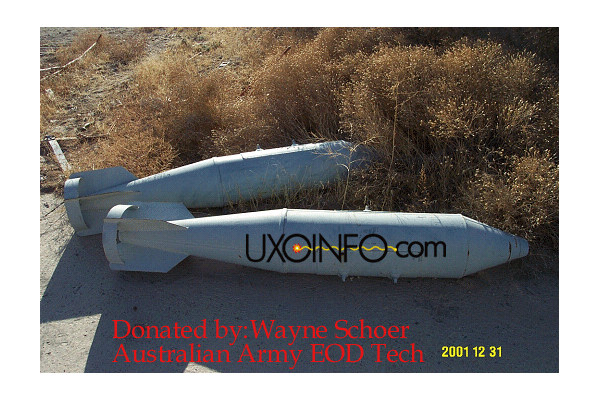
This has complicated finding the specific type of bomb used, but I'm fairly certain the bombs used belong to a family of parachute retarded FAB-500 high explosive bombs, which include the FAB-500 SH, FAB-500 SHN, and FAB-500 SHL, examples of which are shown below
FAB-500 SH
FAB-500 SHN
FAB-500 SHL
Based off the configuration of the tail-fin in the video showing the remains of one of these bombs, it seems the most likely match in that instance is the FAB-500 SHL, although it's impossible to know if other examples have been used. It's also worth keeping in mind smaller and larger versions of these bombs also exist.
What's very interesting is what these bombs are used for. Historically, as air defence systems have become increasingly sophisticated, it became widely accepted that to counter this bombs should be delivered at extremely low altitudes. Standard bombs delivered in this way risked damaging the plane dropping them, so parachutes were added to slow the descent of the bomb. So it would appear the use of these bombs is a reaction to the opposition's improving air-defences, especially as it's clear that in recent months MANPADS are playing an increasingly important role in the opposition air-defences.
Back in August Bjørn H Jespersen examined evidence that pointed towards thermobaric bombs being used in Syria. These bombs, also known as vacuum bombs, function by first dispersing a cloud of fuel shortly before a secondary detonation that ignites the fuel, creating a powerful shock wave.
Bjørn H Jespersen was first alerted to these after coming across this very unusual video from Talbiseh that clearly showed two large bombs moments before impact
Since that video 4 more videos have been found they appear to be the same style of bomb, if not the same model, 3 of which are from Talbiseh
By examining the damage to the three bombs in Talbiseh it appears they are different, not the same bomb filmed on 3 separate occasions.
Earlier today I came across this video from a village outside of Aleppo, which shows an unexploded example of a previously unseen bomb, which is closely (and dangerously) examined by the men in the video
According to Jane's the "bombs are believed to be cleared for carriage on MiG-21 'Fishbed', MiG-27 'Flogger', MiG-29 'Fulcrum', Su-22 'Fitter', Su-24 'Fencer', Su-25 'Frogfoot', Su-27 'Flanker', Tu-95 'Bear', Tu-16 'Badger', Tu-22 'Blinder' and Tu-22M 'Backfire'", which includes the aircraft used by the Syrian Air Force.
Update September 19th The second half of this video shows the same BETAB as filmed above
I've been taking a look at the various video of fixed winged aircraft spotted above Aleppo following this report by Ian Pannell of the BBC
But it was what happened late in the afternoon that underlined the grave risk to the government of losing ground in what is Syria's largest city and its economic capital.
First came an unmistakeable sound that has so far been absent in this conflict - the roar of fighter jets.
What appeared to be Russian-made MiG planes arced through the sky. We watched as they dropped in, bombing and strafing rebel positions.
A number of videos supposedly from Aleppo showing aircraft flying through the sky, for example this one from Bambuser and this one from Youtube, and are generally pretty unclear, so making out the shape of the aircraft is difficult. However, one video has been posted that has a great shot of the aircraft
I've blown up this screengrab to get a clear idea of the silhouette of the aircraft
Let's compare that to some of the aircraft listed as being used by the Syrian Air Force, first the various MiGs
The above two aircraft are a MiG-21 and MiG-29, both of which clear have wings that look nothing like the aircraft in the videos. Then we have MiG-23 and Su-24, with variable geometry wings
To me it looks like the wings are too thin, and set too far back, plus it appears in the video there's something on the end of the wings, and what I believe we are seeing in the video is an Aero L-39 Albatros
Here's a clearer top down view which we can compare to the still from the video
So in this case it seems likely that what we're seeing in the above video is not a MiG, but a jet training aircraft being used to attack targets in Aleppo. The question is, why?
Update - After some discussion of whether or not it could be a SU-25 (which I believe the Syrian Air Force doesn't have) Tim Robinson, editor of Aerospace International, Tweeted to say
Its a L-39. Straight wings, wingtip fuel tanks, & longer nose than Su-25.
Update - HamaEcho sent me a second clip from Aleppo that seems to clearly show an L-39
And as yet there's been no video evidence of any other fixed-wing aircraft being used.
Update - Another video showing a L-39 over Aleppo
The excellent Aviationist blog has also taken a look at this and also come to the same conclusions.
Update July 28th - Two more videos have been posted showing the L-39 flying over Aleppo in the opening stages of the Syrian Army's attack on the FSA inside the city
Update July 28th - This video appears to show a L-39 making bombing runs, although the video quality makes it difficult to be certain
Update July 31st This video shows another L-39 above Aleppo possibly firing rockets or missiles
Today there have been a number of reports from activists in Jobar, Damascus of a car bomb left outside a mosque, for example this Facebook post (translated by @LostInBeirut)
After the end of large protest held following Friday Prayer, Assad's gangs entered the Jobar neighborhood and spread around the mosques. When they arrived at the Grand Jobar Mosque, they left a car (Saba brand) near the north gate of the mosque and then left the neighborhood. One of the residents noticed this car and notified members of the FSA, who came to to the scene and searched the car and found a large bomb in the trunk with wireless detonators. They defused it and removed the bomb from the neighborhood.
Assad's gangs threatened the people of Jobar a number of times with punishment if they did stop the demonstrations and sent warnings to several prominent people in the neighborhood that the rebels of Jobar wanted them to stop the demonstrations and they will not bomb the neighborhood or carry out a terrible massacre.
One of the officers in Assad's gangs told striking shopkeepers last Saturday that they will soon face tougher punishment.
It was reported to the leaders of the Brigade the existence of a car (Saba brand), white color with the license number 429 691, parked next to the north gate of the Grand Jobar Mosque. It had been seen entering with Assad's criminal forces while they were storming the neighborhood following the mass demonstrations, after Friday Prayers, to condemn the crimes of the regime and its massacres against the rights of our people in Tremseh.
The car had been parked in a suspicious way under the observance of security forces and Assad's brigades and immediately after the security forces exited, an engineering unit under the command of the Haroun al-Rashid brigade discovered that the car had an explosive device with around 100kg of explosives and a wireless detonator.
Praise be to god that they were able to disarm the bomb and move it out of the neighborhood and transfer it to the control of General al-Habib al-Mustafa and send the car to a public street near Martyr's Square where it was burned to condemn this despicable move by al-Assad.
This video has also been posted by local activists showing the car bomb they claim was placed by Assad's men (via @sherbalkis)
In the video we see a white car, as described in the above Facebook posts, in the boot of which we clearly see what appears to be some sort of tank with two devices attached, which are removed from the device. Luckily for the people removing those devices there's no anti-tampering devices on the bomb. A number of photographs of the two devices removed were posted on the local activists Facebook page (thanks to Xandu)
As always it's impossibly to independently verify any of the claims about the car bomb being planted by Assad's forces, but the local activists have provided a good number of images of the bomb, so hopefully anyone with knowledge of these devices might be able to identify where the above pictured wireless detonator and charge may have come from. It's believed that this is the actual explosive charge used to detonate the tank
And this is the wireless receiving used to detonate the charge from a distance
Following on from my earlier post on OFAB 250-270 High Explosive Bombs being deployed in Syria a pair of new videos have been posted online showing a new type of bomb (thanks to HamaEcho). Both videos were filmed at the same location in the Jabal Shehshebo region in the Hama countryside, the same area as the first OFAB 250-270 videos were filmed.
The video shows around 15 bomblets marked with A-IX-2, a Russian explosive used in military shells. This would imply the shells are loaded with explosives, but have failed to detonate. A poster on Something Awful pointed out that they appear to be AO-1 SCH bomblets (image), and are submunitions in a number of bombs. The next videos show the likely delivery device
Bjørn H Jespersen, of the excellent .processing blog put together a quick sketch of the weapon based on the above video
It is believed that the RBK-250-275 was originally designed to carry fragmentation bomblets designated AO-2.5. However, later versions carried 150 AO-1 SCh fragmentation bomblets, or 30 PTAB-2.5 anti-armour bomblets. The designation letters AO stand for aviatsionnaya oskolochnaya meaning 'aircraft fragmentation', PTAB stands for protivo-tankovaya aviatsionnaya bomba meaning 'anti-tank aircraft bomb'.
As I reported earlier, after we saw the OFAB 250-270 High Explosive Bombs being dropped in fields in the Jabal Shehshebo region in the Hama we then saw evidence of them being dropped on buildings in other parts of Syria, and with a failure rate high enough to allow us to identify a number of examples of the bomb landing somewhat intact. In fact, the final video showed a bomb that had gone through the roof of a house and landed in one piece in a large crater, so the question is, are we seeing old stock now being deployed in Syria, and could the explain the failure rate? Another theory is the fuse was incorrectly set on the bombs, and this led to a failed or partial detonation. And as it's clear there's large number of dud bomblets it's also important to point of the long term and unintentional effects of cluster bomb usage in civilian areas
Cluster munitions are inaccurate and unreliable weapons that by their very nature pose unacceptable dangers to civilians. They pose an immediate threat during conflict by randomly scattering thousands of submunitions or "bomblets" over a vast area, and they continue to take even more civilian lives and limbs long after a conflict has ended, as hundreds of submunitions may fail to explode upon impact, littering the landscape with landmine-like "duds."
Over the past several months of the Syrian conflict there's been a great deal of evidence posted online and recently confirmed by the UN that helicopters have been used to attack opposition areas. What's been unclear is exactly the range of weapons being used against opposition areas, with rocket and machine gun fire being the most common. Two videos posted yesterday (highlighted by markito0171) indicate that as well as rockets and machine gun fire the Syrian air force is using unguided bombs
The cameraman claims these videos were filmed on June 27th in the Jabal Shehshebo region in the Hama countryside. In the first video he says they were fired by helicopters, but in the second uses a more general term for aircraft. It's of course impossible to verify any of these claims, so let's examine what we can see in the video. I believe what we are seeing in these videos are OFAB 250-270 High Explosive Fragmentation Bombs, and I've come to the conclusions by identifying a number of characteristics which I believe collectively are unique to that specific model of bomb. First, taken from here, a picture of (from left to right) of a P-50T training bomb, an OFAB-100-120, and an OFAB-250-270
To begin with CJ Chivers noted the configuration of the lug holes on the bomb casing. This led me to examine them more closely, and in the below picture I've marked the lug holes you can see on the badly damaged bomb in the first video, the two red circled lug holes being on one side of the casing, visible on the above picture, and the single lug hole on the other side of the casing (as pictured here) circled in green, but not visible in the above picture
Other bombs in the range with two lug holes on one side are much larger, and don't share the very specific tail fin configuration on the OFAB-250-270.
In the above picture I've marked the tail fins in red and yellow boxes. The red fins overlap go outside the outer edge, while the yellow fins stay inside the outer edge. This same configuration can be seen clearly on this picture (taken from here), as well as the grooves stamped along the length of each fin
They also share the two concentric rings at the end of the tail fin, and if you examine this wide selection of bomb photographs you can see that the combination of the tail fin pattern, number and position of lug, and the concentric rings at the end of the tail fin strongly indicates the bombs are OFAB 250-270 High Explosive Fragmentation Bombs. Add to that the cameraman estimating the bombs are about 50cm across, roughly the same as the OFAB 250-270 it seems that it's a pretty strong contender. While widely used on Russian made jets these bombs are also dropped by Hind helicopters, the below picture showing an example of a similar model in use (taken from here)
So there's a number of questions that need answering; where exactly were the bombs dropped? It seems clear they weren't dropped near any buildings, which may support Austin Tice's report that some of the pilots are purposely avoiding hitting targets, or flying to high to be effective
The tactics employed by helicopters observed in the past few weeks are a case in point.
Identified from photographs by an experienced American attack helicopter pilot as Russian-made MI-17s, which are designed both for transporting troops and cargo and for use as an attack aircraft, the helicopters typically fly in slow circles at altitudes between 1,500 and 2,000 feet. They fire unguided rockets and guns at apparently random or nonexistent targets and do not appear to employ guided missiles.
It's also interesting that the bombs appear to be in pretty good condition for high explosive fragmentation bombs. Are they both duds? One bomb even appears to be hollow, so could they be some sort of modified practice bombs? There's many more questions that remain, and I'll be on the look out for more evidence of unguided bombs being used by the Syrian Air Force.
Update June 28th This video has been sent to me by @sherbalkis which supposedly shows the area hit shortly after impact
As you can see the bomb appears to have landed nowhere near any structures, which may suggest pilot error or a purposeful attempt to miss any targets.
Update July 1st HamaEcho has sent me another video of the same kind of bomb, this time from Hawaijeh, Hama
Even though the bomb is badly damage it clearly shows the tail fins which match the OFAB 250-270, and like the bomb dropped above it was apparently dropped in a wide open space. So yet again the question is was that done on purpose?
Update July 6th A new video from Dier Ez Zor has been posted, showing a fully intact OFAB 250-270 that appears to have crashed through a roof and landed without detonating. What's very interesting about this video is it shows various markings on the bomb, and if anyone knows what they mean I'd be very grateful if you let me know
Updated July 17th The following video is from Talbiseh, and may show a OFAB actually being dropped by a helicopter
Update July 30th This video has been posted showing a helicopter in Daraa dropping what appears to be two OFABs
Update August 2nd This video from a suburb of Damascus was sent to me by HamaEcho and shows a small OFAB 100-120 bomb, identifiable by it's 4 tail fins, and the first example I've seen of this size bomb being used
Update August 2nd Two more videos have been posted to the above channel. The first shows the OFAB after it's been moved, which is extremely dangerous and should never be attempted with UXO
I believe this next video might actually show the remains of a OFAB that detonated
A third video from Homs countryside has also been posted, showing another OFAB 100-120
Note - This replaces an earlier article that misidentified the bombs as only being dropped by jets. You can contact the author on Twitter @brown_moses or by email at brownmoses@gmail.com