Today the following video was posted online by the Syrian Islamic Front
The video shows a brief statement on what the video shows, followed by the confession of one of the men involved
0:08 unnamed man: An Assad’s criminal gang was caught in Idlib. It was sent by the Militrary Security Branch (one of Assad’s various security apparatuses) and was planning to set a number of car bombs in the liberated areas in northern Idlib. They were taken to the Sharia Court. The car bombs were to be put near mosques. The truck bomb was detonated in a remote area.
0:15 I am Alaa’ Muhammed al-Basha (علاء محمد الباشا) from the town of Binnish (بنش). The Military Security Branch in Idilib tempted us by money and gave each one of us SYP 100.000 to park a Kia truck bomb near a mosque in al-Dana (الدانة). The truck was loaded with more than three tons of explosives. (He mentions the same number on the plate of the truck)
0:51 the cameraman explains how the
explosives were hidden in a box made of metal plates and that the
truck looks empty. 2:10 he shows the fuse 2:35 the truck bomb will be detonated
because it was too difficult to defuse the bomb.
This incident follows another reported series of arrests in the town of Morek (مورك) near Hama on September 24th where it was claimed three men were arrested planting the following devices in an attempt to kill opposition commanders (source)
The use of IEDs by the Syrian army seems to have become increasingly widespread in the past year, with a number of examples being posted online (see here), and it's not the first time a car bomb has been allegedly used to target a mosque, with this example from July 2012. As always, it should be made clear it's difficult to independently verify the claims made the the opposition in these circumstances.
The below video from Syrian State TV shows various weapons and ammunition reportedly captured from opposition fighters in the Hama region.
Among the dozens of large mortar rounds, thousands of bullets, and various heavy machine guns a few items stand out. On the less unusual side of things we see a pair of Metis-M missile tubes, a wire-guided anti-tank system which hasn't been an uncommon sight in the conflict, and is part of the Syrian army's arsenal
What's far more interesting are the items in this shot
To the right there are two SA-7 MANPADS (Man Portable Air Defence Systems), minus the grip-stocks required to operate both systems. While not an unusual sight in the conflict, this is the first time I've seen any MANPADS captured and shown on State TV. The three large tubes with the octagonal ends are something much more interesting, the first examples that I've seen of French MILAN anti-tank missiles in Syria. While the quality of the video is quite poor I've numbered the two following images to demonstrate 7 matching features on both the items shown in the video and a reference image of a MILAN missile
1 - The octagonal end piece.
2 - Dark red stripe.
3 - Yellow triangle.
4 - Yellow arrow.
5 - Handle.
6 - Yellow text.
7 - Circular symbol.
When most followers of the various Arab Spring conflicts think of MILAN missiles they will probably think of the MILAN AT missiles provided to the Libyan rebels by Qatar, and seeing the same types of missiles apparently appearing in the possession of the Syrian opposition will also probably make them think about reports of Libyan arms being sent to Syria. However, it's important to understand that not only does the Syrian military use MILAN missiles, but so do many other countries in the region, including Syria's neighbours Iraq, Lebanon, and Turkey, so although it's the first sighting of these weapons in the conflict that I'm aware of, it cannot be assumed these are being provided the the opposition from abroad.
As I've written about in the past videos showing the handling of UXO (unexploded ordnance) have been frequently uploaded to Youtube by activists in Syria, with great risk to everyone in the video. For example, in this recent video from a village in the Hama region of Syria shows the cluster bomblets from an Egyptian Saqr 122mm rocket, launched from BM-21 Grads, being handled and shown to the camera
On the same channel we have a video of a man who tried to pull one of the Saqr bomblets out of the ground by pulling at the ribbon attached to the bomblet, which caused it to explode, destroying both his hands and killing him
Cluster bomblets used in the Saqr rockets have a very different arming mechanism from the bomblets used in the RBK cluster bombs dropped by aircraft in Syria. The ribbon each one is attached to is connected to the arming pin, and when the bomblet is dispersed the ribbon stabilises the bomblet and arms the bomblet as it falls through the air by pulling the pin into the armed position. The problem is, if the bomblet doesn't disperse correctly and the ribbon doesn't have chance to pull the pin, the bomblet is not activated, but still very likely to go off if the ribbon is pulled. Think of it as a hand grenade pin, as soon as it's remove the munition is going to go off, and this is likely what cost the man in the above video his life. It's very unlikely the people handling these unexploded munitions know how the arming mechanism relates to the ribbon, so they are taking huge risks handling these submunitions, as the above video clearly demonstrates.
The RRMA (Responsible Reseachers for Arms and Munitions) has put together a number of safety posters in English and Arabic with details of some of the cluster submunitions commonly sighted in Syria, and videos of other examples of Saqr rockets seen in Syria can be found here.
Over the past month we've seen large numbers of cluster bombs being dropped by the Syrian Air Force across Syria, leaving unexploded bomblets across the country. These are extremely unsafe and leave a long term UXO threat that one group in Syria has taken a rather novel approach to removing. In this following video filmed in Hama from one of the groups that make up Al-Farouq Brigade we see something quite remarkable, cluster bomblets being repurposed as warheads for DIY rockets.
At the start of the video we see the bomblets being plucked from the ground, itself extremely dangerous, and the fuze being removed. We then see the rocket workshop with rows of these bomblets on the ground, all with the fuzes removed, and we're then shown a bomblet having it's tail fins removed, and replaced with a fitting that then allows it to be screwed into the rocket. A newly manufactured fuze is screwed into the bomlet/warhead, completing the rocket.
What this video shows isn't just simply the bomblets being used as warheads, but that there's an entire manufacturing process behind this, with new fuzes being made, the new fitting being designed and manufactured specifically for this task, and the rockets being designed around carrying the bomblets as a warhead. It really shows how sophisticated the manufacturing process for making these DIY weapons has become.
Thanks to @troublejee for pointing out this post on Jihadist forum showing a rather interesting detail from a recent truck bomb attack executed by Jabhat al-Nusra. The post details an attack that took place using what they claim was a 3.5 tonne truck bomb, claiming to have killed 200 men and injuring many more. It's impossible to verify these claims, but I believe it relates to this report from Hama where 50 government soldiers were reportedly killed.
What caught my eye was this following image
This shows the payload of the bomb, fairly typical lengths of metal tubes filled with explosives, as seen in other examples of truck bombs, but what I find very interesting is what's between some of them.
The 4th and 6th items from the left aren't barrels of explosives, but appear to be unexploded FAB 500 M62 high explosive bombs, a pair of which can be seen in this video
As Bjørn H Jespersen notes on his blog post examining UXO evidence of FAB 500 M62s these are one of the most powerful bombs used in the conflict, carrying 200kg of high explosives, so those two bombs on the truck contain at least 400kg of high explosives, so it's no wonder that along with the explosives in the barrels they produce an massive explosion like this
Update January 7th The following video shows footage from the above attack, including the martyr video of the driver, and footage of the vehicle driving into the compound shortly before detonating. The video also allows us to confirm the location
I'm often sent videos and pictures with requests to identify the weapons shown, and one I've been seeing a lot of in the last 24 hours is this video from Qalaat al Mudeeq, near Hama
This screenshot gives you a full view of the weapon
The men in the video seem a bit confused about what dropped this, one claiming a MiG, the other a helicopter, but it's likely they are both right, as what we're seeing here is the remains of two totally different bombs.
The bottom half clearly belongs to a RBK series cluster bomb, used widely in that region, an example of which can be see here. Note the number of tail fins which extend beyond the metal ring at the end of the bomb
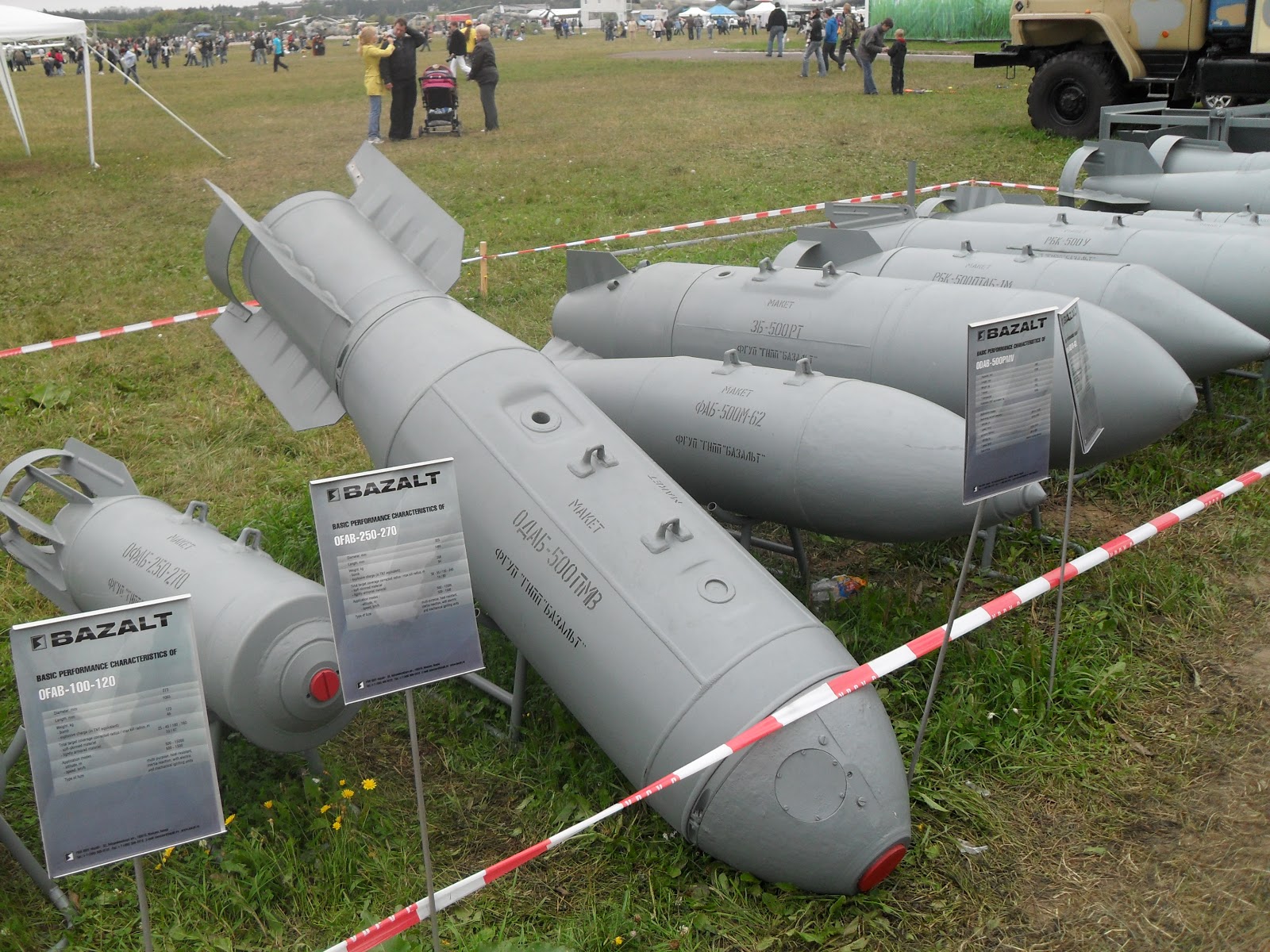
The top of the bomb is a less commonly seen weapon an ODAB, which I've written about before here. There's not many examples of the ODAB where the nose cone is with the rest of the bomb, this being one of them, but if you compare the following two pictures of ODAB variants to the nose cone in the Franken-bomb video you get an idea of what they look like
So what are we seeing? Some DIY hybrid dropped by the Syrian Air Force? That seems unlikely, as while this bomb has a nose cone and tail it's missing the all important payload, which makes it only really effective if it lands on top of someone and crushes them to death. What's more likely is the men in the video have mis-identified two pieces from different bombs as belonging to the same weapon, and inadvertently created the Franken-bomb we see above.
In the last couple of weeks there's been much written about the Syrian military's latest escalation, the use of cluster bombs, but at the same time the Syrian armed opposition* appears to have been having an escalation of their own. Aside from increased sightings and the apparent use of SA-7 surface to air missiles by the armed opposition, as reported by CJ Chivers in the New York Times At War Blog, there's also been a sudden increase in videos showing two other kinds of weapons being used.
Type 63 multiple rocket launcher
In recent weeks a number of videos have been posted from locations across Syria, including Hama, Rastan, Idlib, and Lattakia, showing truck mounted Type 63 multiple rocket launchers being used by the armed opposition. Type 63s are generally towed rocket launcher, firing 107mm rockets, manufactured in China, but licensed for manufacture in a number of other countries, including Iran and Turkey. With a range of 8km it would be one of the longest range weapons in the armed opposition's armoury, and the below video from 7:20 shows an example of the launchers being captured by the armed opposition
9K115-2 Metis-M
The 9K115-2 Metis-M (NATO reporting name AT-13 Saxhorn-2) is a Russian anti-tank missile system, with a 2km and SACLOS wire guided targeting system. While the system has been spotted on very rare occasion before in Syria, notably an air base attack in March 2012, it appears in the last two weeks there's been a sudden increase in videos showing the systems, for example this video and this video from Idlib, and the below example from Hama, showing the missile being fired, and apparently hitting it's target
The Syrian Army's vehicle's wouldn't stand much of a chance against these system, especially with their range compared to the RPG rockets they are used to going up against, so if their use becomes widespread it seems likely the Syrian Army will face a great number of tank loses.
* Personally I prefer the term Syrian armed opposition as it covers all armed groups, and I feel the term "FSA" is now rather inaccurate as some armed groups in Syria aren't part of the actual Free Syrian Army, and "rebels" wouldn't accurately reflect the presence of foreign fighters, many of which are Jihadists, in Syria.
In an article in today's New York Times a reference was made to claims on Syrian State TV that Turkish fighters were involved in fighting in Tremseh, site of a recent alleged massacre
State television also broadcast pictures of a roomful of weapons that it said had been captured from the town, the inventory mostly underscoring just what a crude and simple arsenal the opposition uses. It included 54 guns, 9 rocket-propelled grenade launchers, 5,000 cartridges, 25 satellite telephones and 24 mortars, the latter looking as if they had been welded by hand.
The broadcast also showed the identification card of what it said was a Turkish fighter in the group, and a captured man named Abdelsalem Darwish said there had been a Turkish fighter and some Libyans there, as well as money and arms from Turkey.
Activist THE_47th posted a screenshot of the ID card as it was shown on Syrian State TV
Now the card has a few features that suggest the individual isn't Turkish. First the name isn't a typically Turkish name, and Hama is mentioned on the card, which would make sense as the name at the top, Islahiye, is the location of a major Syrian refugee camp. It also happens to look nothing like a Turkish ID card, for example (source)
Over the past several months of the Syrian conflict there's been a great deal of evidence posted online and recently confirmed by the UN that helicopters have been used to attack opposition areas. What's been unclear is exactly the range of weapons being used against opposition areas, with rocket and machine gun fire being the most common. Two videos posted yesterday (highlighted by markito0171) indicate that as well as rockets and machine gun fire the Syrian air force is using unguided bombs
The cameraman claims these videos were filmed on June 27th in the Jabal Shehshebo region in the Hama countryside. In the first video he says they were fired by helicopters, but in the second uses a more general term for aircraft. It's of course impossible to verify any of these claims, so let's examine what we can see in the video. I believe what we are seeing in these videos are OFAB 250-270 High Explosive Fragmentation Bombs, and I've come to the conclusions by identifying a number of characteristics which I believe collectively are unique to that specific model of bomb. First, taken from here, a picture of (from left to right) of a P-50T training bomb, an OFAB-100-120, and an OFAB-250-270
To begin with CJ Chivers noted the configuration of the lug holes on the bomb casing. This led me to examine them more closely, and in the below picture I've marked the lug holes you can see on the badly damaged bomb in the first video, the two red circled lug holes being on one side of the casing, visible on the above picture, and the single lug hole on the other side of the casing (as pictured here) circled in green, but not visible in the above picture
Other bombs in the range with two lug holes on one side are much larger, and don't share the very specific tail fin configuration on the OFAB-250-270.
In the above picture I've marked the tail fins in red and yellow boxes. The red fins overlap go outside the outer edge, while the yellow fins stay inside the outer edge. This same configuration can be seen clearly on this picture (taken from here), as well as the grooves stamped along the length of each fin
They also share the two concentric rings at the end of the tail fin, and if you examine this wide selection of bomb photographs you can see that the combination of the tail fin pattern, number and position of lug, and the concentric rings at the end of the tail fin strongly indicates the bombs are OFAB 250-270 High Explosive Fragmentation Bombs. Add to that the cameraman estimating the bombs are about 50cm across, roughly the same as the OFAB 250-270 it seems that it's a pretty strong contender. While widely used on Russian made jets these bombs are also dropped by Hind helicopters, the below picture showing an example of a similar model in use (taken from here)
So there's a number of questions that need answering; where exactly were the bombs dropped? It seems clear they weren't dropped near any buildings, which may support Austin Tice's report that some of the pilots are purposely avoiding hitting targets, or flying to high to be effective
The tactics employed by helicopters observed in the past few weeks are a case in point.
Identified from photographs by an experienced American attack helicopter pilot as Russian-made MI-17s, which are designed both for transporting troops and cargo and for use as an attack aircraft, the helicopters typically fly in slow circles at altitudes between 1,500 and 2,000 feet. They fire unguided rockets and guns at apparently random or nonexistent targets and do not appear to employ guided missiles.
It's also interesting that the bombs appear to be in pretty good condition for high explosive fragmentation bombs. Are they both duds? One bomb even appears to be hollow, so could they be some sort of modified practice bombs? There's many more questions that remain, and I'll be on the look out for more evidence of unguided bombs being used by the Syrian Air Force.
Update June 28th This video has been sent to me by @sherbalkis which supposedly shows the area hit shortly after impact
As you can see the bomb appears to have landed nowhere near any structures, which may suggest pilot error or a purposeful attempt to miss any targets.
Update July 1st HamaEcho has sent me another video of the same kind of bomb, this time from Hawaijeh, Hama
Even though the bomb is badly damage it clearly shows the tail fins which match the OFAB 250-270, and like the bomb dropped above it was apparently dropped in a wide open space. So yet again the question is was that done on purpose?
Update July 6th A new video from Dier Ez Zor has been posted, showing a fully intact OFAB 250-270 that appears to have crashed through a roof and landed without detonating. What's very interesting about this video is it shows various markings on the bomb, and if anyone knows what they mean I'd be very grateful if you let me know
Updated July 17th The following video is from Talbiseh, and may show a OFAB actually being dropped by a helicopter
Update July 30th This video has been posted showing a helicopter in Daraa dropping what appears to be two OFABs
Update August 2nd This video from a suburb of Damascus was sent to me by HamaEcho and shows a small OFAB 100-120 bomb, identifiable by it's 4 tail fins, and the first example I've seen of this size bomb being used
Update August 2nd Two more videos have been posted to the above channel. The first shows the OFAB after it's been moved, which is extremely dangerous and should never be attempted with UXO
I believe this next video might actually show the remains of a OFAB that detonated
A third video from Homs countryside has also been posted, showing another OFAB 100-120
Note - This replaces an earlier article that misidentified the bombs as only being dropped by jets. You can contact the author on Twitter @brown_moses or by email at brownmoses@gmail.com
As many of you no doubt are aware Russia Today, the English language government funded global news channel, has taken a rather strong stance against the Syrian opposition, and it here's a couple of examples of that stance that edge towards propaganda, or just bad journalism.
In this first article Russia Today claimed, before changing the article
Footage showing the results of an alleged massacre in the Syrian city of Hama in April has been obtained by RT. In the video, family members claim opposition rebels committed the atrocity.
The original text can be seen here, and on other similar sites. Having no doubt watched the actual video they posted online they've now changed the text to this
Footage showing the results of an alleged massacre in the Syrian city of Hama in April has been obtained by RT. Sources say that opposition rebels committed the atrocity.
But still leaving the original text on the Russia Today Youtube page for the video. So some kudos to them for correcting their mistake, even if it does undermine the main source of the claims made in the article, leaving them to unnamed mysterious "sources".
Shocking images have surfaced, revealing the alleged desecration of Christian churches in Syria by Western-backed rebels. The pictures, taken by local Christians outraged at the violence, were published by PrisonPlanet.com.
In one of the photos a man who is said to be a member of the Free Syrian Army poses in a stolen priest’s robe while brandishing a looted cross in one hand and a machine gun in the other. The photos were taken by a Christian woman in Homs, one of the cities most devastated by continued violent clashes between rebels and government forces.
“Everyone knows simply removing these garments from the church is a sin. The priest is the only one who wears them. They even pray before putting them on,” the woman told PrisonPlanet.com.
She added that after the rebels tore the church apart, they went inside to document their violence.
Images show church pews broken apart, with pieces strewn all over the nave. The floor is covered with rubble, and even the altar looks like it has been desecrated.
There's also a watermark across the photograph that says in Arabic "Lens Young Homsi", in case there's any doubt. As for the other accusations of the rebels tearing the church apart, this video from inside the church filmed by activists appears to show a hole in the roof from shelling
So it appears that copying posts from conspiracy websites like Prison Planet doesn't really do much for your journalistic credibility.
Back in February TIME magazine visited a bomb makers workshop in Syria, highlighting what would appear to be the beginnings of a shift in tactics by FSA groups around Idlib to guerrilla warfare rather than direct confrontation with Assad's forces. A more recent LA Times article also visited a bomb makers near Idlib:
The rebels have been using homemade bombs for months, but they have begun to depend on them even more in the last month as the government has turned its attention to regaining control here in Idlib, a rebellious northwestern province bordering Turkey, after months of gradual progress on the part of the rebels.
I've noted on Youtube there's been a big increase in the number of IED videos being posted from Idlib in the past month, here's a selection of videos I've found showing IEDs being used to attack Assad's forces:
Khan Sheikhoun, Idlib 09/03/12
As is common in many of the videos from Idlib a BMP is being targeted by the IED.
Jericho, Idlib 11/03/12
It's hard to make out if this is a BMP or tank because of the grain of the video.
Jericho, Idlib 11/03/12
This video clearly shows a tank passing first before the BMP is hit by the IED, something that's shown repeatedly in these IED videos.
Idlib 14/03/12
This video shows what I believe to be a T72 tank being hit by an IED, but with it's underside armour it's questionable how effective this would have been.
Idlib 15/03/12
Again, this video shows a BMP being targeted, a much easier target to disable or destroy without shaped charges.
Idlib 15/03/12
Another video where a tank is allowed to pass before the BMP is hit with the IED, strongly suggesting this is a tactic repeatedly used in Idlib by the FSA.
More recently two videos from Hama have emerged showing the use of IED against even softer targets. In this first video from 22/03/12 a small IED is used to attack a foot patrol (graphic)
And in this video from 28/03/12 an IED is used to attack what's claimed to be a white security van
It'll be interesting to see more videos coming from Hama to see if it has the same pattern of attacks against softer targets. Idlib certaintly seems focused on attacking BMPs, and it could just be that there's less BMPs to attack near Hama, or they prefer hitting much lighter targets.
Finally, one video appeared in the last couple of days from Dael, Daera, dated 29/03/12 showing a BMP being attacked
I'll certaintly be keeping an eye out for more IED attack videos as they certaintly indicate a shift in tactics by the various FSA affiliated groups, and the more recent videos from outside Idlib seems to indicate it's something that's spreading across the country.
If any of you have videos of IEDs being used at any point in the conflict please post them in the comments below, it would be especially interesting if they were from much earlier in the conflict, or areas where there's no evidence of IEDs being used as of yet. I'm also relying on Google Translate for informaiton on the videos, so if I've put anything inaccurate or you have more information on the videos let me know and I'll update the post accordingly.