Today the following video was posted online by the Syrian Islamic Front
The video shows a brief statement on what the video shows, followed by the confession of one of the men involved
0:08 unnamed man: An Assad’s criminal gang was caught in Idlib. It was sent by the Militrary Security Branch (one of Assad’s various security apparatuses) and was planning to set a number of car bombs in the liberated areas in northern Idlib. They were taken to the Sharia Court. The car bombs were to be put near mosques. The truck bomb was detonated in a remote area.
0:15 I am Alaa’ Muhammed al-Basha (علاء محمد الباشا) from the town of Binnish (بنش). The Military Security Branch in Idilib tempted us by money and gave each one of us SYP 100.000 to park a Kia truck bomb near a mosque in al-Dana (الدانة). The truck was loaded with more than three tons of explosives. (He mentions the same number on the plate of the truck)
0:51 the cameraman explains how the
explosives were hidden in a box made of metal plates and that the
truck looks empty. 2:10 he shows the fuse 2:35 the truck bomb will be detonated
because it was too difficult to defuse the bomb.
This incident follows another reported series of arrests in the town of Morek (مورك) near Hama on September 24th where it was claimed three men were arrested planting the following devices in an attempt to kill opposition commanders (source)
The use of IEDs by the Syrian army seems to have become increasingly widespread in the past year, with a number of examples being posted online (see here), and it's not the first time a car bomb has been allegedly used to target a mosque, with this example from July 2012. As always, it should be made clear it's difficult to independently verify the claims made the the opposition in these circumstances.
Earlier this week I wrote about two photographs I had been sent by a journalist working in Syria who had been hunting for the gas grenades linked to two alleged chemical weapon attacks in Sheikh Maqsoud, Aleppo, and Saraqeb, Idlib. I've now spoken to the journalist, Alfred Hackensberger, who recently wrote about his investigation in Syria for Die Welt, and provided me with more details of his investigation. I began by asking which areas of Syria he visited
Alfred Hackensberger - We (my photographer Victor Breiner and I) went to Aleppo and visited the area around the city, including some front lines, like Kafra Hamra (close to the Shia villages of Nuba and Zahra) and Assafireh, where rebels were besieging a military complex with chemical and ammunition materials inside.
When we were driving around meeting rebels and their commanders we showed them a picture of the grenade used in alleged chemical attacks. At beginning, nobody recognized them and we thought we are at a dead end. But later, we found two rebels at front line position in Assafireh who immediately recognized them. They were sure of seeing them on rebels, but didn't remember if the were from Liwa Tawhid or al-Nusra. But anyway, they said this were smoke grenades, not chemical grenades. Later in Aleppo we found two more men who said same thing.
At the al-Nusra Base fighters recognised the grenade immediately, and showed grenades of same type or series. They said: "All are smoke grenades, and we got them from Syrian Army depots." Again, they pointed out that their grenades are not "chemical weapon" grenades. Regarding whether or not they used them in combat, they didn't mention, or didn't want to mention anything.
To my understanding, nobody we were talking to was aware that these kind of grenades were used in the alleged chemical attacks in Saraqeb or Sheikh Maqsoud. We had to explain to them, that these ones were used. I mean they really didn't know anything about them.
After their statement that they got them from Syrian Army, we were looking for former officers, soldiers who might recognise them. It took a couple of days asking and, again, showing around the picture of the grenade to former soldiers till we found one who had seen it.
It was a rebel fighter, who goes back and forth to the Turkish border to organise weapon transports. He said, that he saw these grenades (the original one from Saraqeb and Maqsoud) during his military service over one year ago in Daraa (before he defected). An elite force, supposedly from the 4th Division, was training with these grenades. His officer told him that the grenades were delivered by Iran and would contain, beside smoke, a certain nerve relaxant, to calm protesters down. The former soldier also said that these grenades were not used at that time.
----------
Some very interesting details there, especially when you consider these are the only munitions that appear to be linked to the Saraqeb attack, which I've examined in great detail here.
In the coming days I'll be posting a series of interviews from a number of chemical weapon experts, discussing the finer points of sarin, the attack in Saraqeb, where the US claims sarin was used, and the attack in Khan al-Assal, where Russia claims sarin was used.
A few weeks ago I was sent the following photographs by a journalist investigating the white gas grenades I've previously linked to two alleged chemical weapon attacks in Saraqeb, Idlib, and Sheikh Maqsoud, Aleppo
These photographs, taken at a Jabhat al-Nusra base in Aleppo, and shows a type of grenade which was described to the journalist as smoke grenades. What's very interesting about these grenades is they appear to have exactly the same fuze as the gas grenades recovered from the attacks in Saraqeb and Sheikh Maqsoud, as well as appearing to be made from the same type of material. The following image shows the fuze for both types side by side
I'll be talking to the journalist who sent me these photographs in the coming days, who has been on the trail of these grenades in Syria over the past weeks, and has come up with some interesting information on them.
Recently I've been writing about items recovered from the scenes of two alleged chemical attacks in Sheikh Maqsoud, Aleppo and Saraqeb, Idlib, which appear to link the two attacks. These containers shown, below in photographs from Sheikh Maqsoud and videos from Saraqeb appear to be an as yet unidentified gas grenade
I've now been sent the following photograph from Jeffry Ruigendijk, which is a cropped image of a Jabhat al-Nusra fighter in the Serekaniye/Ras al Ayn region of Syria (Update higher resolution images can be now found here)
Here's a close up of the grenade
You'll note it shares the features of the items recovered in Sheikh Maqsoud and Saraqeb, including the offset holes on the body of the grenade, the distinctive ridge, and a matching fuze. It's worth noting in the Sheikh Maqsoud photograph the fly-off levers have been attached back-to-front, causing them to stand out more than they should, instead of flush with the fuze.
So, what does this tell us about the device? It seems clear now that the devices used are some sort of gas grenade, and it seems unlikely sarin and other deadly chemical weapons would make an appropriate fill for a hand thrown weapon, but it's still unclear exactly what this grenade contains. As yet there's been no positive ID on the specific type of grenade, and Richard Engel of NBC claimed it could possibly be an Indian crowd control grenade after a visit to Saraqeb, without providing the specific type, so I think that's a bit of a shaky conclusion.
However, it does seem increasingly clear that the attacks in Sheikh Maqsoud and Saraqeb may not have involved the more powerful chemical weapons such as sarin or VX, but possibly some sort of as yet unidentified crowd control substance, which in the right circumstances can prove to be deadly.
I should start this post by saying that in the past I've found much of what's been posted on Global Research to be far to conspiratorial for my liking, and in many cases just plain nonsense (for example this piece), so when I say this piece is a good round up of reports of chemical weapon use in Syria, it's not something I say lightly.
As this post is a partly response to the article Was the Syria Chemical Weapons Probe “Torpedoed” by the West?, it's best to start giving that a read. While I may not agree with some of the conclusion the article draws, particularly the last paragraph before the postscript, it's a good summary of many of the reports on chemical weapon use in Syria. However, there's a few points I'd like to comment and expand on in relation to three attacks I've written about on this blog in the past.
Khan Al-Assal
The author takes a look at many of the claims surrounding this attack, and one thing I'd like to focus on the claims of the government written about by Alex Thomson of Channel 4 News
Syria believes the chemical involved was a relatively small amount of chlorine gas, namely CL17 which was dissolved into saline solution in a home-made rocket. Two separate military sources have confirmed to Channel 4 News that it was a rocket and not a shell.
Syrian sources say the missile was fired from an area close to Al-Bab which they say has been in the control of the Islamist group Al-Nusra Front for some time and that it hit a military checkpoint on the edge of Khan al-Assal to the west of Aleppo.
So note the following characteristics
- A "relatively small amount of chlorine gas" which was "dissolved into saline solution".
- A "home-made rocket"
- Fired from an area "close to Al-Bab" hitting "a military checkpoint on the edge of Khan al-Assal to the west of Aleppo", distance of around 47km.
It's also worth noting the causalities, with various reports put the number killed as around 25-30, with dozens injured, as well as reports of the smell of chlorine at the scene of the attack.
The reports of chlorine being used in the attack have led a number of people to draw a connection between that and the capture of a chlorine-gas manufacturing plant near Aleppo which is now reportedly under the control of Jabhat al-Nusra, and chlorine gas attacks by insurgents in Iraq from 2006 onwards.
My problem with that claim is if you look at the types of attacks in Iraq and the number of causalities that theory seems to fall apart. First consider that according to Alex Thomson's report the chlorine was dissolved into a saline solution carried by a homemade rocket. In Iraq chlorine tanks (and in some cases tankers) were loaded onto vehicles packed with explosives with many of the causalities coming from the initial explosion rather than exposure to chlorine gas. Very few of these attacks resulted in the same numbers of deaths and injuries as the Khan Al-Assal attack, so the question is whether or not it's reasonable that a single DIY rocket loaded with chlorine dissolved in saline could reasonably be expect to cause anywhere near the same amount of injuries as trucks laden with explosives and chlorine gas canisters.
There's also the question of the rocket used. The vast majority of DIY rockets I've seen in Syria look something like this:
These rockets have far too small a payload (around 13 pounds) and would have trouble reaching targets 4km away, let alone 47km. There have been far rarer videos of a larger DIY rocket, shown below
In the video it's claimed the rocket can reach 60km away, but I would always take these sorts of claims coming from the opposition with a pinch of salt, especially when you consider the range of other similarly sized rockets, which are helpfully listed here. You would have to believe this DIY rocket had a comparable range to larger professionally manufactured rockets for it to reach Khan Al-Assal from Al-Bab, as well as the rocket being able to deliver enough saline dissolved chlorine using an unknown dispersal method to cause the causalities reported. I'd also have to ask how the government knew the chlorine has been dissolved in a saline solution.
Another thing to note is that if a DIY rocket was used, and it was carrying a warhead containing saline dissolved chlorine rather than explosives you'd expect there would be some sort of remains that could have been recovered from the scene of the attack, yet there's never been any images of that. As far as I'm aware there's also been very few, if any, images from the scene of the attack, and considering how quickly Syrian State TV appears on the scene after many of these attacks it seems odd there's never been any footage produce from the scene in this instance (although I'd be happily proven wrong in that regard).
Now this isn't to say I'm 100% certain chlorine was or wasn't used, but just to highlight a number of key questions and problems if that's the final story from the government. If the government had said this was a vehicle loaded with chlorine that was detonated in Khan Al-Assal then I'd have a much easier time believing their story, but I just don't think a DIY rocket with a saline dissolved chlorine warhead fired from 47km away is a reasonable explanation for the number of causalities seen.
Sheikh Maqsoud and Saraqeb
I've touched on this subject in a previous post, highlighting the links between the two attacks, but I'd like to look at it in more detail, and examine what has been said about both attacks.
Aleppo province: Two children aged 1 and 2 years old were martyred and a woman was killed by wounds. They were killed by 2 bombs dropped by a military helicopter on their house in the al-Sheikh Maqsoud neighbourhood, based on activists from the neighbourhood. The casualties' neighbours reported to the Syrian Observatory that they heard a helicopter at dawn and later heard two explosions, after heading to the house they found some of the residents unconscious and others killed. 16 were wounded by poisonous gases and were transported to the A'frin city, medical sources reported that those injured suffered hallucinations, severe vomiting, nose bleeding and eye burning, one of which lost eye sight. The Syrian Observatory calls upon the United Nations and the Red Cross to immediately send committees for treating the injuries and discovering the nature of the gases, that has been reportedly used in al-Sheikh Maqsoud neighbourhood.
After completing his prayers around 1 a.m. on April 13, Yasser fell asleep with his wife, two young children, and sister, who all shared a bed in a modest home in Sheikh Maqsood, the Kurdish-majority frontline neighborhood in Aleppo.
“I heard something explode on the roof. I thought it was a shell and called my brother for help,” he said. His eldest son, one and a half years old, started mumbling and was soon hyperventilating.
The baby, only four months old, was also struggling. “I knew then that there were chemicals in the air and I told everyone to get out. I screamed for help and saw my neighbors come in,” Yasser said, recounting the horror he experienced while recuperating at a hospital in Afrin, a town north of Aleppo.
Patients exhibited hyper-salivation, increased secretions, eye pain, muscle spasms and seizures, and loss of consciousness, Dr. Hassan said. Volunteers who helped rescue Yasser’s family and medical staff who came in contact with the victims all exhibited the same symptoms.
Unusually items were recovered from the scene of the attack and photographed
The victims of the attack were also filmed
The second video was part of a report by the Times which left CBRNe World (a respected magazine providing "those tasked with defending against CBRN and IED threats with the essential practical, scientific and political information") unimpressed
The Times newspaper broke the story with grand words about their ‘investigation’ by Anthony Loyd. It takes a brave journalist to work in a warzone, but last time we checked Mr Loyd is neither a doctor or an expert on chemical attacks. Other than a building hit by a munition, he was mainly shown video footage of the medical aftermath- which he (and others) have decided is convincing because it has people frothing at the mouth. The other ‘key evidence’ is that Doctors have said they used atropine and it had an immediate effect.
So why are we so skeptical? Well let’s start with the foaming. Its incredibly bright white and even compared to the discoloured, flecked and bubbled nature one more usually associates with mouth foaming. Its also the first time I have seen the word ‘foaming’ used as a symptom. Salivation, drooling yes but not foaming. A cursory check of CDC, NLM, or indeed any of a range of good medical sources would have backed this up. Even comparison with the victims of Tokyo.
What can we infer from the ‘evidence’? Nothing. No bodies, no medical evidence, no pictures made public of the ‘canister’ and no explanation for such an unusual and frankly ineffectual use of chemical agent. As for responding to atropine quickly - anyone given atropine reacts quickly! Heart rates will slow, sweating reduce or stop, jitters and shaking will be calmed. Its effectiveness at this doesn’t mean the person was exposed to nerve agents. The description of the attack is unusual, both the level of physical damage (a torn plastic awning) and the description of its functioning.
Could it be real - possibly. Could it be misdiagnosed and something other than sarin - possibly, could it be a fake - possibly. Has it advanced our understanding or confidence - not a single iota.
Now let's look at the attack in Saraqeb on April 29th. In this attack a number of videos were posted showing the victims of the attack, as well as the video that begins with what's claimed to be an item dropped from a helicopter falling through the skies
What's very interesting is the item shown in the following two videos, which is claimed to be the weapon used in the attack
As I detailed in my earlier post this is an exact match for one of the two items recovered from the scene of the earlier Sheikh Maqsoud attack, and having spent a lot of time investigating what these items are I believe they are almost certainly some sort of gas grenade. I believe in the following photograph they've attempt to reassemble the top of the grenade with the fly-off lever, but have actually put the lever on back-to-front
It seems incredibly unlikely sarin gas, or any lethal chemical weapon, would be delivered from a helicopter inside a gas grenade. That leaves two questions, what type of grenade is this, and what was inside it? Despite asking multiple experts in various related fields, those two answers have elluded us, so if anyone is able to answer those questions it might bring some clarity to the issue of chemical weapon use in Syria.
I'd also like to say to anyone who plans to investigate this container that it's about getting a perfect match, not something that "looks a bit like it". I've seen plenty of those, and that's the problem, it's the perfect match that's alluding us.
Today there's been fresh reports of an alleged chemical attack on the town of Saraqeb, Idlib, with photographs and videos from the scene posted online
One thing that stood out was this image, of one of devices supposedly used to deliver the chemical
What stands out about this is it appears to be a very strong match to the remnants of devices that were supposedly used in an earlier attack in Sheikh Maghsoud, Aleppo, for example
Note the large ridge, and these two features
Also note the top of the item in the Saraqeb images, and this image
There's also been a video posted online showing what is supposedly the attack occurring, and this does not appear to match to any form of attack I've seen in Syria before, and looks very much like something falling through the sky producing smoke/gas (h/t James Miller of EA Worldview)
This leads me to believe the same devices and chemical were used in both attacks, but as yet it's unclear what the chemical and device is.
Update April 29th 2013 Something else that links the two attacks is the description of the earlier attack, via Mohammed Aly Sergie
Some survivors said the canisters were dropped from a helicopter, but others didn't hear rotors. Doctors don't know what the chemicals were
Update April 29th 2013 Another video has been uploaded showing the victims, and a much clearer shot of the device used
This extra detail on this video seems to prove that the devices used in both attacks were identical.
Update April 30th 2013 Thanks to Anita McNaught of Al Jazeera English for sending me this new video show the canister much more clearly
The following video from Idlib was posted online today, and shows a new type of cluster bomblet not yet seen in the conflict
With the help of Peter Bouckaert and Mark Hiznay of Human Rights Watch we've been able to identify this as a ShOAB-0.5 bomblet (a copy of the US BLU-26 bomblet), used with a RBK-500 cluster bomb dispenser, much larger than the RBK-250 cluster bomb dispensers used so far in the conflict. The following images show a complete bomblet, and a diagram of the bomblet
Compare the text on the bomblet in the above image to that on the bomblet in the video, shown below, and the match becomes clear
This is the first clear evidence of the larger RBK-500 cluster bomb dispenser being used in Syria, but there has been some evidence that they may have been used earlier. This image was posted online at the start of February
This is a nose fairing for a number of bombs, including the ZAB-500 incendiary bomb and various types of RBK-500 cluster bomb dispenser. Although this video filmed in the same area and on the same date as the above photograph showing a damaged tail fin surrounded by burning bomblets pointed me in the direction of it being a RBK-500 ZAB incendiary cluster bomb I wasn't 100% certain of a match. While that question remains open the ShOAB-0.5 bomblet seems to strongly indicate RBK-500 series cluster bombs are now in use in Syria, demonstrating yet another escalation in the Syrian air war.
Meet the Amr bin ma'ad Yakrib al-Zubaydi Brigade, based around Jisr Al Shughoor, Idlib
Note both the presence of the Free Syrian Army logo, and a version of the Islamic State of Iraq flag modified to include the name of the brigade, taken from the name of one of Mohammad's companions, itself not too unusual. They've operated in the region for several months, and yesterday this video was posted online, from the village of Zarzur
At around 1:15 we see the mosque (marked here) has been set alight, and among the commotion someone says "destroying the dens of the Rejectionists (a term for derogatory of Shiites) and the Shabbiha" and "God is great, all glory to God. The banner of Islam is being raised [over the mosque]", and later flags being burnt.
We also see graffiti that reads "No, 1,001 times to Sectarian strife!", which in the circumstances seems unlikely to have been written by the men in the video
So is this a sign of sectarian violence rearing it's ugly head in Syria? Other motivations for burning the mosque appear unclear, and as the group involved associates itself with the Islamic State of Iraq, an organisation that "aims to establish a caliphate in the Sunni dominated regions of Iraq", it seems there's a strong possibility of sectarianism playing a significant part of the events shown in the video.
Many thanks to Michael Nahum for his translation work on this video.
I'm often sent videos and pictures with requests to identify the weapons shown, and one I've been seeing a lot of in the last 24 hours is this video from Qalaat al Mudeeq, near Hama
This screenshot gives you a full view of the weapon
The men in the video seem a bit confused about what dropped this, one claiming a MiG, the other a helicopter, but it's likely they are both right, as what we're seeing here is the remains of two totally different bombs.
The bottom half clearly belongs to a RBK series cluster bomb, used widely in that region, an example of which can be see here. Note the number of tail fins which extend beyond the metal ring at the end of the bomb
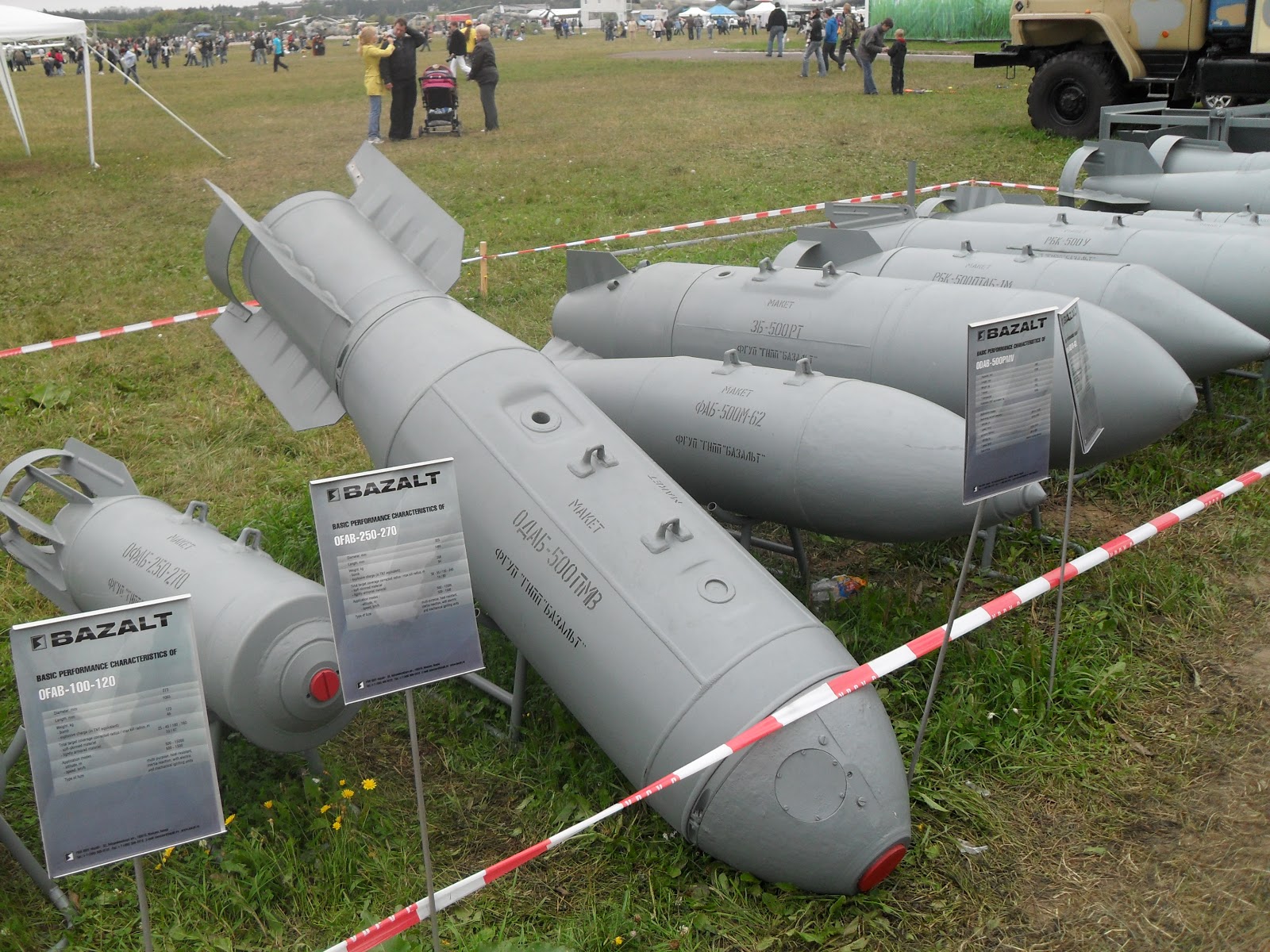
The top of the bomb is a less commonly seen weapon an ODAB, which I've written about before here. There's not many examples of the ODAB where the nose cone is with the rest of the bomb, this being one of them, but if you compare the following two pictures of ODAB variants to the nose cone in the Franken-bomb video you get an idea of what they look like
So what are we seeing? Some DIY hybrid dropped by the Syrian Air Force? That seems unlikely, as while this bomb has a nose cone and tail it's missing the all important payload, which makes it only really effective if it lands on top of someone and crushes them to death. What's more likely is the men in the video have mis-identified two pieces from different bombs as belonging to the same weapon, and inadvertently created the Franken-bomb we see above.
Due to the large quantity of cluster bomb videos coming out of Syria at the moment it's not really reasonable to post endless videos of cluster bomb tail fins sticking out the ground, so I've selected some of the more interesting and unusual videos posted in the last week.
In this first video from Al Hivounah, Douma we see an excellent example of clearly marked cluster bomblets
This video from Maarrat al-Numan, Idlib shows the holes left by detonated cluster bomblets alongside bomblets that have become embedded in the ground after failing to detonate
Here we see the shrapnel left behind from exploded cluster bomblets in Kafr Tahari-m, Idlib
In this video from East Bweyda, Homs we see a cluster bomb canister's ejection rod causing difficulties for the people trying to remove it from the ground
In Alth, Idlib, this unusual video shows a cluster bomb canister tail lodged in the roof of a nearby building
The next two videos from East Bweyda, Homs, and Maarrat al-Numan, Idlib, claim to show civilians injured as result of cluster bomb attacks, but it's extremely difficult to verify the accuracy of the those claims
Human Rights Watch has put out a new report with more details of cluster bombs used in Syria in the two weeks since their last report. I've been providing them with videos of cluster bombs during that time, and I would like to thank all of you who sent me links to videos for your help with gathering all the videos of cluster bombs in Syria. I'm fairly confident the vast majority of videos (if not all) of cluster bombs in Syria were gathered together for this, along with many photographs. More videos, photos, and images can be found on the HRW site, as well as this video explaining the details of the report
In the last couple of weeks there's been much written about the Syrian military's latest escalation, the use of cluster bombs, but at the same time the Syrian armed opposition* appears to have been having an escalation of their own. Aside from increased sightings and the apparent use of SA-7 surface to air missiles by the armed opposition, as reported by CJ Chivers in the New York Times At War Blog, there's also been a sudden increase in videos showing two other kinds of weapons being used.
Type 63 multiple rocket launcher
In recent weeks a number of videos have been posted from locations across Syria, including Hama, Rastan, Idlib, and Lattakia, showing truck mounted Type 63 multiple rocket launchers being used by the armed opposition. Type 63s are generally towed rocket launcher, firing 107mm rockets, manufactured in China, but licensed for manufacture in a number of other countries, including Iran and Turkey. With a range of 8km it would be one of the longest range weapons in the armed opposition's armoury, and the below video from 7:20 shows an example of the launchers being captured by the armed opposition
9K115-2 Metis-M
The 9K115-2 Metis-M (NATO reporting name AT-13 Saxhorn-2) is a Russian anti-tank missile system, with a 2km and SACLOS wire guided targeting system. While the system has been spotted on very rare occasion before in Syria, notably an air base attack in March 2012, it appears in the last two weeks there's been a sudden increase in videos showing the systems, for example this video and this video from Idlib, and the below example from Hama, showing the missile being fired, and apparently hitting it's target
The Syrian Army's vehicle's wouldn't stand much of a chance against these system, especially with their range compared to the RPG rockets they are used to going up against, so if their use becomes widespread it seems likely the Syrian Army will face a great number of tank loses.
* Personally I prefer the term Syrian armed opposition as it covers all armed groups, and I feel the term "FSA" is now rather inaccurate as some armed groups in Syria aren't part of the actual Free Syrian Army, and "rebels" wouldn't accurately reflect the presence of foreign fighters, many of which are Jihadists, in Syria.
To start with here's two pictures demonstrating extremely irresponsible behaviour with unexploded cluster bomblets, both showing AO1-Sch bomblets being held by children
On the opposite end of the UXO handling spectrum we have this video from al-Qusayr, Homs, showing PTAB 2.5m bomblets buried in the ground marked with circles of rocks as a warning to others, an effect unfortunately ruined by the handling of one of the bomblets at the end of the video
In Armanaz, Idlib, we have a series of videos, first two showing holes left by detonating bomblets, then one showing unexploded bomblets lodged in the ground, and finally one showing the tail end of a canister
In Maarrat al-Numan, Idlib, we have this photo of AO1-Sch bomblets, including the markings "55 107 77", which if I believe shows the factory it was manufactured in, the batch, and the year of manufacture, which is an interesting consideration when looking at these bomblets