Showing posts with label Youtube. Show all posts

Wednesday, 23 October 2013

The “Hizballah Execution Video”: Confirmation of Shia Militia Involvement

A guest post by Phillip Smyth of Jihadology.net.  Videos and images should be considered graphic.

Figure : Photo of those executed by Hizballah and posted to social media.

On October 8, 2013, the news website, NewLebanon.info released a video claiming to show members of Lebanon’s Iranian-backed Shia Islamist Hizballah, executing what appeared to be wounded men they pulled from the back of a van. The slain men were reported to be Syrians, possibly captured rebels.

The video caused controversy with the public and activists alike in Lebanon, Syria, the broader Middle East, and the West. Hizballah has been silent on the issue, but one spokesman said the organization would address the issue. Despite accusations Hizballah had pulled-off the killings, along with audio recordings demonstrating the executioners with Lebanese accents talking about Iranian Revolutionary religious concepts (an important underpinning for Hizballah’s ideology), there was still enough plausible deniability available for Hizballah and other Shia militia groups to argue they had no part in the killings.

Nevertheless, after analyzing Shia militia social media pages, I did come across the proverbial, “Picture worth a thousand words” in relation to the execution video: A photo featuring the same men who had been killed in the grainy execution video, were in fact the dead men in another photograph. This picture was uploaded to a prominent pro-Shia militia Facebook page which promotes the “Al-Muqawama al-Islamiyah” (“The Islamic Resistance”). This term regularly describes Iranian-backed Shia Islamist groups with militia apparatuses established in Iraq and Lebanon. It was also of a higher definition than the video recording. Adding to the photograph’s credibility was the fact that it was posted on October 1, 2013; Seven days before the video was released.

One of the dead men, the first to be dragged from the van in the video and wearing visible red boxer shorts is in the photograph. Another man, in a white T-shirt covered in blood, was summarily executed in the video. For the photo, he was placed in the pile of the other dead. The man in the striped sweater was taken out of the van at 0.48 and was then shot in the head twice. His destroyed cranium is easily spotted in the photograph and the video.

Figure : The man in the red boxer shorts. (video capture)
Figure : The black shirted man lying dead over the legs of the man in the red boxer shorts. (video capture)
Figure : The killed man in the white blood-stained T-shirt. (video capture)
Figure : The dead and executed men lying in the same position as the hi-res photo above. (video capture) 
When one follower of the page asked why such a graphic image needed to be posted, the admin responded, saying this would be the fate for anyone who wishes “to abuse Sayyida Zaynab”. Another outspoken member of other pro-Shia militia Facebook sites responded that the dead bodies were the result of, “self-defense”.

The admin for the page claims to be located in Tehran, Iran and the page he administers says it is based in Iraq. The administrator is also a prominent poster of graphics which promote the cause of Iraq’s Kata’ib Hizballah, Asa’ib Ahl al-Haq, Kata’ib Sayyid al-Shuhada, and Lebanese Hizballah—all Iranian-backed suppliers of foreign Shia fighters to Syria. These graphics have been widely circulated in these circles, suggesting a more formal link between the administrator and these organizations. 

After processing around eighty Facebook pages (posts from August 15th-October 23rd ) which promote pro-Shia militia in Syria material, only this Facebook page posted the photograph. When measured against more directly controlled Assad groups on social media, the same photo could not be found. Most interesting was the lack of any type of watermark which would demonstrate the photograph was taken from another website or source. 

However, photographs of the executed had circulated elsewhere prior to the release of the video and to this particular photograph posted on Shia militia social media. On September 23, 2013, the same dead men were part of a post placed online by Bousla.net. At that time, it was claimed they were part of the Salafi rebel organization, Liwa’a al-Islam, and were ambushed in the rural East Ghouta region outside of Damascus. Furthermore, it was reported in the article that elements of Liwa’a Zulfiqar, a Syrian based Shia militia whose fighters primarily come from the aforementioned groups in Iraq, and work in conjunction with Lebanese Hizballah, led the attack. Elsewhere, on LiveLeak, the pictures were republished and it was added that the executed individuals were, “near jordanan border the place where the cia saudi arabia and jordanian intelligence finance and train rebels [sic]”.  

Figure : Three of the photos published by Bousla.net which clearly showing the executed men in the video.
Most intriguing about the video and photo posts in news media (as opposed to social media), were the two sources to which this material was leaked. Both market themselves as “independent” Lebanese (as opposed to Iraqi, Iranian, Syrian, or other Arab outlets) news providers, have little original content, and do not have much of a share of an already packed Lebanese media market. Ironically, Bousla.net, the original poster of the images of those executed in the video, published a piece claiming the video was a fabrication and that Lebanese Hizballah had no role in the killings. Bousla.net also drew no connection between the original photos and the video.

Figure : The banner photograph for the Facebook page featuring the execution photo in question. The title reads, “Al Muqawama” (“The Resistance”). The logos for (left to right) Asa'ib Ahl al-Haq, Lebanese Hizballah, Kata'ib Hizballah, and Kata'ib Sayyid al-Shuhada are shown on the poster with the golden dome for the Sayyida Zaynab shrine in Damascus. Iranian Supreme Leader Ayatollah Khamenei is shown prominently in the left.  
The dates these photographs were posted, their higher resolution (when compared to the video), the source(s) which published the information, and the utilization of the same bodies, conclusively establish that a Shia Islamist militia—most likely involving Hizballah, was behind the killings. The publishing of the photographs and the leak of the video of the killings further symbolize a new and carefully coordinated social and traditional online media campaign to show Syria’s rebels that Iranian-backed groups will resort to brutal means to win in Syria. 

Monday, 14 October 2013

Hizballah Executing Syrian Prisoners? - Analyzing the Video

A guest post by Phillip Smyth of Jihadology.net.  Videos and images should be considered graphic.


Uploaded onto YouTube on October 8, 2013 was a 1 minute and 40 seconds long video claiming to show members of Lebanese Hizballah brutally executing, “wounded Syrians”.

The film was shocking for more than its sadistic contents. Accusations of Lebanese Hizballah carrying out massacres and executions have been part and parcel of the pro-Syrian rebel narrative for some time. Yet, despite claims of that variety and daily doses of ultra-violence pouring endlessly onto the web for the past two years from pro-rebel and anti-Assad sides of the spectrum; little, in terms of videotaped human rights violations by Hizballah or by their allied Syria-based Iraqi Shia militias, could be found online.

Owing in large part to these groups’ Iranian-proxy status and clear religiously-based order, the aforementioned Shia Islamist organizations function in a far more militarily professional manner. Additionally, Lebanese Hizballah and their Iranian-backed Iraqi cohorts, operate advanced messaging and propaganda initiatives. In turn, this has allowed for them to successfully present their narratives and images to a wide audience.

Furthermore, there has been some criticism regarding the veracity and authenticity of the video clip. In part this is due to claims that the audio for the clip could not be verified and may be taken from other sources.
Nevertheless, after close analysis, this clip may be the first substantial video evidence demonstrating Lebanese Hizballah and/or other Shia militia (primarily staffed by Iraqis) groups in Syria of conducting blatant human rights abuses.

This piece will attempt to go through the evidence presented in the video by assessing the main data-points and other factors which have been at play in Shia militia circles and details found in the video:
  • Uniforms, headbands, and ribbons worn by the fighters.
  • The Lebanese accent of the shooters and those speaking
  • The discussion of Iranian revolutionary concepts adopted by Hizballah.
  • Trends in Hizballah and among fellow Iranian-backed Shia Islamist groups for filming and photographing dead rebels.
  • Assessing where the video originated.
  • An increase in the posting of brutal images featuring dead rebels by Shia Islamist groups in Syria.
A Rough Transcript of the Film

With the traffic from short wave radios and the lack of visible speech by particular fighters, the task of writing a highly accurate transcription was made somewhat difficult. Additionally, I did not write what was being said during the radio transmissions. Regardless, this is what could be picked-up:

Fighter to other militants: “Move it! Move it! Move it!” *The fighters run around a van to the vehicle’s trunk.* (0.01-0.05)

*Radio traffic* (0.05-0.14)

A chant from off camera: “fi sabil Allah” (0.11)

*The fighters pull what appear to be wounded men, most likely Syrians, from the back of a van or minibus. There’s heavy radio traffic obscuring what the fighters are saying.* (0.12-0.30)

A fighter says: “Fi sabil Allah” (0.20-0.21)

*Three men are pulled from the back of the van.* (0.20.-0.35)

*One of the men is immediately shot.* (0.35-0.37)

*Another man is pulled from the van.* (0.37-0.54) 

A supposed militant says: “Bring him down.” (Meaning a man from the back of the van). (0.44)

A more hushed voice chimes in and says: “Hold on! Wait! Wait!” (0.53-0.54)

*This man is shot multiple times in the head.* (0.57-1.01) 

Screaming voice off camera: “O guys!” (1.01)

Another fighter’s voice: “Enough” (1.02)
Said by another person (possibly the cameraman or a fighter to another fighter. Even added to the video’s context it can be viewed as a compliment or as sarcasm): “You’re a tough one.” (1.05-1.06) (some have speculated that the accent used is Syrian, still this section of speech is not definitive enough to be deemed Syrian).

One of the fighters: “That one is mine…The killer of the martyr Yahiya is mine!” (Meaning the fighter had selected a person on the ground to shoot) (1.06-1.10)

Another fighter says: “I am *inaudible* on my own (1.10-1.12)

In the background another fighter says: “Hizballah” (1.10-12)

Another voice (possibly a fighter): “Why are you using this rhetoric?” (1.12-1.13)   
*What appears to be wounded a man is pulled from the back of the van.* (1.11-1.16) 

Another Militant: “O! For the martyr Yahiya!” (1.16-1.19)

*Inaudible speech in background* (1.16-19)

A clearer voice says: “Come, come.” (1.16-1.19)

*The fighter who pulled down the man kicks him and is stopped by another militant.* (1.16-1.20)

Fighter referred to as ‘Hajj’ (speaking Lebanese dialect): “Wait. Wait. We are performing our taklif and we are not seeking personal vengeance.” *This fighter goes off camera and another comes to the fore and shoots the man on the ground.* (1:23-1:36)

Another fighter off-screen says: "fine, fine, Hajj. fi sabil Allah.” (1.28)

Another militant: "No! The martyr Yahiya! No!” (1.29-1.35)

*A rifle is fired by a militant who comes into frame at the man writhing on the ground* (1.35-1.38)

Off-screen militant: “Move it [“yallah”, in Lebanese slang], let’s go." (1.38-1.40)

Criticism of the Clip


Found on some pro-Assad and pro-Hizballah websites was a piece criticizing the movie by Mr. Ahmed M. Yassin. In an interesting twist, the author blames the Syrian army and/or the National Defense Forces (a Syrian state-supported militia-style group trained by Iran and Hizballah). He also correctly states that the actions of those in the video would constitute a war crime.

Yassin starts out by saying the radio transmissions are taken from a clip involving Hizballah fighters in Qusayr and their headquarters in May, 2013. These clips were provided in the article. When compared, it is extremely hard to tell whether there is any credibility to this criticism. Additionally, if the radio traffic was faked, that would necessitate the other audio sections were also added later. Still, the author does not come to this conclusion. Plus, the audio tends to match with the actions seen in the film.

Yassin added to this by claiming the uniforms seen in the video do not match the type worn by Hizballah. According to the author, this was due to the green and brown colors not being as “dark” as some previously utilized by Hizballah. An example from the 2006 Hizballah-Israel War is offered as supporting evidence for this claim. Additionally, the author also claims that the pants are not the same as those Hizballah. However, rationally speaking, it’s not hard, nor is it unheard of fighters (in professional or paramilitary organizations) altering their uniforms. (See explanation covering uniforms used by Hizballah and other Shia militias below).

The piece also stated that “fi sabil Allah” would not be used by an ideologically educated Hizballah fighter in the context of “killing” (a term used during the film) for Allah. Only “fighting” in a justified and sanctioned war for Allah (see explanation below regarding this phrase). Though, this minor linguistic distinction appears to be more about splitting hairs, rather than establishing the statements made in the video as spurious.

Where Did the Video Come From?

The clip was first uploaded to a YouTube account belonging to a website called NewLebanon.info. This site appears to present itself as a more independent (as opposed to being tied to the main Shia parties, Hizballah or Harakat Amal) Shia-oriented news provider in Lebanon.

After the video was posted, NewLebanon.info published a piece defending its authenticity. In it, they argued that even if the audio was added later, defenders of Hizballah had no explanation for the material shown in the video. This form of defense also leaves holes for further criticism, particularly regarding the images presented in the video. Essentially, NewLebanon.info’s case rests on the assumption the fighters shown were Hizballah members. However, with the little information available, sans audio, it would be impossible to confirm whether the fighters were from Hizballah or not.  

The Ayatollah’s New Clothes
Some viewers of the video have come to the conclusion that the fighters shown in the clip must be Hizballah members due to the presence of yellow ribbons tied to their battle fatigues. While this sounds like an argument based on an odd piece of minutia, Syrian rebel groups, their supporters, and onlookers have repeatedly stated that yellow ribbons are a clear identity marker for Hizballah members in Syria. 

Additionally, one of the fighters in the video is wearing a green headband as he drags wounded and possibly dead bodies from the back of a van. This may be another sign he may belong to a Shia organization.
It is true that the variety of Shia militia groups backing the Assad regime have been photographed and recorded wearing plain headbands or those featuring religious slogans (most often, they are colored black, green, red, or yellow).

Additionally, there is quite a lot of history of yellow ribbon decorations symbolizing Khomeinist causes. In the early 90s, Iranian protesters would go to Mecca and protest the U.S. and Israel wearing their yellow ribbons and bands.

More recently, Hizballah fighters have also been recorded in Syria with yellow-ribbons tied to their uniforms. In Lebanon, the group used yellow-ribbon wearing street-toughs when intimating and attacking their Shia opposition. Members of the Iranian-backed Iraqi Shia groups, Asa’ib Ahl al-Haq and Kata’ib Sayyid al-Shuhada, often feature their fighters in Syria wearing these types of adornments. Liwa’a ‘Ammar Ibn Yasir (see videos marked: “LAIY Fighters With A Captured Rebel & Engaged In Combat” and “LAIY Fighters Record Syrian Rebels They Killed”), another Shia militia group formed primarily from Asa’ib Ahl al-Haq and Kata’ib Hizballah members, has also been filmed with their members wearing green headbands featuring Shia religious slogans and yellow ribbons.

The emphasis on these color combinations has roots which trace back to Hizballah’s official party colors, yellow and green, which are featured on the group’s flag (though, in most occasions, yellow is more normally associated with Hizballah). Green also finds its place into the color spectrum of Shia Islamists since it is the color of Islam and the Ahl al-Bayt (the descendants of the Prophet Muhammed to whom Shia pay special devotion).

While markers such as these serve as interesting circumstantial evidence pointing to Lebanese Hizballah involvement, they are hardly enough to establish that fighters from Hizballah or Iraqi Shia militia members were in the video. Shia militia groups operating in Syria and militias directly controlled by the regime of Bashar al-Assad have donned many different styles of colored ribbons as identity markers. Members of Liwa’a al-Imam al-Hasan, a primarily Iraqi Shia militia which operates in conjunction with Hizballah in Rif Dimashq, has been recorded wearing red and yellow ribbons. Assad’s own Ba’ath Party militia, Kata’ib al-Ba’ath and the National Defense Forces have also been shown wearing red (in an ironic twist, the video link actually has a Lebanese Hizballah song playing in the background) and yellow ribbons.

Ribbons and headbands aside, there is also the issue of the taped fighters’ uniforms. The pattern, appears to be modeled off of or an actual U.S. M81 Woodland Pattern Battle Dress Uniform (BDU). This uniform type is seen quite regularly on Lebanese Hizballah members and with other Shia militiamen operating in Syria. Additionally, Woodland Pattern types are widely available across the Middle East. Hizballah’s main backer, Iran, has even manufactured its own varieties. This style of uniform is also commonly worn by Hizballah and other Shia militias fighting in Syria.  

Figure : A Kata'ib Sayyid Shuhada member in a Woodland Pattern-style BDU (covered in dust) and with a headband featuring a Shia slogan ("Husayn ya aba al-shuhada"or “Husayn O father of the martyrs”)
Figure : Lebanese Hizballah’s Mahdi Yaghi. His death in Syria was announced on October 1, 2013. Note his woodland pattern-style uniform and the headband. 
Figure : A Hizballah figher who was kiilled in September during a fight in Ba'albek, Lebanon. He too wears the woodland pattern-type camouflage.
Khomeinism Rears Its Head

Throughout the clip, “In the path of Allah” (“fi sabil Allah”, also transliterated as, “fi sabillah”) is said a number of times, underlining a religious message from executioners. In the context of the video, the phrase is used as another religious justification for the killings. While this phrase is important for Sunni and Shia Muslims alike, particularly those waging jihad, it has a special place in Hizballah propaganda and in the party’s background. One of Hizballah’s earliest songs, “Ya Aba Abdillah”, repeats the phrase as part of the lyrics. When Hizballah’s “martyrs” have been announced, the slogan finds its way into online commemorations. As a long-arm for Iran’s Islamic Revolution, the group itself is also cast as following “in the path of Allah”. Thus, the “Party of Allah”, is presented as executing his will on earth.

One of the filmed Hizballah members pauses to state the goals of the executions and possible chide another fighter who kicked a prisoner. In a very clear Lebanese accent he states, “We are performing our taklif and we are not seeking personal vengeance”. The mention of performance of a taklif is one of the most important sections of the video demonstrating these fighters likely originated from Hizballah.

In a June USA Today article which covered Hizballah’s involvement in Syria, a Hizballah fighter noted, "Everyone who is sent to fight in Syria has received a 'Taklif Sharii'". USA Today added the taklif sharii is “a religious command that means he will go to heaven if killed.” Nevertheless, the taklif sharii is more than just a religious edict which guarantees a martyred fighter’s spot in heavenly paradise. It is a religious obligation put forth by a cleric and must be followed. In fact, it is a form of religious ruling which underpins the Khomeinist ideology guiding Iran, Hizballah, and all of the main Iraqi Shia organizations sending militiamen to Syria.

Augustus Richard Norton noted that Hizballah’s adherence to taklif sharii is a theological legal ruling, “as though commanded by Allah”. According to Mohammed Sherri, an Al-Manar (Hizballah’s official TV channel) commentator, “once a taklif is issued, violating it is similar to any sin, like murder or adultery, or not praying or fasting.” In traditional Shi’ism, the taklif sharii was rarely issued and normally did not deal with political issues. The concept was actually revived as an important Shia idea by the father of Iran’s Revolution, Grand Ayatollah Khomeini and as an important support for his form of clerical rule, Wilayat al-Faqih (in Persian it’s known as Velayat e-Faqih). In effect, the issuing of a taklif sharii by a high ranking Shia cleric, in this case Iranian Supreme Leader Ayatollah Khamenei—The “Spiritual leader” of Hizballah and the other Iraqi Shia groups, is a direct order coming from Allah.

Prior to and during the Iraq War (2003), Iran facilitated the creation of so-called, “special groups” and political organizations loyal to Wilayat al-Faqih. Hizballah is also a firm supporter of the Wilayat al-Faqih ideology. Iraq’s “special groups” of yesteryear are now fully formed political and militant organizations. Included among these organizations are Iraq’s Asa’ib Ahl al-Haq, Kata’ib Hizballah, the Badr Organization, and Kata’ib Sayyid al-Shuhada—All suppliers of Shia fighters to Syria.

Journalist Nicholas Blanford notes that new Hizballah members, “absorb the principles of the Islamic revolution in Iran, obedience to the wali al-faqih [the head of an Islamic state, according to the system of wilayat al-faqih, which holds that the preeminent religious authority should be the supreme ruler]”. The same is true for these Iraqi Shia fighters who cooperate with Hizballah in Syria.

All of these organizations received a takif sharii from Iranian and higher-level local clerics to fight in Syria. Thus, this concept’s appearance in the clip’s dialogue underlines that the fighters are not simply “Shia volunteers”, but ideologically trained fighters.

The Propaganda of Brutality

Ideology is not the only factor pointing to Hizballah’s involvement in the video. Staged photographs featuring dead rebel fighters is also hardly a new form of propaganda for Hizballah and allied Shia Islamist organizations. In fact, a prominent face for Hizballah “martyrdom” in Syria, Hajj Ali Jamal al-Jashi (A.K.A. Haidar) was filmed prior to his death (announced in April, 2013) posing next dead rebel fighters (it’s important to note that the footage seen after Jashi is shown supposedly comes from a Hizballah “night time ambush” in Syria in September).

The message presented is clear, the rebels are being “punished” (a common term on Shia militia social media on captions for dead rebels) for daring to oppose the “Resistance” of Hizballah and its allied regional organizations. Still, Hizballah and their social media sites do not often post the more graphic varieties photographs of dead rebels and has rarely posted photographs of its fighters with the dead. Nevertheless, this is not the case for other Iraqi Shia organizations fighting in Syria and the posting of these types of photos onto Shia Islamist social media has been an increasing trend.

The executions also bear a striking resemblance to photographs released by other allied Shia militia organizations. In some respects, it can be argued that Kata’ib Sayyid al-Shuhada has almost fetishized the posting of gruesome photographs of dead rebels, at times featuring piles of dead, and of their own fighters posing with the bodies (see the section marked, “Gruesome Uploads: KSS Promotes Their Kills”). Nearly 20 percent (37) of the 207 photographs posted by Kata’ib Sayyid al-Shuhada’s official Facebook page are of dead rebels. Asa’ib Ahl al-Haq also occasionally posts photographs of dead rebels. In April and May, Liwa’a Abu Fadl al-Abbas also posted graphic photographs of their dead enemies. These same pictures have circulated around social media circles which promote Shia Islamist militias in Syria.


Since piles of dead bodies are often photographed together in open fields and other areas, it can be assumed they have been piled there and then photographed. This allows for Hizballah and their allied organizations to issue a more effective message. With these photos, they can bluntly demonstrate they are having success in the field and that they have contempt for their enemies.  

Figure : This photograph purportedly shows a member of Liwa’a Abu Fadl al-Abbas stepping on the head of a captured Syrian rebel. The picture has circulated on pro-Shia militia social media pages since April. 
Figure : Another photograph posted in April supposedly showing Liwa'a Abu Fadl al-Abbas members standing over a dead rebel. This is a newer version of the photo with a new logo posted in the upper-right corner.
Figure : Two Kata'ib Sayyid al-Shuhada militiamen pose with the bodies of dead rebels. One of the Shia militiamen has his boot on the face of a dead rebel.
Figure : Another photo supposedly showing a Shia militiaman with his foot on the body of a "Nusra Front terrorist" in Damascus.
Extremely graphic - Figure : A Kata'ib Sayyid al-Shuhada photograph of a rebel with his ribcage blown open. The caption for this picture included a, "Hahahahahaha".

Figure : Asa'ib Ahl al-Haq's Liwa'a Kafil Zaynab (AAH-LKZ) posted this and a number of photos featuring killed rebels and using them as examples of AAH-LKZ’s combat effectiveness.
Figure : A photo of dead rebel bodies from a pro-Shia militia Facebook page. The picture is credited to Kata'ib Sayyid al-Shuhada. However, it has been posted by other Shia miitia groups.
Conclusion

Attempting to conclude which organization the militants in the video came from, based simply on their uniforms and ribbons, is a futile exercise. This is particularly the case in Syria where weapons systems, uniforms, and a wide variety of equipment can and has easily traded hands.

However, when placed in a wider context with the fighters speaking in Lebanese accents and discussing important Khomeinist ideological concepts (which are of key importance to Hizballah) helps establish the possibility that fighters from Hizballah were involved. Since Hizballah and its allied organizations have taken to posting brutal imagery, featuring piles of dead rebel fighters, the clip may have shown what could have been a prelude to posts of that nature or another example (this time, involving Shia fighters) of a heightened level of brutality present in Syria.

Unfortunately, as with many YouTube clips emanating from Syria, more evidence is needed to make a definitive calls about the clip in question. Though, based on the large amount of circumstantial data, it is highly likely these were Hizballah fighters executing a number of men.  

Tuesday, 24 September 2013

Evidence Of The Syrian Army Using Munitions Linked To The August 21st Sarin Attack

Since the UN report into the August 21st sarin attack confirmed the use of a previously unknown munition in the attack, which I had previously named the UMLACA (more details here), there's been a lot of debate about whether or not the Syrian army has such a munition.  There's been multiple videos of the munitions posted online by the Syrian opposition, and they've been consistently described as being fired by Syrian government forces.  From those videos, I've been able to identify at least two types of these munitions, one type linked to the August 21st sarin attack and past alleged chemical attacks, and a second, high explosive, type.

The following video from Daraya, Damascus, published on Decemeber 29th 2012, was highlighted by @hesbol on a blog post attempting to discern the range of the UMLACA.  It shows what seems to be a high explosive version of the UMLACA being launched and detonating


As the camera tracks the flight of the UMLACA it's very distinct outline can be clearly seen


In the video it's claimed that the munitions are fired from Mezzeh airbase, and it's actually possible to confirm they are coming from the direction of Mezzeh airbase.  At the start of the video we see the launch, and the outline of the hills behind it.


Using Google Earth we can position the virtual camera facing north from Daraya, looking towards Mezzeh airbase, and it's clear the topography matches what we see in the video


The structure at the top of the hill is the HQ of Maher al-Assad's 4th division, which can be seen here on Wikimapia.  A report from the Institute for the Study of War examining the situation in Damascus in December 2012, shows that the area north of Daraya, including Mezzeh airbase, and the 4th division terrain to the north, were under the control of the Syrian army, and it seems, from what we can see in the above video, that the UMLACA was fired by Syrian government forces.  This not only shows the Syrian army have been using the munitions, but they've been using them since December 2012.

More posted on the subject of the August 21st attacks can be found here, and other posts on chemical weapons and Syria, including extremely informative interviews with chemical weapon specialists, can be found here.

You can contact the author on Twitter @brown_moses or by email at brownmoses@gmail.com.

Friday, 30 August 2013

Photographs Showing Measurements Of The Munition Linked To Alleged Chemical Attacks

I've just been sent a series of high resolution photographs showing the munition linked to the alleged chemical attacks in Damascus.  These images are the first ones where measurements have been taken, and all can be freely used by anyone, be they newspapers, TV stations, bloggers, or government agencies.  These images and more can be found here.  If you have any pieces of the munition you'd like photographed and measured please let me know, and I'll try to arrange it.

One interesting thing to note it the tail fin is the right width to fit the Iranian 333mm Falaq-2 rocket launcher, which would match which what Nic Jenzen-Jones discussed on his blog yesterday.


For more details on these munitions head to Collected Media Of Munitions Linked To Alleged Chemical Attacks In Syria.

You can contact the author on Twitter @brown_moses or by email at brownmoses@gmail.com

Tuesday, 6 August 2013

DIY Weapon Linked To Alleged Chemical Weapon Attack in Adra, Damascus

Yesterday there were more reports of alleged chemical weapon use in Adra, Damascus, scene of several previously reportedly alleged chemical weapon attacks.  A number of videos were posted online, including this video showing a number of dead animals, and the remains of a device alleged to be linked to the alleged chemical weapon attack


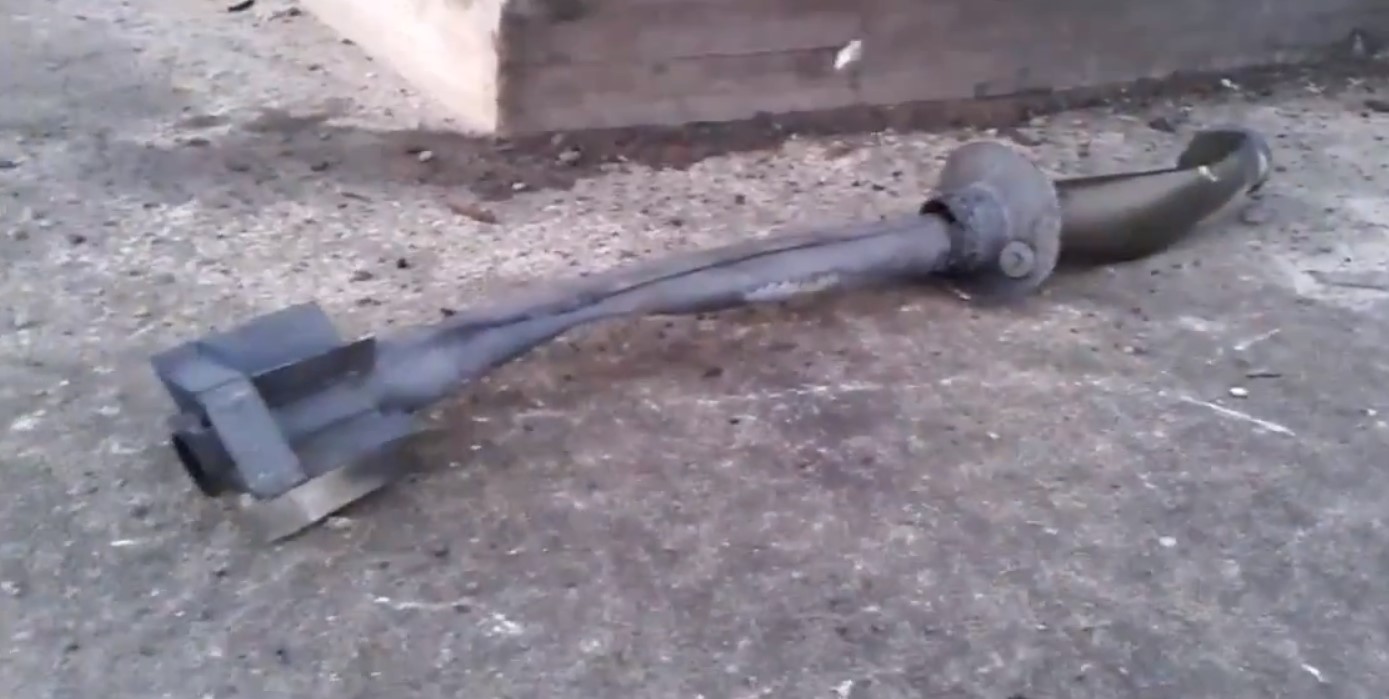
Regular readers of the blog might recognise this device as resembling an unidentified rocket/missile I've written about recently, reportedly used by government forces in Daraya, Damascus in January, and in Adra, Damascus in June.  Since I made that post I've been sent two photographs of another example that was used in Daraya on the same day as January video


In addition to these images from Damascus we also have this video posted a few days ago from Khalidiya, Homs

It's worth noting that none of the previous videos or photographs have been associated with chemical attacks, so the questions remains, what are these?

In the video from Homs, Khalidiya, it appears there's a clear shot of the unexploded payload


This tightly packed yellow substance is very reminiscent of the explosive fill of high explosive bombs, such as the OFAB 250-275 (seen here), and if the entire front end of that weapon is filled with that sort of high explosive it would be a devastating weapon.  If this was propelled by a rocket it would be very much like an IRAM (Improvised Rocket Assisted Munition/Mortar) that has been previously used in the conflict on several occasions.  The problem is, the other videos and photographs would seem to point away from the payload being a large amount of high explosive.  It seems very likely an explosion of that size would totally destroy the front end of the munition, and almost certainly badly damage the rest of the munition, yet it's clear that in some of the images the front end seems relatively undamaged for what should be a massive explosion.

That made me think, are we perhaps looking at more than one kind of payload?  Looking at the two photographs taken in Daraya in January it appears a near by wall has been splattered by a dark liquid


There's also traces of a dark liquid on the munition used in Adra in June, on the section where the payload would be contained.


In the most recent attack the tube of metal where the payload would have been looks black and shiny, possibly covered in a black liquid, although it's difficult to be sure


It's also interesting that the metal plate shown above appears to have what might be two holes possibly used for filling the warhead, and this appears to be present in all the examples where that part of the munition is visible.

However, without further information it seems to be difficult to ascertain the payload used.  Judging by the number of images being produced of these munitions in recent weeks it does seem to indicate they are being used on a more regular basis, and they also appear to be a rare example of a DIY weapon used by government forces.

Related Articles
DIY Weapons In Syria - Hezbollah Deploys IRAMs In Qusayr
DIY Weapons In Syria - The Hell Cannon
More Details Of Air-To-Air Missiles Used As Surface-To-Surface Missiles
Video Footage Of Air-To-Air Missiles Being Used As Surface-To-Surface Missiles In Syria
DIY Weapons In Syria - The Mobile Mortar Battery
DIY Weapons In Syria - The DIY Grenade Launcher
Unexploded Cluster Bomblets Repurposed As DIY Rocket Warheads
Unexploded Cluster Bomblets Repurposed As DIY Mortar Bombs

You can contact the author on Twitter @brown_moses or by email at brownmoses@gmail.com

Thursday, 4 July 2013

A Piece Of Political Satire From The Syrian Opposition

Over a year ago one of the first posts I made on this blog was Syrian Activists - Laughing In The Face of Danger, a look at some of the humourous and satirical videos being produced by the Syrian opposition.  Since then various videos have been produced, in particular on one channel from Talbiseh, Homs, and I thought I'd highlight one recent example which gives an insight into the political landscape in Syria


Thanks to Wrennic_26 who put together a translation of the video:

[Military uniformed man in back of pickup truck yelling]
"We've got seats! Seats in the Alliance, chairs in the Parliament, in local government, in the provincial council!"

[Group of other men pile around the car, asking about the chairs]

Military man: Oh, peace be upon you.
Mob: And also with you. Seats! What do you have?
Military man: By god, we have seats in the Alliance, in the Parliament, in local government, and the provincial council.
Mob: How much are the seats?
Military man: Well, this seat [Alliance] is 2,000 lira, this one [Parliament] is 1,250, this one [local government] is 1,750, and this one [provincial council] is 250.
Mob: But what, how much did you pay for these seats? The prices for these seats are high.
Military man: Eh, well, we paid for this this seat [Alliance]... about 100,000 martyrs. And this Parliament one, we paid 50,000 martyrs, and this one was about... 50,000 martyrs. And this one 1,500 martyrs.
Mob: Oh!! Well... what about for all of them then!!
Military man: Wh... wh.. for the Alliance one brother?

[Chaos ensues as the mob all grabs chairs and runs off, firing weapons etc.]

[Suit charges in, waving bag of bread -- offers to provide bread for seats; mob member demands weapons instead]

[Bread suit wins over, they reluctantly return seats to the truck]

[An argument then ensues between the mob offering the military man weapons for seats, and the suit, offering bread for seats]

[The military man objects that he paid in blood for the seats, so he cannot give them away lightly; some mob members offer to pay in martyrs for seats]

Military man, suit, and mob member turn to the camera at 2:14, and plead with the people outside of Syria not to waste their efforts by trading in seats, and trading away their freedom.

You can contact the author on Twitter @brown_moses or by email at brownmoses@gmail.com

Thursday, 13 June 2013

A Mystery Munition - Syrian Army DIY Rockets?

Occasionally I've come across items that appears to be some sort of unexploded ordnance (UXO) that I've been unable to identify at the time.  Sometimes it's because they are damaged beyond recognition, or they are badly filmed, or they are just weird.  In the weird category was this video from Daraya, south-west Damascus, filmed on January 4th 2013


It shows what is supposedly some type of rocket or missile embedded in the ground, supposedly fired by Syrian government forces.  What's odd is it doesn't appear to match any design of rocket or missile I could find, and seemed as if it could be a DIY weapon.  It certainly didn't match any of the DIY rockets I'd seen used by the opposition, and I even suspected it could have been some random piece of junk.

Six months later and we now have this video from Adra, north-east of Damascus, of what's claimed to be a "chemical" missile


This appears to be the same design as the missile in the January video, and I'll just explain how I came to that conclusion.  It's really all about the tail fin, shown below

January Video
June Video
The one thing that stands out is the tail ring is missing a section in the June video, but I suspect this might be due to damage.  You'll note the tail fins are welded to the body of the rocket/missile in the same way, and have been cut in an usually right-angled fashion.  In the below picture I've taken the tail fin from each video and lined them up against each other, to check the proportion of the tail fin to the tail ring


It should be noted the below half is angled towards the camera, so while it looks like it's slightly longer you'll note the base of the tail fin is the same distance apart.  I've marked the below version of the picture to make it clearer


So it appears they share identical dimensions.  This isn't the only similarity, the rocket motor also appears to be identical in both videos

January video
June video
You'll also note in the above pictures that in the position of the bolt or screw between the tail fins in the January video there's a hole in the June video, possibly that once held the same sort of bolt or screw.

So it seems clear these are the same design, but the questions remains what exactly they are?  It doesn't appear to match any design of rocket or missile I can find, which would imply it's possibly a DIY rocket, or something locally produced that hasn't been seen before.  I'd even consider it's the same rocket in both video they've filmed twice after doing some additional damage, but so far it remains a mystery munition.

Related Articles
More Details Of Air-To-Air Missiles Used As Surface-To-Surface Missiles
Video Footage Of Air-To-Air Missiles Being Used As Surface-To-Surface Missiles In Syria
DIY Weapons In Syria - The Mobile Mortar Battery
DIY Weapons In Syria - The DIY Grenade Launcher
DIY Weapons In Syria - The Hell Cannon
Unexploded Cluster Bomblets Repurposed As DIY Rocket Warheads
Unexploded Cluster Bomblets Repurposed As DIY Mortar Bombs
Unexploded Bombs Used In A Truck Bomb By Jabhat al-Nusra

You can contact the author on Twitter @brown_moses or by email at brownmoses@gmail.com


Monday, 10 June 2013

English Transcripts Of Witnesses Describing The Execution Of A 14-Year-Old For Blasphemy In Aleppo

Today there's been a number of reports on the execution of Mohammad Katta, a young coffee seller in Aleppo, by men described in some reports as foreign Islamist rebels for blasphemy after telling another boy that "even if Muhammad comes down, I will not give it as debt" when asked to give coffee on credit.  An extremely graphic photograph of the boy has been posted online, showing him shot through the mouth and neck, and videos have now been posted online of the boy's parents and a witness to the execution, which I've had translated into English, with notes from my translator in italics:


0:01 Mother: My son is second only to Hamza al-Khateeb (A boy from Daraa whose torture and execution by Assad’s troops shocked the world in May 2011). No, he is second to none, he is the grand martyr because he was innocent and didn't hurt anybody. They shot him dead in front of my eyes. This act is against religion and against Sharia. I want to ask Muhammad Hassan (A prominent Egyptian cleric) and the Saudi king whether my boy deserved death or not. If they say there is a rule, I will not object to it.
After he was accused of blasphemous language against the prophet [Muhammad], he replied that he is ready to sacrifice his soul for the sake of Muhammad, expressing his great love for him. He repeated it in front of them, and when they asked him to get in the car he agreed saying that he isn't guilty. He was only 14 years old and he didn't reach adulthood (As in civil law, Sharia rules aren’t applied to minors).
Those who killed my son must be brought to justice if it was proved that what they did was out of Sharia rules. My son didn't join neither part of the war. They just slaughtered him as if he was a lamb or an animal. He was just a boy and had his rights. He used to work in order to provide for us because his father is ill. He was blindfolded and he was bleeding in front of my eyes. I cried: shame on you, why did you do this? There were a crowd of around 300 to 400 men standing there watching and no-one tried saving the boy. He was shot three times; in his head, neck the third in his chest.
3:37 Interviewer: Did you see the men? Were they Islamists?
3:39 Mother: Yes, I saw them. They spoke standard Arabic (Spoken by very religious people only, or what can be called the strict clergymen) and were long-bearded and were wearing short garbs with trousers underneath. One of the three men was from Aleppo and he was seated next to the driver.
4:04 Interviewer Did you recognize him?
4:05 Mother: No, I couldn't see his face well, but I knew he was from Aleppo by his accent. He told the men to let the boy go but they refused. After they returned with the boy he was hardly able to sit down due to the torture they inflicted on him. His face was covered with his shirt. May God and punish them.

0:01 Father: I am Abd-Alwahab Katta’. My son was 14 years old and he used to sell coffee in front of “Sarj al-Lawz”. He was arguing with a customer and saying that he wouldn't buy on credit anymore even if Muhammad descended down to earth. I sell in cash only.
At that moment three unidentified men were passing by and heard the boy. They were wearing short garbs and were long-haired spoke standard Arabic. They asked the boy why he was blaspheming but he denied doing so. They ordered him to get in the car and took him away. My younger son came here and told me that they took his brother. He added that they were going to punish him and get back. I said let them punish him by beating or whipping if really said blasphemous words.
After half an hour they came back and put the boy near the coffee stall. My wife heard that there were a crowd of around thirty men in the street and after that we heard the sound of gunshots. My wife cried that they killed the boy because she heard a man reading from a paper. I was giving prayers when I heard two gunshots. I then rushed downstairs to find my son’s body lying on the street. After that the men ran over the boy’s arm and dashed away.
1:34 Interviewer: They said before killing the boy that God accepts the repentance if one blasphemes him unlike when one blasphemes the Prophet and in this case he deserves death.
1:42 Father: Yes, they said this and my son denied blaspheming.
1:52 Interviewer: Whom do you accuse of killing your son? Are they FSA or Islamists?
1:55 Father: I don’t know whether they were FSA, Islamist or Afghans, but they spoke standard Arabic. There are now too many battalions and I can’t distinguish one from the other.
2:05 Interviewer: What was written on the car?
2:07 Father: The car was black and there were three men inside. Those who saw them said that they carried the boy out of the car as he wasn't able to stand on his feet as a result of severe torture.
2:29 Interviewer: Did he blaspheme?
2:30 Father: No, he didn't. They asked the crowd to listen to the rule by which my son was killed. “God accepts the repentance if one blasphemes him unlike when one blasphemes the Prophet and in this case he deserves death”.
3:04 Interviewer: Are you going to file a suit?
3:07 Father: I filed a suit to the Sharia [Court] and they came here and I am waiting for what will they do. They gave me its number, here it is.
3:16 Interviewer: What did they say?
3:18 Father: They said they will deal with it.


0:01 Boy: He (one of the three men) was asking the boy (the victim) why he refused to sell on credit. The boy replied that he won’t do even if The Prophet comes down to earth. The men then asked the boy why he was blaspheming. The boy denied doing this and repeated what he said earlier and added that he is willing to give his soul for the Prophet. Then the men asked the boy to get in the car and took him inside. After half an hour or so they came back with the boy. They got him out because he couldn't stand on his feet. They carried the boy and laid him here and shot him three times.
0:32 Interviewer: Did you see the car?
0:33 Boy: Yes, I did. It was black.
0:35 Interviewer:  How many there were?
0:36 Boy: They were three. Two of them get out of the car and one remained inside.
1:01 Interviewer: Can you tell what happened?
1:02 Male witness: The boy didn't say anything blasphemous. He just said that if the Prophet comes down he won’t sell on credit. That’s it. They took the boy with them and whipped him and after around an hour they came back and laid in the street and shot him in his head three times. He was 14 years old only. 
Related Articles
"The Security Battalion In Saraqeb" Starts Patrolling The Streets
Alleged Shabiha Tried And Executed In Aleppo
Zaino Berri, Shabiha Leader, Captured And Executed

You can contact the author on Twitter @brown_moses or by email at brownmoses@gmail.com