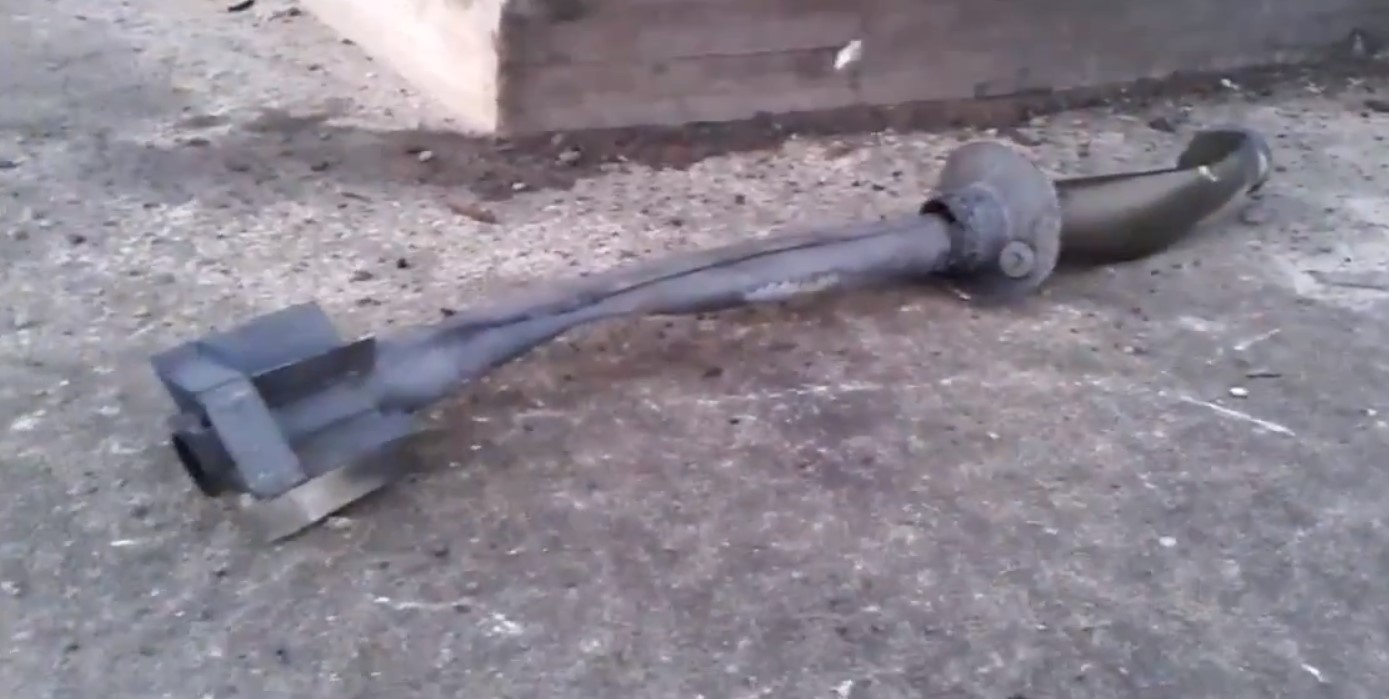
Yesterday there were more reports of alleged chemical weapon use in Adra, Damascus, scene of several previously reportedly alleged chemical weapon attacks. A number of videos were posted online, including this video showing a number of dead animals, and the remains of a device alleged to be linked to the alleged chemical weapon attack
Regular readers of the blog might recognise this device as resembling an unidentified rocket/missile I've written about recently, reportedly used by government forces in Daraya, Damascus in January, and in Adra, Damascus in June. Since I made that post I've been sent two photographs of another example that was used in Daraya on the same day as January video
In addition to these images from Damascus we also have this video posted a few days ago from Khalidiya, Homs
It's worth noting that none of the previous videos or photographs have been associated with chemical attacks, so the questions remains, what are these?
In the video from Homs, Khalidiya, it appears there's a clear shot of the unexploded payload
This tightly packed yellow substance is very reminiscent of the explosive fill of high explosive bombs, such as the OFAB 250-275 (seen here), and if the entire front end of that weapon is filled with that sort of high explosive it would be a devastating weapon. If this was propelled by a rocket it would be very much like an IRAM (Improvised Rocket Assisted Munition/Mortar) that has been previously used in the conflict on several occasions. The problem is, the other videos and photographs would seem to point away from the payload being a large amount of high explosive. It seems very likely an explosion of that size would totally destroy the front end of the munition, and almost certainly badly damage the rest of the munition, yet it's clear that in some of the images the front end seems relatively undamaged for what should be a massive explosion.
That made me think, are we perhaps looking at more than one kind of payload? Looking at the two photographs taken in Daraya in January it appears a near by wall has been splattered by a dark liquid
There's also traces of a dark liquid on the munition used in Adra in June, on the section where the payload would be contained.
In the most recent attack the tube of metal where the payload would have been looks black and shiny, possibly covered in a black liquid, although it's difficult to be sure
It's also interesting that the metal plate shown above appears to have what might be two holes possibly used for filling the warhead, and this appears to be present in all the examples where that part of the munition is visible.
However, without further information it seems to be difficult to ascertain the payload used. Judging by the number of images being produced of these munitions in recent weeks it does seem to indicate they are being used on a more regular basis, and they also appear to be a rare example of a DIY weapon used by government forces.
One thing that seems apparent to anyone following the Syrian conflict over the past few weeks is how it appears the FSA are being increasingly well equipped. It seems the FSA have started to go beyond the machine guns, AK-47s, and RPGs that make up the majority of their equipment and have begun to acquire greater quantities of weapons, and a greater variety. Despite reports of Qatar and Saudi Arabia supplying weapons to the FSA, and high level talks in Washington, it does appear that they've been doing quite well with getting their hands on weapons without their help.
To begin with, let's look at the more standard equipment many of the FSA are equipped with, where it that coming from? The Global Post reported in two excellent articles, "You will never guess who arms the rebels" and "Syria’s rebels learn the value of a prisoner", the FSA members they interviewed have gain the majority of arms from the purchasing them from corrupt members of the Syrian army, funding those purchases by ransoming captured soldiers:
Fatahallah estimated that his village purchased 40 percent of their weapons from the regime. Prisoner exchanges have so far contributed almost $80,000 toward weapons purchases, he said. And they obtain an additional 50 percent of their weapons during battle. The remaining 10 percent are donated and smuggled from outside the country, or are purchased from private merchants, mostly from Iraq.
In other areas it seems the black market plays a big role. Javier Espinosa recently Tweeted this during his time in Idlib
local commander told me that they have bought more than 1,500 new shells for RPGs in Idlib,very effective because tanks are very old #Syria
Some videos show weapons and ammo that have apparently been captured from Assad's forces, this video from Latamiyah, Hama, shows a cargo of RPG launchers and ammo captured by FSA fighters
This video from al-Atarab, Aleppo, shows arms captured from a police station
And here we see a wide selection of ammo, weapons, and armour captured from a checkpoint in Deir Ezzor
It also appears that more recently the FSA have been capturing heavier weapons. These two videos show the Ansar Battalion using large 120mm mortars
Update June 18th I've also been sent another video of a B-10 in action west of Baba Amr
Update June 21st This video from Jisr ash-Shugur, Idlib shows a PG-7VR warhead loaded into the RPG launcher on the right hand side of the video, capable of penetrating the armour on most, if not all, of Assad's armoured vehicles
This video shows more captured equipment, most notably a captured anti-aircraft gun, which were often mounted to trucks in the Libyan Civil War
Update June 21st This video from Deir ez-Zor shows a group in possession of a ZU-23-2 anti-aircraft gun to the left, and a truck mounted heavy machine gun to the right
Now while it's arguable whether or not the above weapons could have been in fact smuggled into the country by Saudi Arabia/Qatar/America etc, the next videos show items that are somewhat harder to smuggle across borders.
In this video we see FSA fighters from Latakia capturing a BMP
This video from a Damascus FSA battalion apparently shows one destroyed armoured vehicles, along with a Shilka and BMP which were apparently captured
Now it's one thing to say a tank has been captured, but another to see it being driven off, something these two videos show. First from Homs
And this video of a captured BMP driving around the Hama countryside
Update June 18th This news report also shows more captured vehicles, including at least one fully operational tank
What's interesting to me about these videos is the FSA feel confident enough to drive these vehicles out in the open when there's helicopters more than capable enough of destroying these vehicles. Maybe that has something to do with captured AA guns and the recent AA missile base defection which supposedly gave the FSA access to a large number of SA-7 shoulder launched missiles. It should be noted that despite claims the SA-7s were looted from the base I've yet to see them in any videos, or any helicopters shot down by them.
In both Rastan and Talbiseh, destroyed Syrian tanks and armored personnel carriers remained on the streets – including one near Talbiseh that remained in the median of the highway.
“We captured two armored personnel carriers and used them before the government destroyed them with helicopters,” Najjar said, adding that the cannons and heavy machine guns salvaged from some of the destroyed APCs would be mounted on rebel pickup trucks.
Tlass, who is based in Rastan, said the group had seized tanks from the Syrian military, and on Saturday, Farouq fighters in Qusayr sent footage to the Al Jazeera television network that showed them in possession of a tank and captured anti-aircraft weaponry. Najjar said that Farouq’s fighters in Talbiseh had managed to capture large amounts of ammunition in the offensive there, and were in possession of anti-tank rockets bought from weapons smugglers and captured from the military.
For those FSA members not lucky enough to have access to 1500 RPG rounds and BMPs improvisation is the name of the game. As I've previously posted, IEDs have played a large part in certain areas, especially Idlib, and as this video shows they are getting bigger as time goes on
There's also been recent reports in the press of remote controlled trucks and cars being used, which may in part explain the sudden upsurge in supposed "suicide bombings". This video from April shows a car equipped with remote controls
A video of remote controlled bombs in action was available on Youtube, but has since been removed.
Other vehicle modifications have also been made to assist the FSA, including a number of armoured cars. This video apparently leaked from Assad's forces show a truck that has been converted into an armoured car, including firing ports, and armoured wheels
In this video we see an armoured car being put together in Homs
And this picture shows a finished creation
Of course, they still have a while to go until they beat the "Libyan Killdozer"
This video from Al Jazerea Arabic shows a few interesting vehicles, one which appears to have metal shielding mounted in front of a heavy machine gun, and another which has a heavy machine gun mounted on the back of a truck, as well as another appearance of an AA gun
On the stranger end of the scale there's been a number of items posted, such as this DShK heavy machine gun, possibly salvaged from a T-55 or T-62, mounted on a trolley
Or this partly built remote control car bomb used to attack checkpoints
There's also this rather unsafe looking homemade rocket, which seems to have a specially shaped head
Update June 21st The above video might relate to these following four videos which appear to be some sort of unguided long range rocket artillery
Update June 21st This video shows fuse lit homemade explosive filled bottles being launched at Assad's army using a oversized slingshot
And finally, not everyone who makes stuff from scratch for the FSA is building weapons, like this tailor from the Khalidiya neighbour of Homs making uniforms for the FSA