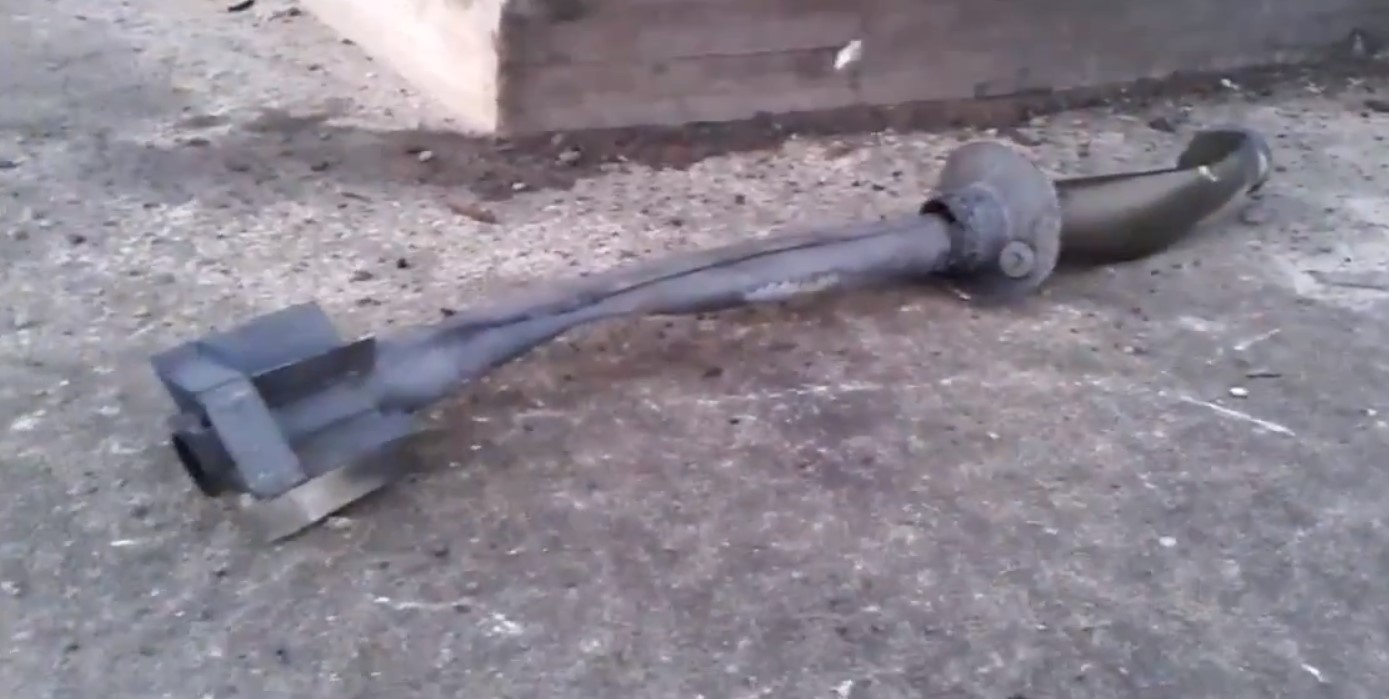
Now, two more videos have been posted online showing Syrian military forces using the same kind of munitions. The first video was posted on the YouTube channel of Tarek Ali, a reporter for Al Mayadeen TV, a Lebanese news channel that's been supportive of the Syrian government. Tarek Ali has been spending time with the Syrian military, and this report is from the SAA and NDF advance on the villages of Maheen and Hawaree, after taking the town of Sadad, Homs.
At the start of the video we see a vehicle drive by, with a twin-barrel launching on the rear

This is clearly the same type of truck mounted launcher that has been filmed and photographed in Damascus and Aleppo, and shown to launch the UMLACA
 |
| Aleppo |
 |
| Mezzeh air base, Damascus |
The next example, helpfully posted on the Facebook page of the National Defence Force in Damascus, gives us our best view yet of the larger type of munition and single-barrel launcher
For those of us who have been trying to figure out every detail possible about these munitions, it provides some more clues about how these munitions and their launchers work.

The above image shows the single hole on the rear of the warhead, and a cover that has been manufactured for the nozzle of the rocket. Not something that points towards a hastily put together DIY weapon.

Here we have the UMLACA in the launch tube, and you can just make out the black numbering that's common to the explosive type of these munitions, along with the single hole on the rear of the warhead. Here we can see a black rod shaped device that has been attached to the hole. It was noted that in the footage posted online shortly after the August 21st attack, showing the same kind of launcher and munition, that one of the men in the video appeared to screw something into the rear of the warhead, and this appears to be what that was. What it actually is though, is another question.

During the launch we also get our first clear video of the fuze at the end of the warhead, which seems to point it being some sort of impact fuze. It also appears that the black rod attached to the rear of the warhead is still in place, although it's hard to be 100% sure because of the motion of the rocket during launch.

This image was taken just after the cap on the nozzle was removed, and it appears a white cable was being held in by the cap.

A cable is also seen running of the side of the truck, but it's unclear if this could be a command cable.

The man who removes the nozzle cap then appears to possibly pull the cable onto the truck, maybe to connect to the possible command cable?

It also appears that just before each launch, no cable can be seen hanging from the rear of the rocket, suggesting that perhaps the cable has been looped back onto the truck to connect to the potential command cable.
If nothing else, this gives you an idea of the extra little details this video provides, and for those of us still trying to gather every single tiny piece of information on these munitions this sort of footage is invaluable.
More posts on the subject of the August 21st attacks can be found here, and other posts on chemical weapons and Syria, including extremely informative interviews with chemical weapon specialists, can be found here.
You can contact the author on Twitter @brown_moses or by email at brownmoses@gmail.com.